
Table of Contents
- Is Chiropractic Care Tax Deductible?
- Understanding IRS Medical Expense Deduction Rules
- Medical Expenses Itemized Deduction on Schedule A
- HSA Eligible Chiropractic Care and Tax-Free Withdrawals
- Chiropractic Care Tax Deduction Receipts and Documentation
- Insurance Reimbursements and Out-of-Pocket Costs
- Frequently Asked Questions
Last Updated: October 8, 2026
Is Chiropractic Care Tax Deductible?
Whether chiropractic care tax deductible depends on whether you itemize deductions on your federal income tax return. (Source: IRS Publication 502, Medical and Dental Expenses)
Not all healthcare spending qualifies. Chiropractic visits may be deductible only if they treat an injury or illness, not general wellness or preventive care without a diagnosed condition.
Understanding IRS Medical Expense Deduction Rules
The IRS allows you to deduct qualified medical expenses if you itemize instead of taking the standard deduction. Medical expenses include amounts paid for diagnosis, cure, mitigation, treatment, or prevention of disease. Chiropractic care qualifies when it addresses a specific health problem.
What qualifies as a medical expense
A qualified medical expense is any cost paid for medical care of you, your spouse, or your dependents that treats or prevents a diagnosed condition.
Related costs count too: travel to appointments, prescription medications recommended by your chiropractor, and prescribed equipment like orthopedic supports or braces.
One common mistake is claiming chiropractic care for general health maintenance.
Save every receipt and invoice from your chiropractor. The IRS may request proof that your treatment addressed a diagnosed condition, not just general wellness.
The 7.5% AGI threshold
You can only deduct medical expenses that exceed 7.5% of your adjusted gross income (AGI).
This threshold is the biggest barrier for most taxpayers.
However, you can combine your spouse's medical expenses and those of dependent children or parents you support, which often helps you reach the threshold.
Medical Expenses Itemized Deduction on Schedule A
You claim deductible medical expenses on Schedule A (Form 1040). You must choose between itemizing or taking the standard deduction, for 2026, $14,600 for single filers and $29,200 for married couples filing jointly. If your itemized deductions exceed these amounts, itemizing saves you money.

When itemizing makes sense
Itemizing makes sense when your total itemized deductions, medical expenses, state and local taxes (up to $10,000), mortgage interest, and charitable contributions, exceed your standard deduction.
Chiropractic care alone rarely justifies itemizing unless you have high medical costs.
Filing status matters: married couples filing jointly have a higher standard deduction and need more itemized deductions to benefit, while single filers may itemize more easily.
Calculate your total itemized deductions before deciding to itemize. If medical expenses alone don't exceed your standard deduction, look at other deductible items like taxes and charitable giving.
Step-by-step calculation with a chiropractic example
Here's how to calculate your deductible chiropractic expenses:
Step 1: Gather all chiropractic receipts from the tax year. Include adjustment costs, X-rays, and prescribed equipment or supports.
Step 2: Add up total chiropractic expenses. Say you spent $2,400 on chiropractic care in 2026.
Step 3: Calculate 7.5% of your AGI. If your AGI is $50,000, 7.5% equals $3,750.
Step 6: Subtract the threshold again. $5,000 minus $3,750 = $1,250 in deductible medical expenses.
This amount reduces your taxable income, lowering your tax bill depending on your bracket.
HSA Eligible Chiropractic Care and Tax-Free Withdrawals
If you have a Health Savings Account (HSA), chiropractic care is generally an eligible expense when it treats a diagnosed condition. You can withdraw HSA funds tax-free to pay for those services. Because the money goes in pre-tax and comes out tax-free, the benefit is often larger than an itemized deduction, which only reduces taxable income above the 7.5% AGI floor.
The double-dipping rule you cannot ignore
The IRS does not allow you to claim the same expense twice. If you paid for chiropractic care with tax-free HSA or FSA dollars, you cannot also include that amount on Schedule A, claiming it again is a duplicate benefit and a common audit trigger.
Keep two running totals during the year:
- HSA/FSA-paid chiropractic costs, excluded from Schedule A
- Out-of-pocket chiropractic costs paid with after-tax dollars, eligible for Schedule A, subject to the 7.5% floor
If you mix payment methods, reconcile your account statements against your chiropractor's invoices before you file.
HSA vs. Schedule A: which wins for chiropractic care
Most taxpayers get more value from paying chiropractic costs with HSA funds than from itemizing them:
- Suppose you spent $2,000 on qualifying chiropractic care and your AGI is $60,000. The 7.5% floor is $4,500, so that $2,000 produces $0 of Schedule A deduction on its own.
- If you pay that same $2,000 from an HSA, the entire amount is tax-free, no floor, no itemizing requirement, no need to exceed the standard deduction.
The HSA route also does not depend on itemizing, you can take the standard deduction and still enjoy tax-free HSA withdrawals for qualified chiropractic care.
HSA contribution limits and HDHP requirement
To contribute to an HSA, you must be covered by a high-deductible health plan (HDHP) and meet other eligibility rules. For 2026, contribution limits are $4,400 for self-only coverage and $8,750 for family coverage, plus a $1,000 catch-up for account holders 55 and older. Contributions reduce taxable income, and withdrawals for qualified medical expenses, including chiropractic care for a diagnosed condition, are tax-free.
FSA coordination and the use-it-or-lose-it problem
A Flexible Spending Account (FSA) also covers qualifying chiropractic care, but the rules differ:
- Contribution limits are lower than HSA limits, and the amount is set during open enrollment.
- Funds are generally use-it-or-lose-it. Many plans allow a small carryover or a grace period, but anything beyond that is forfeited.
- You cannot contribute to an FSA and an HSA at the same time (with limited exceptions for certain limited-purpose FSAs).
If you expect a predictable amount of chiropractic care, an FSA can work well; if your needs vary or you want the balance to roll over, an HSA is usually more flexible.
Wellness visits and HSA eligibility
The same treatment-versus-wellness distinction that governs Schedule A also governs HSA and FSA eligibility. Adjustments for a diagnosed injury or illness are eligible; routine maintenance adjustments with no diagnosed condition generally are not. Using HSA or FSA funds for a non-qualifying wellness visit may make that distribution taxable and subject to a 20% additional tax on the HSA side.
Never claim the same chiropractic expense on both your HSA/FSA and your Schedule A medical expenses. The IRS treats that as a double benefit, and it is one of the easiest errors for an examiner to spot when account statements and returns are matched.
For most people, paying qualifying chiropractic costs with HSA funds beats itemizing them, no 7.5% floor, no itemizing requirement, and tax-free treatment on the full amount. Just keep HSA-paid and out-of-pocket amounts separate so you never claim the same dollar twice.
Chiropractic Care Tax Deduction Receipts and Documentation
The IRS requires documentation for any deduction you claim. For chiropractic care, keep receipts showing the date, amount paid, and type of service, your chiropractor's invoice should list the specific treatment or adjustment.
What records the IRS requires
Maintain these documents:
- Receipts or invoices from your chiropractor showing the date, amount, and service type
- Explanation of benefits (EOB) from your insurance if you had coverage
- Records of out-of-pocket payments you made directly to your chiropractor
Keep these records for at least three years after filing, the IRS can audit prior-year returns, and you'll need proof if questioned (How long should I keep records?).
Digital copies are acceptable, photograph or scan receipts into a folder, and many tax software programs let you upload images directly.
Distinguishing treatment from wellness services
This distinction is critical for the IRS. Treatment addresses a diagnosed injury or illness. Wellness maintains general health without treating a specific problem.
Treatment examples:
- Adjustments for lower back pain from a car accident
- Chiropractic care for cervical spine issues causing headaches
- Treatment for work-related neck strain
Wellness examples:
- Regular adjustments "to stay healthy"
- Preventive care without a diagnosed condition
- Maintenance visits recommended for general well-being
Your chiropractor's notes should document the diagnosis being treated.
Ask your chiropractor to clearly document the medical reason for each visit. This protects both you and your deduction.
Claiming wellness visits as medical deductions is a red flag for IRS audits. The IRS scrutinizes healthcare deductions closely. Document medical necessity, not just the service received.
Insurance Reimbursements and Out-of-Pocket Costs
Insurance coverage directly changes how much you can deduct. You may deduct only the amounts you actually paid out of pocket for qualified medical care, every dollar your insurer paid, and every contractual write-off you never owed, is excluded. Figuring out which dollars those are is where most filers get it wrong.
The three numbers on every chiropractic claim
When you receive chiropractic care, three distinct figures usually appear across your paperwork:
- Billed charge, what the chiropractor's office lists as the price of the service.
- Allowed amount, the negotiated rate your insurer has agreed to pay for that service under your plan.
- Patient responsibility, the portion you owe after the insurer pays its share. This is the only figure that can count toward a deduction.
The difference between the billed charge and the allowed amount is a contractual adjustment, you never paid or owed it, so it cannot be deducted even though it appears on the invoice.
Reading your Explanation of Benefits correctly
Your Explanation of Benefits (EOB) shows how a claim was processed: the billed amount, allowed amount, insurer's payment, any contractual adjustment, and your patient responsibility broken into deductible, copay, and coinsurance.
A common pattern is adding up invoices, seeing a large total, and assuming that is the deductible medical expense, in reality, the EOB-adjusted patient responsibility is usually much smaller.
Working through a deductible-phase example
Suppose your chiropractor bills $120 per visit, your plan's allowed amount is $90, and you have not met your annual deductible.
- Deductible medical expense per visit: $90 (your patient responsibility)
- Not deductible: $30 (contractual adjustment)
If you had 20 visits during the deductible phase, your deductible medical expense total is 20 × $90 = $1,800, not 20 × $120 = $2,400.
Once you meet your deductible, the math changes.
Copays, coinsurance, and what actually counts
- Copay, a fixed dollar amount you pay per visit. Counts toward your deductible medical expenses.
- Coinsurance, a percentage of the allowed amount you pay after the deductible is met. Counts.
- Deductible payments, amounts you pay before insurance kicks in. Count.
When you have no insurance or pay cash
If you pay cash and have no insurance, your deductible amount is what you actually paid for a qualifying service. If a practice offers a cash discount, the discounted amount you pay is your deductible figure, not the undiscounted list price.
Reimbursements that arrive after you paid
If you paid out of pocket and your insurer later reimburses you, subtract the reimbursement from your deductible expenses for the year it relates to. If you deducted the full amount in one year and were reimbursed in the next, you may need to include the reimbursement in income in the year received, to the extent it produced a tax benefit.
Keeping a running tally
A spreadsheet with one row per visit, date, provider, billed amount, allowed amount, insurer payment, contractual adjustment, patient responsibility, and payment method (cash, HSA, FSA), lets you reconcile your deductible total in minutes and flags which dollars were paid with tax-advantaged funds and must be excluded from Schedule A.
Always reconcile your chiropractor's invoices against your EOBs before adding up medical expenses. The EOB reflects the allowed amount and your true patient responsibility; the invoice alone will overstate what you can deduct.
Do not include contractual adjustments, insurer payments, or amounts later reimbursed in your deductible medical expenses. Overstating the total is one of the most common reasons a medical deduction is reduced or disallowed on examination.
Frequently Asked Questions
Can I deduct chiropractic care if my insurance reimbursed me?
No. You can only deduct the amount you actually paid out of pocket. If insurance reimbursed you for chiropractic care expenses, subtract that reimbursement from your total chiropractic costs before calculating your deduction. The IRS does not allow you to deduct amounts covered by insurance. However, if you paid a copay or coinsurance, those out-of-pocket portions may be deductible if you meet the 7.5% AGI threshold.
Do I have to itemize deductions to claim chiropractic care as a tax deduction?
Yes. Chiropractic care qualifies as a medical expense only if you itemize deductions on Schedule A of Form 1040. You cannot claim it using the standard deduction. To itemize, your total qualified medical and dental expenses must exceed 7.5% of your adjusted gross income. If your itemized deductions are less than the standard deduction for your filing status, claiming chiropractic expenses will not reduce your tax liability.
Can I use HSA or FSA funds to pay for chiropractic care?
Yes. Chiropractic care is an eligible medical expense under both Health Savings Accounts (HSAs) and Flexible Spending Accounts (FSAs). You can withdraw funds tax-free from these accounts to pay for chiropractic treatment. This is often more advantageous than itemizing deductions because HSA and FSA withdrawals avoid federal income tax, self-employment tax (for HSAs), and state income tax, without requiring you to exceed the 7.5% AGI threshold.
What documentation do I need to claim chiropractic care as a tax deduction?
Keep receipts and invoices from your chiropractor showing the date of service, description of treatment, and amount paid. The IRS requires documentation proving the expenses were for medical care, not wellness or general health maintenance. If your treatment was for a specific injury or illness, retain records of the diagnosis or medical necessity. For dependents or spouses, keep documentation showing the relationship. The IRS does not require you to attach receipts to your tax return, but you must have them available if audited.
Learn more about insurance and payment options at our Montgomery, AL clinic, or book an evaluation.
Table of Contents
- Why Chair Selection Matters for Chronic Back Pain
- Best Office Chair Features for Spinal Health
- How to Sit With Chronic Back Pain
- Ergonomic Chair Adjustment Guide
- What Chair Design Cannot Fix
- Choosing the Right Chair for Your Body and Workspace
- Frequently Asked Questions
Last Updated: October 6, 2026
Why Chair Selection Matters for Chronic Back Pain
Choosing the best ergonomic office chairs for chronic back pain is one of the most underestimated decisions people with chronic back pain make. The wrong seating can amplify pain, while the right chair can meaningfully reduce it. (Source: Occupational Safety and Health Administration (OSHA) guidelines)
Chronic back pain doesn't disappear because of a chair alone. But a poorly designed seat accelerates degeneration, strains muscles, and locks you into postures that worsen existing conditions. A well-designed ergonomic office chair for chronic back pain does the opposite: it supports your spine's natural curves, reduces muscle fatigue, and makes it possible to maintain good posture without constant effort.
The difference between a generic office chair and a true ergonomic office chair for chronic back pain comes down to four things: lumbar support that matches your spine's shape, adjustability that lets you customize fit to your body, materials that keep you comfortable during long hours, and design features that encourage movement rather than static positions.
This guide covers what to look for, how to set up your chair correctly, and the honest limits of what a chair can and cannot do for chronic pain.
Best Office Chair Features for Spinal Health
The best ergonomic office chairs for chronic back pain share specific features that reduce strain on your lower back and support proper spinal alignment. Not every feature matters equally for every person, but these are the ones that move the needle.
Lumbar Support and Lower-Back Pain Relief
Lumbar support is the single most important feature in an office chair for anyone with chronic back pain. Your lower back naturally curves inward (called lordosis). A chair without proper lumbar support flattens this curve, forcing your discs and ligaments to work harder and your muscles to compensate.
The best lumbar support is dynamic, it adjusts as you move and sit at different depths in the chair. Static lumbar support helps, but it only supports one position. If you shift forward or recline, that support becomes useless.
Look for chairs with adjustable lumbar support that you can move up and down and increase or decrease in firmness. Some chairs offer three-zone lumbar support, which targets your lower, mid, and upper back separately. For chronic back pain, the lower-back focus matters most.
Adjustability: Seat Height, Depth, and Backrest
Adjustability transforms a mediocre chair into one that fits your body. Chronic back pain often worsens when your chair forces you into a generic posture that doesn't match your proportions.
Seat height should allow your feet to rest flat on the floor with your knees at a 90-degree angle. If your feet dangle or your knees angle upward, pressure redistributes to your lower back. Seat depth is equally critical, too deep and your thighs compress, cutting off circulation; too shallow and you lose support.
Backrest angle adjustment lets you recline slightly, which reduces pressure on your discs during extended sitting. A backrest that locks at 90 degrees forces you into an upright position that fatigues your back muscles over time. Most people with chronic back pain benefit from a slight recline (around 100-110 degrees) during long workdays.
Armrest height and width matter too. Arms that are too high force your shoulders up, creating neck and upper-back tension. Arms that are too low make you lean sideways to reach them.
Materials and Breathability for Extended Sitting
Mesh chairs breathe better than solid upholstery, which matters during extended sitting. Heat and moisture accumulation under your back can increase muscle tension and make existing pain worse.
Breathable materials also matter for circulation. Sitting compresses blood vessels in your legs and lower back. A chair that traps heat reduces circulation further, increasing stiffness and pain. Mesh or ventilated upholstery keeps airflow moving, supporting better circulation during the 8+ hours you're seated.
High-density foam in the seat cushion provides support without going flat after a few months. Low-quality foam compresses quickly, and once it does, you're sitting on a hard base that transfers pressure directly to your spine.
How to Sit With Chronic Back Pain
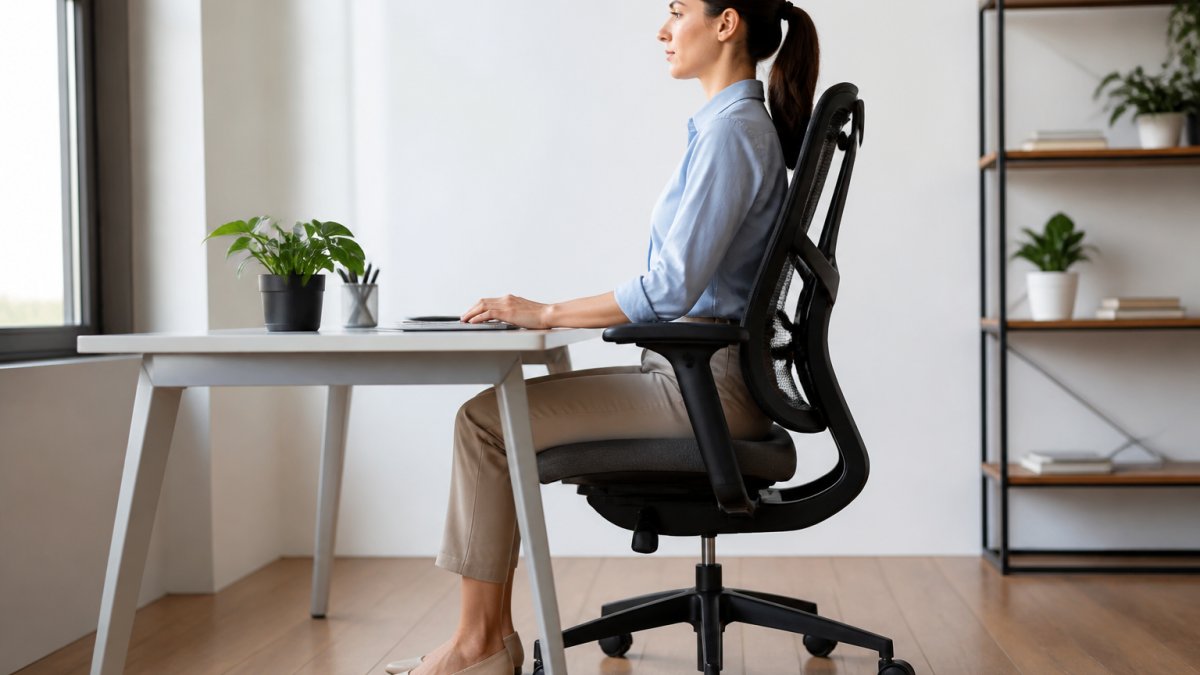
Buying the right chair is only half the equation. How you sit in it determines whether that chair reduces pain or becomes another source of it.
Most people with chronic back pain sit in ways that undermine even good chair design. They lean forward toward their monitor. They cross their legs. They slouch when they're tired.
The correct sitting posture for chronic back pain is not the rigid, military-straight position most people imagine. Your spine has natural curves. A healthy sitting posture maintains those curves rather than flattening them.
Your lower back should touch the lumbar support. Your shoulders should be relaxed, not hunched forward or pulled back. Your elbows should rest at 90 degrees, with your wrists neutral.
The most important rule: never stay in one position for more than 30 minutes. Chronic back pain worsens with static postures. Shift your position regularly. Stand and walk for 2-3 minutes every 30 minutes.
Ergonomic Chair Adjustment Guide
A chair only works if it's adjusted to your body. Most people buy an ergonomic office chair for chronic back pain and never adjust it beyond the height. That's why they don't see the pain relief they expected. (Source: National Institute for Occupational Safety and Health (NIOSH) recommendations)
Step-by-Step Adjustment Process
Step 1: Set your seat height. Sit in the chair with your feet flat on the floor. Your knees should be at 90 degrees or slightly lower.
Step 2: Adjust lumbar support height. The lumbar support curve should align with the natural curve of your lower back, typically 4-6 inches above your seat. Sit back and feel where the support contacts your spine.
Step 3: Increase lumbar support firmness. Tighten the lumbar support dial or adjustment mechanism until you feel support without discomfort. It should feel like a hand gently supporting your lower back, not a hard push.
Step 4: Set seat depth. Sit back in the chair. There should be 2-3 inches of space between the front edge of the seat and the back of your knees.
Step 5: Adjust armrests. Your elbows should rest on the armrests at 90 degrees when your shoulders are relaxed. Adjust height and width so your arms feel supported without effort.
Step 6: Position your monitor. Place your monitor at arm's length away and at eye level when you're sitting with proper posture. Your eyes should look slightly downward at the top of the screen.
Common Setup Mistakes to Avoid
The most common mistake is setting the seat too high. People do this to reach their desk comfortably, but it leaves their feet dangling. This cuts off circulation and transfers weight to your lower back. Lower the seat and raise your desk or monitor instead.
Another frequent error is over-tightening lumbar support. More firmness is not better. Excessive lumbar support can actually increase muscle tension by forcing your back into a position that's too rigid. You want support that feels like assistance, not constraint.
Many people position their monitor too low, which forces them to look down constantly. This strains your neck and upper back, and that strain often radiates down to your lower back. Keep your monitor at eye level.
Failing to adjust the backrest angle is another oversight. A locked 90-degree backrest fatigues your muscles during long sitting. A slight recline (100-110 degrees) reduces disc pressure and muscle fatigue without making you feel unstable.
What Chair Design Cannot Fix
An ergonomic office chair for chronic back pain is a tool, not a cure. It reduces strain and supports better posture, but it cannot address underlying structural issues, disc degeneration, or conditions that require medical intervention.
If your chronic back pain stems from a herniated disc, arthritis, or spinal stenosis, a chair will make sitting more tolerable but won't reverse the condition. Pain relief from a better chair typically comes from reduced muscle fatigue and improved circulation, not from healing damaged tissue.
Prolonged sitting itself is problematic for chronic back pain, regardless of chair quality. Even the best ergonomic chair cannot replace movement. Sitting compresses your discs and shortens your hip flexors. The longer you sit without moving, the more your pain worsens.
Some chronic pain conditions worsen with certain chair features. If reclined positions increase your pain, keep your backrest more upright. If lumbar support aggravates your condition, reduce the firmness or remove it temporarily. A chair should reduce pain, not create it. If a feature causes discomfort, adjust or disable it.
Choosing the Right Chair for Your Body and Workspace
Not every ergonomic office chair for chronic back pain works for every person. Your body type, workspace setup, and specific pain pattern all influence which chair features matter most.
If you're taller than 6 feet, look for chairs with extended seat depths and high backrests. Standard chairs often leave tall people with inadequate lumbar support because the support sits too low on their spine.
Your workspace layout matters too. If your desk is fixed and too high, you need a chair with a wide height range to compensate.
The type of chronic back pain you experience should guide your choices. If your pain is primarily lower-back focused, prioritize lumbar support and seat depth. If you experience upper-back and neck pain that radiates downward, focus on backrest height and armrest positioning.
Your budget matters, but not in the way most people think. An expensive chair with features you don't need wastes money. A mid-range chair with the specific adjustments your body requires delivers better results.
Chronic back pain complicates every aspect of your workday, and the wrong chair amplifies that struggle.
| Feature | Why It Matters | Best For |
|---|---|---|
| Adjustable lumbar support | Supports your spine's natural curve and reduces disc pressure | Anyone with lower-back pain |
| Seat height adjustment | Keeps feet flat and knees at 90 degrees | All body types |
| Seat depth adjustment | Prevents thigh compression and maintains proper support | Taller and shorter individuals |
| Backrest recline | Reduces disc pressure during extended sitting | People with chronic lower-back pain |
| Breathable mesh materials | Improves circulation and reduces muscle tension from heat | Anyone sitting 8+ hours daily |
| Armrest adjustment | Reduces shoulder and neck strain | Office workers with upper-body pain |
Frequently Asked Questions
What features should an office chair have for chronic back pain?
A chair for chronic back pain should include adjustable lumbar support that matches your spine's natural curve, seat height adjustment to keep feet flat on the floor, adjustable seat depth to support your thighs without pressure behind your knees, and armrests that allow your shoulders to relax. Breathable materials help reduce heat buildup during extended sitting. High-back design provides neck and shoulder support, which is especially important if you experience pain radiating upward from your lower back.
Do ergonomic chairs actually help with chronic back pain?
A well-adjusted ergonomic office chair can reduce strain on your spine and improve comfort during work, but it is not a cure for chronic back pain. The chair works best as part of a broader approach that includes movement breaks, stretching, proper posture, and professional care. Many people with chronic conditions find that reducing postural stress throughout the workday makes their symptoms more manageable. Results vary based on the underlying cause of your pain and how consistently you maintain proper positioning.
How do I adjust my office chair to prevent back pain?
Start by setting seat height so your feet rest flat on the floor and your knees bend at 90 degrees. Adjust lumbar support to fit the inward curve of your lower back without forcing it. Position the seat depth so there is a 2-3 inch gap between the seat edge and the back of your knees. Armrests should support your forearms at elbow height without forcing your shoulders up. Backrest angle should support your natural posture without tilting too far back. Make small adjustments over several days to find what feels most comfortable, and reassess if you change your desk height or monitor position.
Is a mesh or leather chair better for back support?
Mesh and leather offer different benefits. Mesh is breathable and ideal for long workdays because it allows air circulation, reducing heat buildup and moisture. Leather is durable and easier to clean but traps more heat. For chronic back pain relief, breathability matters because discomfort from sweating can compound existing pain. Mesh is generally preferred for all-day sitting, but the material alone does not determine back support, lumbar support quality, adjustability, and proper positioning are far more important than fabric type.
Learn more about back pain care at our Montgomery, AL clinic, or book an evaluation.
Table of Contents
- Understanding Your Chronic Back Pain and Recovery Goals
- Chronic Back Pain Treatment Options That Support Long-Term Recovery
- Exercises for Chronic Lower Back Pain and Progressive Strengthening
- Building Your Back Pain Recovery Plan With Milestones and Tracking
- Managing Chronic Back Pain Flare-Ups and Preventing Setbacks
- Daily Habits and Self-Care That Support Long-Term Management
- When to Seek Professional Care and Red Flags to Watch
- Frequently Asked Questions
Last Updated: October 4, 2026
Understanding Your Chronic Back Pain and Recovery Goals
Chronic back pain affects millions of adults (the CDC). A long term recovery plan for chronic back pain requires a structured approach that addresses pain management, functional restoration, and prevention of future episodes, not a quick fix, but sustainable habits and strategies that work within your lifestyle. (Source: the Centers for Disease Control and Prevention (CDC))
Chronic back pain varies widely in cause, severity, and impact on daily life, from degenerative disc disease and muscle weakness to postural issues or past injuries.
Identify your primary goals, pain reduction, improved mobility, return to work or sports, or better quality of life.
Chronic Back Pain Treatment Options That Support Long-Term Recovery
Effective long term recovery typically involves multiple treatment modalities working together. The best results come from combining strategies based on your specific needs, evidence quality, and response to treatment.
Manual therapy and spinal manipulation
Manual therapy encompasses hands-on techniques performed by qualified practitioners.
Research shows manual therapy provides modest short-term pain relief and improved function, particularly when combined with exercise (pubmed.ncbi.nlm.nih.gov).
Manual therapy is generally safe when performed by licensed practitioners.
Physical therapy and rehabilitation
Physical therapy is a cornerstone of long term recovery plans.
Physical therapy is supported by strong evidence.
Most effective programs involve 2-3 sessions per week for 4-8 weeks with daily home exercises.
Physical therapy typically requires a referral and is covered by most insurance plans.
Medication and pain management
Over-the-counter medications like acetaminophen and NSAIDs (ibuprofen, naproxen) support pain management as part of a broader strategy, not standalone solutions.
Muscle relaxants provide short-term relief during flare-ups but aren't recommended for long-term use due to side effects and dependence risk. SNRIs like duloxetine have evidence for chronic pain, especially if you experience depression or anxiety.
Discuss medication options with your healthcare provider, including benefits, risks, duration, and fit within your recovery plan.
Combining treatments: A sequenced approach
Most effective plans layer treatments strategically: (1) start physical therapy and home exercise immediately, (2) add manual therapy if mobility severely restricts exercise, (3) use over-the-counter medication as needed for the first 4-6 weeks, and (4) reassess at 4-6 weeks.
Exercises for Chronic Lower Back Pain and Progressive Strengthening
Exercise forms the backbone of effective long term recovery plans, reducing pain, improving function, and building resilience against future episodes.
Mobility and stretching routines
Flexibility exercises address stiffness by targeting hip flexors, hamstrings, glutes, and chest muscles. Hold stretches for 20-30 seconds without bouncing, when muscles are warm. Daily gentle stretching outperforms occasional intense sessions.
Core strengthening and progressive resistance
Weak core muscles force other structures to compensate, perpetuating pain. Begin with basic exercises: bridges, modified planks, and dead bugs. Progress to more challenging variations as strength improves. Training should feel challenging but not painful.
Aerobic activity and staying active
Aerobic exercise improves blood flow and removes inflammatory byproducts. Walking, swimming, and cycling provide effective activity with minimal back stress. Start with 10-15 minutes daily and gradually increase as fitness improves.
Building Your Back Pain Recovery Plan With Milestones and Tracking
A structured long term recovery plan for chronic back pain includes specific phases with measurable milestones. This framework prevents discouragement and helps you recognize progress that extends beyond pain reduction.

Phase 1: Pain reduction and early mobility
Phase 1 lasts 2-4 weeks, focusing on pain management and gentle movement restoration. Rest from aggravating activities, apply heat or cold therapy, and perform gentle stretching.
Phase 1 milestones include reduced pain intensity, improved sleep, easier daily activities, and improved mobility. Track pain levels, activities, and how you felt in a simple journal. (Source: strong evidence supports the effectiveness of physical therapy)
Phase 2: Strengthening and function restoration
Phase 2 spans 4-12 weeks, emphasizing progressive strengthening and functional improvement. Gradually increase exercise intensity, add resistance training, and introduce movements preparing you for normal activities.
Phase 2 milestones include improved strength, increased activity tolerance, reduced medication use, and improved mood and sleep.
Phase 3: Return to activity and prevention
The final phase focuses on returning to work, hobbies, and sports while maintaining improvements. Milestones include: return to work without limitations, resumption of recreational activities, sustained pain reduction, and confidence in managing minor flare-ups independently.
Measuring progress beyond pain intensity
Track functional improvements beyond pain: walking distance, stair climbing, standing time, sleep quality, and mood. Use a notebook, spreadsheet, or app to record weekly pain levels, exercises, activities, and achievements. Reviewing progress reveals patterns about what helps or hinders recovery.
Managing Chronic Back Pain Flare-Ups and Preventing Setbacks
Occasional flare-ups occur even with excellent management. Understanding triggers and having a prepared response plan minimizes their impact.
Recognizing flare-up triggers and warning signs
Common triggers include sudden movements, prolonged sitting or standing, incorrect lifting, stress, poor sleep, or skipped exercise. Early warning signs include increased stiffness or muscle tightness. Keep notes about activities, stress, and sleep to identify your personal patterns.
Immediate response strategies and self-care
When flare-ups occur, avoid complete rest, which worsens stiffness. Instead, modify activity levels and maintain gentle movement. Return to Phase 1 exercises: gentle stretching, walking, and mobility work. Apply heat or cold therapy, take over-the-counter medication if appropriate, and manage stress, which amplifies pain.
Heat and cold therapy, rest, and activity modification
Heat therapy increases blood flow and relaxes muscles (15-20 minutes). Cold therapy reduces inflammation and numbs pain (10-15 minutes). Modify activities to avoid aggravating movements while maintaining gentle activity.
Daily Habits and Self-Care That Support Long-Term Management
Long term recovery requires sustainable daily habits. Small consistent actions compound into significant improvements over months and years.
Posture, ergonomics, and movement patterns
Poor posture stresses spinal structures and perpetuates pain. Develop awareness of your typical posture throughout the day.
Ergonomic modifications at work reduce stress on your back. A supportive chair, proper desk height, and monitor positioning matter. Take frequent breaks to move and stretch.
Sleep, stress management, and hydration
Quality sleep supports healing and pain management. Aim for 7-9 hours nightly. Sleep position matters; side sleeping with a pillow between your knees or back sleeping with pillow support under your knees reduces spinal stress.
Chronic stress amplifies pain perception and slows healing. Regular stress management, exercise, meditation, time in nature, or hobbies, improves both pain and overall health.
When to Seek Professional Care and Red Flags to Watch
Most chronic back pain responds well to conservative management, but certain situations require urgent professional evaluation. Understanding when to escalate care and how to communicate effectively ensures you receive appropriate support throughout your recovery.
Red flags requiring immediate medical attention
Seek immediate medical attention (emergency department or urgent care) if you experience:
- Sudden severe pain following trauma, fall, or lifting, especially if accompanied by inability to move or find any comfortable position
- Numbness or tingling in your legs or feet, particularly if it's new, spreading, or affecting both legs
- Loss of bowel or bladder control or inability to urinate, which may indicate cauda equina syndrome (a surgical emergency)
These symptoms may indicate serious conditions such as spinal infection, fracture, tumor, or nerve compression requiring prompt diagnosis and specialized treatment.
When to contact your healthcare provider (non-urgent)
Contact your primary care provider or pain specialist within a few days if pain significantly worsens despite your recovery plan over 2-3 weeks, new symptoms develop, you're uncertain about exercise progression, medication side effects are affecting your quality of life, your progress plateaus for more than 4 weeks despite consistent effort, or flare-ups are becoming more frequent or severe.
Building a coordinated care team
Optimal long-term recovery often involves multiple providers working together. Your care team might include your primary care physician (overall medical oversight), physical therapist (exercise program design), pain specialist or physiatrist (advanced pain management), mental health professional (addressing anxiety or depression), and manual therapy provider (hands-on treatment).
Shared decision-making: What to discuss at appointments
Effective appointments involve honest two-way conversation about your goals, concerns, and preferences. Come prepared to discuss your current status (specific limited activities, what you've already tried, current pain level and sleep quality), your goals and priorities (activities that matter most, timeline expectations, medication preferences), treatment options and trade-offs (evidence for recommended treatments, realistic timelines, risks and side effects, your role in treatment, cost and access), and monitoring and adjustment (clear milestones for reassessment, backup plans if current approach doesn't help, communication between appointments).
Recognizing when to seek a second opinion
Consider seeking a second opinion if you've followed a treatment plan consistently for 8-12 weeks with no functional improvement, a provider recommends surgery without first trying conservative management (unless you have red flag symptoms), you feel unheard or that your concerns aren't being addressed, your provider dismisses your pain as "all in your head" without exploring physical causes, or treatment recommendations seem inconsistent with other sources.
Documentation and self-advocacy
Keep your own records of your recovery journey: treatment timeline (dates, frequency, duration), response to treatment (how each approach affected your pain and function), medication and supplement use (names, doses, dates, side effects), functional milestones (when you returned to specific activities), and questions and concerns for your next appointment.
Frequently Asked Questions
What should a long-term recovery plan for chronic back pain include?
A comprehensive recovery plan combines treatment options (manual therapy, physical therapy, medication), a phased exercise program starting with mobility and progressing to strengthening, daily habit changes (posture, ergonomics, sleep), flare-up management strategies, and regular progress tracking beyond pain scores. The plan should include specific milestones for each phase and clear criteria for advancing. Working with a qualified healthcare provider ensures your plan matches your condition and functional goals.
Can chronic back pain improve over time with the right recovery plan?
Yes. While chronic back pain may not disappear completely, most people experience significant improvement in pain levels, function, and activity tolerance through consistent treatment and exercise. Recovery depends on adherence to your plan, the underlying cause of your pain, and how well you manage flare-ups. Many individuals return to work, hobbies, and physical activities they thought were lost. Progress often takes weeks to months, not days.
What exercises are safe for chronic lower back pain?
Safe exercises include controlled stretching for flexibility, core strengthening (planks, bridges, dead bugs), low-impact aerobic activity (walking, swimming, cycling), and progressive resistance training with proper form. Start with gentle mobility work and progress gradually under professional guidance. Avoid high-impact activities, heavy lifting, or exercises that increase pain during the early recovery phase. A physical therapist can tailor exercises to your specific condition and ensure you're using correct form.
How can I manage a chronic back pain flare-up?
Flare-up management involves immediate response: rest from aggravating activities, heat or cold therapy (15-20 minutes at a time), over-the-counter pain relief if appropriate, and gentle movement to prevent stiffness. Identify your flare-up triggers (lifting, prolonged sitting, stress) and modify activities accordingly. If pain worsens or new symptoms develop, contact your healthcare provider. Having a pre-planned flare-up response strategy prevents panic and speeds recovery.
How do I track progress while recovering from chronic back pain?
Track metrics beyond pain intensity: functional improvements (walking distance, sitting duration, ability to perform daily tasks), range of motion, strength gains, return to hobbies or work activities, and quality of life measures. Keep a simple log noting pain levels, activities performed, exercises completed, and flare-up triggers. Functional progress often appears before pain reduction. Review your progress monthly with your healthcare provider to adjust your plan as needed.
When should I see a doctor for chronic back pain?
Seek immediate medical attention if you experience severe pain, numbness or tingling in both legs, loss of bladder or bowel control, unexplained weight loss, fever, or pain following trauma. Schedule an appointment if pain worsens despite conservative treatment, new symptoms develop, or pain interferes significantly with daily function. Regular check-ins with your healthcare provider help monitor your recovery plan's effectiveness and catch complications early.
Is chiropractic care appropriate for older adults with chronic back pain?
Many older adults benefit from chiropractic care combined with exercise and self-care, but individual appropriateness depends on your specific condition, age-related factors, and overall health. A qualified chiropractor will perform a thorough evaluation, discuss your medical history, and explain any risks before treatment. Some conditions require physician clearance first. Open communication about your concerns and medical history ensures safe, personalized care.
Learn more about back pain care at our Montgomery, AL clinic, or book an evaluation.
Table of Contents
- Why Back Pain Develops in Remote Work Environments
- Setting Up an Ergonomic Home Office Setup
- How Often to Take Breaks From Sitting
- Stretches for Back Pain at Desk
- Post-Work Recovery Routines and Lifestyle Habits
- Budget-Friendly DIY Ergonomic Hacks
- When to Seek Professional Help
- Frequently Asked Questions
Last Updated: October 1, 2026
Why Back Pain Develops in Remote Work Environments
Understanding how to manage back pain while working from home starts with recognizing the factors that don't exist in traditional office settings. When you work from home, you control your environment, but that freedom often leads to poor choices. Most people set up at the kitchen table or curl up on the couch without thinking about spinal alignment or ergonomic workstation design.
The real culprit is sedentary behavior. Sitting for eight hours straight without movement creates muscle fatigue and places constant stress on your lumbar support structures. Your hip flexors tighten. Your core disengages. Your cervical spine drifts forward as you lean toward the screen. Over time, this posture correction deficit becomes chronic pain.
Remote work removes the natural movement that happens in an office, walking to meetings, moving between desks, standing at the printer. At home, you can work for six hours without leaving your chair. This lack of dynamic movement is what separates remote workers from their office-based counterparts when it comes to musculoskeletal health.
The psychological component matters too. When work and home blur together, stress accumulates. Stress tightens muscles. Tight muscles pull on your spine. Before you know it, you're dealing with work-related musculoskeletal disorders that could have been prevented.
Remote workers develop back pain primarily from prolonged sitting without movement, poor ergonomic setup, and the psychological stress of blended work-life boundaries.
Setting Up an Ergonomic Home Office Setup
Your physical environment determines whether you'll develop back pain or maintain neutral spine alignment. This is non-negotiable. An ergonomic workstation setup prevents problems before they start.
Start with the basics: your desk height, chair selection, and monitor positioning. These three elements control whether your spine stays neutral or gets pulled into harmful positions. Get them wrong and no amount of stretching will fix the underlying problem.
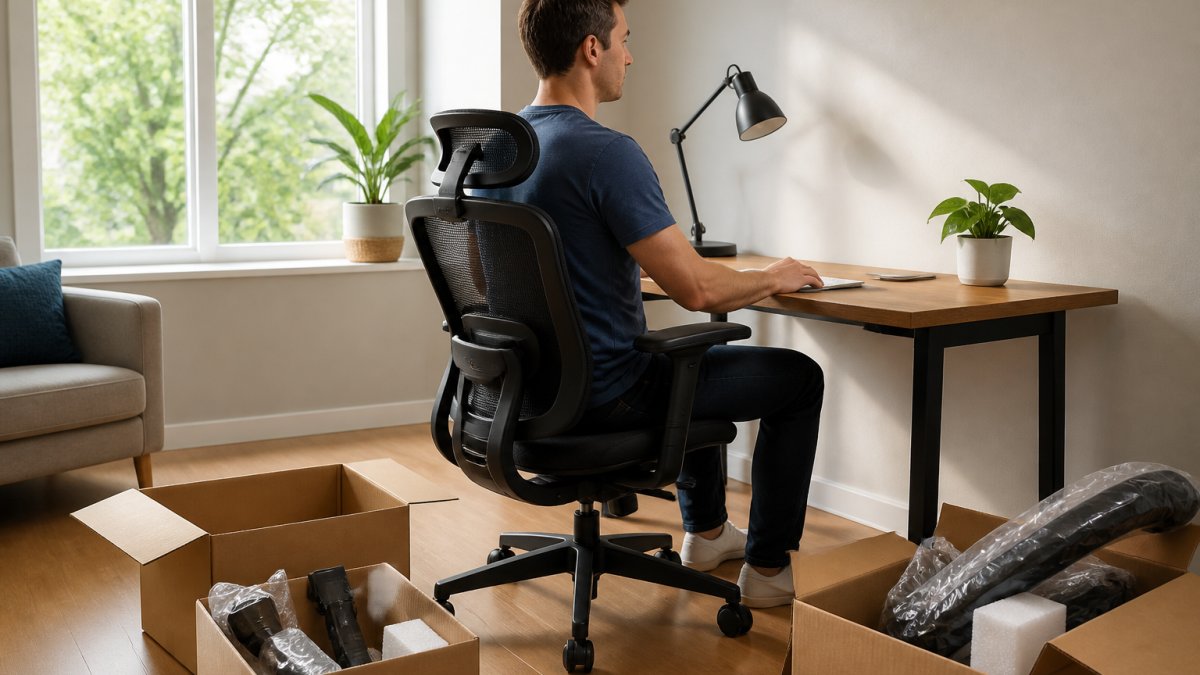
Chair and Lumbar Support
Your chair is the foundation of your ergonomic workstation. A chair without proper lumbar support forces your lower back to work harder than it should. Your lumbar spine has a natural curve, your chair must support that curve.
Look for a chair that allows you to adjust the lumbar support height and depth. Your lower back should feel supported without being pushed forward. When you sit, your feet should rest flat on the floor or a footrest. Your knees should be at a 90-degree angle.
The seat depth matters. Your thighs should be fully supported, but there should be a two-inch gap between the back of your knees and the seat edge. This prevents pressure on the backs of your legs and maintains proper pelvic tilt.
Armrests should support your elbows at desk height. If your armrests are too high or too low, your shoulders will compensate by tensing up. Shoulder blade retraction becomes impossible when your arms aren't properly positioned.
Monitor and Keyboard Positioning
Your monitor should sit at eye level. This is the single most important factor for preventing cervical spine strain. Position the top of your screen at or slightly below eye level when you're sitting upright. Your eyes should look slightly downward, not upward or far downward.
The monitor should be an arm's length away, roughly 20 to 26 inches from your eyes. Too close causes eye strain and forward head posture. Too far and you lean forward to see clearly.
Your keyboard positioning determines whether your wrists stay neutral. Place your keyboard directly in front of you, not off to one side. Your elbows should be at 90 degrees when your hands rest on the keyboard. Your wrists should be straight, not bent upward or downward.
A keyboard tray can help achieve proper keyboard positioning if your desk height doesn't allow it naturally. Your mouse should be at the same height as your keyboard. If you reach for it, your shoulder blade retraction suffers and tension builds.
Use the "20-20-20 rule" for monitor distance: every 20 minutes, look at something 20 feet away for 20 seconds. This reduces eye strain and forces you to break your forward posture.
How Often to Take Breaks From Sitting
Sitting for more than 60 minutes without a break creates muscle fatigue and reduces circulation. Your body isn't designed for eight-hour static positions. Movement is medicine.
Take a break from sitting at least every 45 to 60 minutes. Stand up. Walk around. Do a few stretches. Even three minutes of movement resets your posture and reactivates muscles that have gone dormant.
A standing desk can help, but it's not a complete solution. Standing all day creates different problems than sitting all day. The best approach combines both: sit for 45 minutes, stand for 15 minutes, repeat. This pattern maintains neutral spine alignment without overloading any single position.
Set a timer if you need to. Most people forget to move because they're focused on work. A visual reminder forces the break before pain develops.
Your break routine should include:
- Standing and stretching your hip flexors
- Walking to another room
- Doing a few shoulder blade retractions
- Changing your visual focus to distance objects
Skipping breaks leads to cumulative strain. One day of poor movement habits won't hurt you. Six months of it will. Back pain develops gradually, so prevention feels optional until it's too late.
Stretches for Back Pain at Desk
Stretching counteracts the tightness that develops from sitting. But not all stretches are equally effective. The stretches that work target the specific muscles that get tight when you sit: hip flexors, hamstrings, and the muscles along your spine.
Seated and Standing Stretches
Seated Hip Flexor Stretch, Stay in your chair. Extend one leg straight back, keeping your heel on the floor. Lean forward slightly. You should feel a stretch in the front of your hip. Hold for 30 seconds. Repeat on the other side.
Standing Quad and Hip Flexor Stretch, Stand facing a wall or desk. Pull one foot toward your glutes, keeping your knees aligned. Hold for 30 seconds. This opens up the front of your hip, which gets compressed when you sit.
Seated Spinal Twist, Sit upright. Cross one leg over the other. Place your opposite elbow on your crossed knee and gently twist toward that knee. Hold for 30 seconds. This mobilizes your thoracic spine and relieves tension along your lumbar support structures.
Standing Forward Fold, Stand with feet hip-width apart. Bend forward at the hips and let your arms hang. Don't force it. Just hang there for 30 to 60 seconds. This stretches your hamstrings and the entire back of your body.
Chest and Shoulder Opener, Stand in a doorway. Place one forearm on the doorframe at shoulder height. Step forward slightly until you feel a stretch across your chest.
Strengthening Exercises for Core Stability
Stretching alone won't fix back pain. You need core engagement to stabilize your spine. Core stability prevents your lumbar spine from shifting under load.
Post-Work Recovery Routines and Lifestyle Habits
Learning how to manage back pain while working from home extends beyond work hours, how you spend your time after work determines whether your pain improves or worsens. Recovery isn't passive. It requires intentional movement and stress management.
Budget-Friendly DIY Ergonomic Hacks
You don't need expensive equipment to create an ergonomic workstation. Simple adjustments cost nothing and work surprisingly well.
When to Seek Professional Help
Back pain that persists for more than four weeks despite stretching and ergonomic changes warrants professional evaluation. This doesn't mean you've failed, it means your situation needs expert assessment.
Seek help immediately if you experience:
- Pain that radiates down your leg
- Numbness or tingling in your legs or feet
- Loss of bowel or bladder control
- Severe pain that limits your ability to function
- Pain following a fall or accident
| Strategy | Frequency | Time Required |
|---|---|---|
| Movement breaks | Every 45-60 minutes | 3-5 minutes |
| Stretching routine | Daily | 10 minutes |
| Core strengthening | 3 times per week | 10-15 minutes |
| Walking | Most days | 20-30 minutes |
| Ergonomic assessment | Once initially | 30-60 minutes |
Occupational Safety and Health Administration ergonomic guidelines
American Chiropractic Association information on work-related back pain
Mayo Clinic guide to back pain prevention and management
Frequently Asked Questions
What can I do to relieve back pain caused by working from home?
Start with ergonomic adjustments: position your monitor at eye level, keep your keyboard and mouse close to your body, and use a chair with lumbar support. Take breaks every 30-45 minutes to stand and move. Perform gentle stretches throughout the day, focusing on your hip flexors, hamstrings, and thoracic spine. Strengthen your core with simple exercises like planks and bridges. Apply heat or cold therapy as needed, and consider post-work recovery routines such as foam rolling or gentle yoga to reduce muscle fatigue and promote spinal alignment.
How often should I take breaks from sitting while working?
Aim to take a break every 30-45 minutes. During each break, stand up and move for at least 2-3 minutes. This interrupts sedentary behavior and reduces repetitive strain on your musculoskeletal system. Movement could include walking around your home, doing light stretches, or performing dynamic movements like shoulder rolls and pelvic tilts. Regular movement helps prevent joint stiffness, maintains neutral spine positioning, and improves blood circulation, which supports chronic pain management and overall physical activity levels throughout your day.
Are there budget-friendly ways to improve my home office ergonomics?
Yes. Use a rolled towel or small pillow behind your lower back for lumbar support instead of buying an expensive ergonomic chair. Stack books or use a monitor stand to raise your screen to eye level. A cushion on your seat can improve hip positioning and reduce pelvic tilt strain. Adjust your desk height using risers or place your keyboard on a lower shelf. These DIY ergonomic hacks cost little but significantly reduce repetitive strain and support better posture correction without requiring major purchases.
When should I see a healthcare professional about my back pain?
Consult a healthcare provider if your back pain persists beyond two weeks despite self-care efforts, worsens over time, radiates down your leg, or is accompanied by numbness, tingling, or weakness. Seek immediate care if you experience sudden severe pain, loss of bladder or bowel control, or unexplained weight loss. A qualified professional can assess your condition, rule out serious underlying issues, and recommend appropriate treatment tailored to your specific musculoskeletal health needs.
Learn more about back pain care at our Montgomery, AL clinic, or book an evaluation.
Table of Contents
- Step 1: Get an Accurate Diagnosis Before You Treat Anything
- Step 2: Calm the Flare With Activity Modification and Rest
- Step 3: Rebuild Strength With Shoulder Pain Physical Therapy Exercises
- Step 4: Non-Surgical Shoulder Pain Treatment Options That Go Beyond Exercise
- Step 5: Adjust Your Workspace, Sleep Position, and Daily Habits
- Step 6: When to See a Doctor for Shoulder Pain (and When to Go to the ER)
- Step 7: Manage the Mental Load and Plan for Long-Term Maintenance
- Conclusion
- Frequently Asked Questions
Last Updated: September 29, 2026
Step 1: Get an Accurate Diagnosis Before You Treat Anything
Chronic shoulder pain management starts with knowing exactly what is causing the pain. Treating the wrong structure wastes months and can make the problem worse.
Tests That Identify the Source of Chronic Shoulder Pain
Common tests include:
- X-rays to check for arthritis or bone spurs
- MRI to see soft tissue like the rotator cuff
- Ultrasound to look at tendons and bursitis in real time
The most common causes of chronic shoulder pain include rotator cuff tendonitis, bursitis, impingement, and joint capsule tightness. Each one needs a different approach.
Treating shoulder pain without a diagnosis can delay real recovery. If pain lasts more than two weeks, get it checked before starting any exercise program.
Step 2: Calm the Flare With Activity Modification and Rest
The fastest way to calm a flare is to stop the movements that trigger it. This is called activity modification, and it works better than complete rest.
- Stop overhead lifting and reaching
- Avoid sleeping on the sore side
- Use your other arm for heavy tasks
- Take breaks from repetitive motions
Heat, Cold, and Over-the-Counter Pain Relief
Cold therapy helps right after activity. It reduces swelling and numbs sharp pain. Use it for 15 to 20 minutes at a time.
Step 3: Rebuild Strength With Shoulder Pain Physical Therapy Exercises

Why the Rotator Cuff and Scapular Muscles Both Matter
The shoulder is a ball-and-socket joint held together mostly by soft tissue. The rotator cuff, four small muscles (supraspinatus, infraspinatus, teres minor, subscapularis), centers the ball in the socket. The scapular muscles (trapezius, serratus anterior, rhomboids) position the socket itself. If either group is weak or poorly coordinated, the humeral head migrates and impingement pain follows.
A Typical Progression, Phase by Phase
Most practitioners structure rehab in three overlapping phases. Timelines vary by person, but the sequence is consistent:
- Phase 1, Pain control and range of motion (roughly weeks 1-3). Gentle pendulum swings, supine assisted forward elevation with a cane or stick, and cross-body stretch. Goal: restore pain-free motion before loading.
- Phase 2, Isometrics and light resistance (roughly weeks 3-8). Sub-maximal isometric holds in external rotation, internal rotation, and abduction. Then banded rows, banded external rotation at the side, and prone Y-T-W raises. Goal: activate the cuff without irritating the joint.
- Phase 3, Progressive loading and sport- or task-specific work (roughly weeks 8-16+). Dumbbell or cable external rotation, overhead press with light load, push-up plus, and eventually the movements you actually need for work or sport.
Dosing That Most People Get Wrong
Two rules matter more than the exercise selection:
- Frequency: 3 to 5 sessions per week for the strengthening phases. Daily is fine for range-of-motion work; daily heavy loading is not.
- Volume: 2 to 3 sets of 10 to 15 reps for most rotator cuff exercises. The cuff responds to endurance-style loading, not max strength.
A useful rule of thumb: pain during exercise should stay at or below 3 out of 10, and it should settle within an hour. Sharp pain, pain that worsens the next day, or pain that radiates past the elbow means the load is too high.
Posture Correction Is Part of the Program, Not a Side Note
Forward head and rounded shoulders shorten the pec minor and weaken the lower trapezius. That combination narrows the subacromial space. Adding two or three minutes of pec minor doorway stretch and chin tucks before each strengthening session improves scapular position and often reduces pain during the exercises themselves.
What Progress Actually Looks Like
Physical therapy works when it is dosed like training, not like stretching. Progress the load, train both the cuff and the scapular muscles, and give it 8 to 12 weeks before judging results.
American Academy of Orthopaedic Surgeons on shoulder conditioning provides additional guidance on shoulder strengthening progressions.
Step 4: Non-Surgical Shoulder Pain Treatment Options That Go Beyond Exercise
When exercise is not enough, other non-surgical options can help. These treatments target inflammation and pain directly.
Corticosteroid Injections and Other Medical Interventions
A corticosteroid injection delivers strong anti-inflammatory medicine into the joint or bursa. It can calm a severe flare within days.
Other options include:
- Physical therapy as the main ongoing treatment
- Analgesic creams for surface pain
- Therapeutic ultrasound in some clinics
Step 5: Adjust Your Workspace, Sleep Position, and Daily Habits
Small daily habits shape how your shoulder feels over months. Ergonomics and sleep position matter more than most people think.
For desk work:
- Keep your elbows at 90 degrees
- Place your keyboard close to your body
- Raise your monitor to eye level
- Support your forearms on the desk
Sleep Positions That Reduce Morning Shoulder Stiffness
Morning stiffness often comes from how you sleep. Try these positions:
- Sleep on your back with a small pillow under the sore arm
- Sleep on the good side with a pillow supporting the sore arm
- Avoid sleeping on the painful side
A pillow tucked under the sore arm takes pressure off the joint. Many people wake up with less stiffness after one week of this change.
Step 6: When to See a Doctor for Shoulder Pain (and When to Go to the ER)
See a doctor when shoulder pain lasts more than two weeks or limits daily tasks. Early care prevents small problems from becoming chronic.
Book an appointment if you notice:
- Pain that wakes you at night
- Weakness in the arm or hand
- Stiffness that gets worse over time
- Pain after a fall or injury
Go to the emergency room for:
- Sudden severe pain after trauma
- A visibly deformed shoulder
- Numbness or loss of pulse in the arm
- Signs of infection like fever and redness
Step 7: Manage the Mental Load and Plan for Long-Term Maintenance
Chronic pain wears people down. The psychological side of chronic shoulder pain management is real, and most clinical guides skip it entirely. That omission matters, because the mental load of ongoing pain is often what determines whether a rehab plan gets finished.
How Chronic Pain Changes the Brain
Pain that lasts beyond the normal healing window is not just a signal from the shoulder. The nervous system becomes more sensitive, a process called central sensitization. The same input that used to feel like a 3 out of 10 can start registering as a 6. Sleep disruption, stress, and anxiety all lower the threshold further.
What Actually Helps the Mental Side
A few approaches have the strongest track record for chronic pain specifically:
- Cognitive behavioral therapy (CBT). Structured work with a therapist on how thoughts, attention, and pain interact. Often 6 to 12 sessions.
- Pain education. Learning how pain works reduces fear of movement, which in turn reduces pain. Sometimes called pain neuroscience education.
- Graded activity, not boom-and-bust. Doing a consistent, moderate amount every day beats doing a lot on good days and nothing on bad ones. The boom-and-bust cycle is one of the strongest predictors of chronic pain persistence.
- Sleep hygiene. Poor sleep amplifies pain sensitivity. Consistent wake times, limited screens before bed, and a cool dark room are not optional extras.
- Social connection. Isolation worsens pain outcomes. Staying engaged with work, friends, and hobbies is protective.
Acute Relief vs. Long-Term Maintenance: Two Different Jobs
Most people conflate these. They are not the same goal, and mixing them up is why so many people cycle back into flares.
- Acute relief is about calming an irritated structure. Rest, cold, NSAIDs, and sometimes an injection. It is temporary by design.
- Long-term maintenance is about changing the load tolerance of the shoulder so flares stop happening. That means strength work, posture, and daily habits, done consistently, forever.
A Maintenance Framework That Holds Up Over Years
| Phase | Focus | Frequency |
|---|---|---|
| Acute flare | Activity modification, cold, NSAIDs, sleep positioning | Daily until pain eases |
| Rebuilding | Physical therapy exercises, progressive loading | 3-5 times per week |
| Maintenance | Strength, scapular control, posture, ergonomics | 2-3 times per week |
| Long-term | Same maintenance work, plus periodic check-ins | Indefinitely |
Schedule maintenance work like an appointment, not like a workout you do when you feel like it. Two 20-minute sessions per week, on the same days, is enough for most people to hold their gains.
CDC information on chronic pain notes that ongoing pain affects daily life and mental health, and that a full treatment plan should address both.
Conclusion
Chronic shoulder pain management takes patience and a plan that covers diagnosis, rehab, daily habits, and mental health. Most people improve with consistent conservative treatment.
Frequently Asked Questions
What is the difference between acute and chronic shoulder pain?
Acute shoulder pain comes on suddenly after an injury or strain and usually eases within a few days to a few weeks. Chronic shoulder pain lasts three months or longer, often builds gradually, and may stem from ongoing conditions such as rotator cuff tendonitis, bursitis, or arthritis. The distinction matters because chronic pain management focuses on reducing inflammation, restoring range of motion, and preventing flare-ups rather than just resting until it passes.
How long is too long to wait before seeing a doctor for shoulder pain?
If pain lasts more than two to four weeks despite rest and over-the-counter remedies, it is time to see a doctor. Seek care sooner if you notice swelling, weakness, numbness, or pain that wakes you at night. Persistent symptoms may point to a rotator cuff tear, impingement, or another musculoskeletal issue that needs diagnostic imaging and a tailored treatment plan.
Can chronic shoulder pain be fixed permanently without surgery?
Many people get lasting relief from non-surgical shoulder pain treatment, including physical therapy, activity modification, anti-inflammatory medication, and corticosteroid injections. However, chronic conditions like arthritis or tendon degeneration may require ongoing management rather than a permanent cure. A doctor or physical therapist can help you set realistic goals and build a maintenance routine that keeps pain and stiffness under control.
What lifestyle changes help most with chronic shoulder pain?
Three changes make the biggest difference: adjusting your workstation so your shoulders stay relaxed, sleeping on your back or on the opposite side with a pillow supporting the affected arm, and doing daily mobility exercises to prevent stiffness. Reducing repetitive overhead movements and taking breaks during long periods of sitting also help. These habits support the results you get from physical therapy and medical treatment.
Learn more about neck and shoulder pain care at our Montgomery, AL clinic, or book an evaluation.
Table of Contents
- What Is the Most Effective Chronic Pain Treatment?
- Medication Options for Chronic Pain
- Non-Drug Approaches to Chronic Pain: Physical Therapy and Exercise
- Cognitive Behavioral Therapy for Pain: Rewiring the Mind-Body Connection
- Multidisciplinary Pain Management Programs: The Gold Standard
- Alternative Therapies: Acupuncture, Spinal Manipulation, and More
- The Pain Cycle and Neuroplasticity: A New Understanding
- Cost, Access, and Digital Health: Making Treatment Work for You
- Frequently Asked Questions
Last Updated: September 28, 2026
What Is the Most Effective Chronic Pain Treatment?
The most effective [chronic pain](/chiropractic-treatment-for-chronic-pain-a-complete-guide/) treatment is rarely a single pill or procedure. It is a coordinated, multidisciplinary plan that combines medication, physical therapy, psychological support, and lifestyle changes tailored to the individual. This guide breaks down what the evidence supports and how to build a plan that actually holds up over time.

Why Single Treatments Often Fall Short
Pain that lasts for years rarely responds to one intervention. A medication may dull pain signals without restoring movement. An injection may calm a flare without addressing the muscle weakness feeding it.
The most effective chronic pain treatment is a combination plan, not a single intervention. Expect to address medication, movement, stress, and sleep together.
Medication Options for Chronic Pain
Medication can reduce pain intensity and make movement possible, but it is a tool within a plan, not the plan itself. The choice depends on pain type, other conditions, and side-effect tolerance.
NSAIDs and Acetaminophen
NSAIDs (ibuprofen, naproxen) reduce inflammation and are useful for musculoskeletal pain, though long-term use carries gastrointestinal and cardiovascular risks. Acetaminophen offers mild relief with a different risk profile, mainly liver-related at high doses. Both are best used at the lowest effective dose for the shortest sensible period.
Gabapentinoids and Antidepressants
Gabapentinoids (gabapentin, pregabalin) are used for nerve pain such as diabetic neuropathy or post-shingles pain (pubmed.ncbi.nlm.nih.gov). Tricyclic antidepressants like amitriptyline and SNRIs like duloxetine are prescribed for chronic pain independent of depression, because they modulate pain signaling. These are not "happy pills" for pain; they work on pain signals directly.
| Medication Class | Best For | Key Caveat |
|---|---|---|
| NSAIDs | Inflammatory, musculoskeletal pain | GI and cardiovascular risk with long use |
| Acetaminophen | Mild pain, adjunct relief | Liver risk at high doses |
| Gabapentinoids | Nerve pain | Sedation, dizziness, taper needed |
| Tricyclic antidepressants | Chronic widespread pain, sleep | Dry mouth, drowsiness |
| SNRIs | Chronic musculoskeletal and nerve pain | Nausea, blood pressure monitoring |
Non-Drug Approaches to Chronic Pain: Physical Therapy and Exercise
Non-drug approaches to chronic pain are the foundation of durable improvement. Movement restores strength and range, reduces fear of activity, and directly influences how the nervous system processes pain.
Therapeutic Exercise and Movement
Therapeutic exercise is prescribed movement designed to address a specific deficit: weak core stabilizers, stiff joints, poor shoulder mechanics. Unlike generic gym routines, it is graded and progressed. Physical therapy combines this with manual techniques, education, and a home program.
Track function, not just pain. If you can walk ten minutes longer or sleep an hour more, the plan is working even when the pain score has not moved yet.
Cognitive Behavioral Therapy for Pain: Rewiring the Mind-Body Connection
Cognitive behavioral therapy for pain is a structured, goal-oriented treatment that changes how you interpret and respond to pain. It does not suggest the pain is imaginary. It targets the thoughts, emotions, and behaviors that amplify suffering and disability.
How CBT Changes Pain Perception
CBT teaches skills: pacing activity, challenging catastrophic thinking, relaxing the body, and rebuilding confidence in movement. Over time, these reduce the threat value the brain assigns to pain, a process tied to pain modulation and neuroplasticity. Many programs pair CBT with relaxation training or mindfulness-based stress reduction.
Multidisciplinary Pain Management Programs: The Gold Standard
Multidisciplinary pain management programs combine medical, physical, and psychological care under one coordinated plan. They are widely considered the most effective format for complex, persistent pain because they address the whole person rather than one symptom.
What a Typical Program Includes
- Medical review and medication optimization
- Physical therapy and graded therapeutic exercise
- Cognitive behavioral therapy or pain psychology
- Occupational therapy and return-to-work planning
- Education on central sensitization and the pain cycle
Programs vary in intensity, from weekly outpatient sessions to full-day formats. The unifying feature is coordinated communication between clinicians.
Do not assemble a team of specialists who never talk to each other. Uncoordinated care leads to duplicated tests, conflicting advice, and higher costs without better outcomes.
::: (Source: prevalence of chronic pain in the United States)
Alternative Therapies: Acupuncture, Spinal Manipulation, and More
Complementary therapies earn their place in a chronic pain plan when they do two things: reduce pain enough to let you move more, and carry low risk when layered on top of active treatment. They are adjuncts, not substitutes. The strongest evidence among hands-on options is for acupuncture and spinal manipulation, particularly for back and neck pain.
Acupuncture
Acupuncture involves thin needles placed at defined points, often with electrical stimulation added (electroacupuncture). A common course is 6 to 12 sessions, once or twice weekly, with benefit assessed by function rather than by whether a single session felt good. Proposed mechanisms include local release of endogenous opioids, modulation of descending pain-inhibitory pathways, and a strong expectancy and conditioning effect, which is real and worth acknowledging rather than dismissing.
Spinal Manipulation and Mobilization
Spinal manipulation uses a controlled, high-velocity thrust; mobilization uses slower, graded movement. Both are delivered by chiropractors, osteopathic physicians, and some physical therapists. For acute and chronic low back pain, manipulation produces small-to-moderate short-term improvements in pain and function, typically over a course of several visits. It is most useful when paired with a home exercise program, because the passive adjustment alone does not build the strength and endurance that keep pain from returning.
Other Options Worth Knowing
- Topical analgesics (lidocaine patches, diclofenac gel, capsaicin) act locally with far less systemic exposure than oral drugs, which makes them attractive for older adults and anyone with gastrointestinal or cardiovascular risk.
- Massage therapy gives short-term relief and improved relaxation; benefit fades without an active component.
- Tai chi and yoga combine gentle movement, balance work, and breathing. Both have reasonable evidence for chronic low back pain and fibromyalgia, and both are scalable at home once you learn the basics.
- Mindfulness-based stress reduction (MBSR) is an 8-week structured program that reduces pain-related distress and improves coping; it is not a painkiller but it changes the relationship to pain.
How to Judge Whether an Adjunct Is Working
Set a trial period before you start, usually 4 to 6 weeks, and define success in advance. A reasonable bar is a meaningful improvement in one function you care about (walking distance, sitting tolerance, sleep continuity) plus a tolerable cost and time burden. If neither moves, stop. Continuing a therapy because you have already invested time and money is a common and expensive trap.
Complementary therapies should not delay active care. If a provider advises you to avoid movement, to stay on a passive treatment indefinitely, or to stop prescribed medication without coordinating with your prescriber, get a second opinion.
Ask any hands-on provider two questions up front: "What is the expected number of visits, and what will tell us it is time to stop?" A clear answer is a good sign; an open-ended schedule is not.
The Pain Cycle and Neuroplasticity: A New Understanding
The pain cycle describes how pain, fear, inactivity, and deconditioning reinforce each other. Pain leads to guarding, guarding leads to weakness, weakness leads to more pain.
Cost, Access, and Digital Health: Making Treatment Work for You
Most guides list treatments and stop. The harder question is which treatments you can actually afford to sustain for months, because chronic pain care is a marathon, not a course of antibiotics. A treatment that works but bankrupts you will not be followed. A treatment you can afford but that does not improve function is not worth the time.
What Insurance Typically Covers, and What It Does Not
Coverage varies by plan, but common patterns are worth knowing before you build a plan:
- Physical therapy is usually covered when medically necessary, often with a visit cap per year and a copay per session. Ask whether you need a physician referral; some plans allow direct access.
- Behavioral health, including CBT for pain, is covered under most plans following parity rules, though the network of pain-focused therapists is thin in many areas.
- Medications are tiered. Generic NSAIDs, acetaminophen, gabapentin, and many tricyclics are inexpensive; branded SNRIs and newer agents can carry high copays or prior-authorization requirements.
- Interdisciplinary pain programs are often covered but have limited slots and long waitlists, and some plans treat them as out-of-network.
- Acupuncture and spinal manipulation are frequently self-pay or limited to a small number of visits, even where state law requires some coverage.
- Digital tools, apps, remote monitoring, virtual PT, are inconsistently covered; some plans reimburse telehealth PT and behavioral health at parity with in-person visits.
Questions to Ask Before You Commit
A short script saves money and disappointment:
- "Is this covered, and what is my out-of-pocket cost per visit?"
- "How many visits do you expect, and what is the discharge criterion?"
- "If I hit my visit cap, what is the self-pay rate?"
- "Is there a lower-cost equivalent, a group program, a home program, or a generic medication?"
- "What is the plan if this does not work in 6 weeks?"
Digital Health and Remote Monitoring
Remote tools have moved from novelty to practical support. Pain-tracking apps let you log function, sleep, and flares so patterns become visible instead of remembered. Wearable activity trackers give objective step and sleep data that can be brought to an appointment. Virtual physical therapy platforms deliver guided exercise with remote therapist review, which improves access in areas with few in-person clinics.
| Approach | Typical Access | Best For |
|---|---|---|
| Physical therapy | Insurance or self-pay | Musculoskeletal pain, mobility loss |
| CBT for pain | Insurance, telehealth | Pain-related distress, catastrophizing |
| Multidisciplinary program | Referral, limited availability | Complex, long-standing pain |
| Acupuncture / manipulation | Often self-pay | Back and neck pain, adjunct relief |
| Digital monitoring | App or clinic portal | Tracking progress between visits |
Patient-Provider Communication Framework
Most appointments are short, and pain is complex. Bring three things to every visit: a function log (what you can and cannot do this week), a medication and side-effect list, and one clear goal for the next month. Then ask directly: "What is the expected timeline, and what would tell us this is not working?" This single question surfaces the plan's assumptions and gives you a shared benchmark.
Ask for a written plan with visit count and discharge criteria. Providers who expect you to improve should be able to describe what improvement looks like, and what happens if it does not arrive.
Cost, access, and communication are not side issues, they determine whether an evidence-based plan actually gets followed. Budget for function, not just for pain relief, and treat every appointment as a chance to align expectations.
Frequently Asked Questions
What is the strongest pain relief for chronic pain?
There is no single strongest option for chronic pain treatment. Prescription medications like opioids can be effective short-term but carry risks of dependence. For long-term relief, a combination of non-opioid therapies such as NSAIDs, gabapentinoids, and tricyclic antidepressants, along with physical therapy and cognitive behavioral therapy, often works best. A multidisciplinary approach tailored to your condition is more effective than any single drug.
What is the new treatment for chronic pain in 2026?
Recent advances focus on non-drug approaches and technology. Digital health tools like remote monitoring and telehealth pain programs are expanding access. Neuroplasticity-based therapies, including cognitive behavioral therapy for pain and graded motor imagery, are gaining evidence. Additionally, multidisciplinary pain management programs that combine physical therapy, psychology, and medication management are increasingly recognized as the most effective chronic pain treatment.
How does a multidisciplinary approach improve chronic pain outcomes?
Multidisciplinary pain management programs bring together physicians, physical therapists, psychologists, and other specialists to address the biological, psychological, and social factors of pain. This coordinated approach improves functional improvement, reduces pain intensity, and lowers reliance on opioids. Studies show patients in these programs report better treatment adherence and overall quality of life compared to single-specialty care.
What really works to stop chronic pain?
What works varies by individual, but evidence supports a combination of active therapies. Non-drug approaches to chronic pain, such as therapeutic exercise, cognitive behavioral therapy, and mind-body techniques like meditation, are effective. Medications like NSAIDs, gabapentinoids, and certain antidepressants can help. For many, the most effective chronic pain treatment is a personalized plan that includes lifestyle modification, stress reduction, and gradual functional improvement.
Is cognitive behavioral therapy effective for chronic pain?
Yes, cognitive behavioral therapy for pain is one of the most evidence-based non-drug approaches to chronic pain. It helps patients change negative thought patterns and behaviors that worsen pain. CBT can reduce pain intensity, improve coping skills, and enhance functional improvement. It is often a core component of multidisciplinary pain management programs and is recommended by major health organizations.
What are the risks of relying only on medication for chronic pain?
Relying solely on medication, especially opioids, can lead to tolerance, dependence, and side effects. Non-opioid therapies like physical therapy, cognitive behavioral therapy, and lifestyle modification address underlying causes and are safer long-term. A balanced approach that includes non-drug approaches to chronic pain reduces risks and often provides better pain relief and functional improvement.
Learn more about our full range of services at our Montgomery, AL clinic, or book an evaluation.
Table of Contents
- What Is Spinal Decompression Therapy?
- How Spinal Decompression Relieves Chronic Back Pain
- Conditions Treated by Spinal Decompression
- Spinal Decompression Therapy Recovery Time and Expectations
- Chiropractic Spinal Decompression vs. Surgery: Key Differences
- Safety, Risks, and Who Is a Good Candidate
- Maintenance Exercises and Long-Term Care
- Frequently Asked Questions
Last Updated: September 27, 2026
What Is Spinal Decompression Therapy?
Spinal decompression therapy is a non-surgical treatment that uses motorized traction to gently stretch the spine, reducing pressure on compressed nerves and intervertebral discs. The process works by creating negative pressure within the disc space, which can help retract bulging or herniated disc material and improve blood flow to damaged tissues. (Source: National Institute of Neurological Disorders and Stroke (NINDS))
The therapy typically involves the patient lying on a specialized decompression table while a computer-controlled system applies precise traction forces to the lumbar or cervical spine. Treatment sessions usually last 20-45 minutes, and most patients undergo a series of sessions over several weeks. This approach has become increasingly popular as an alternative for individuals seeking relief through spinal decompression chronic back pain treatment without surgical intervention.
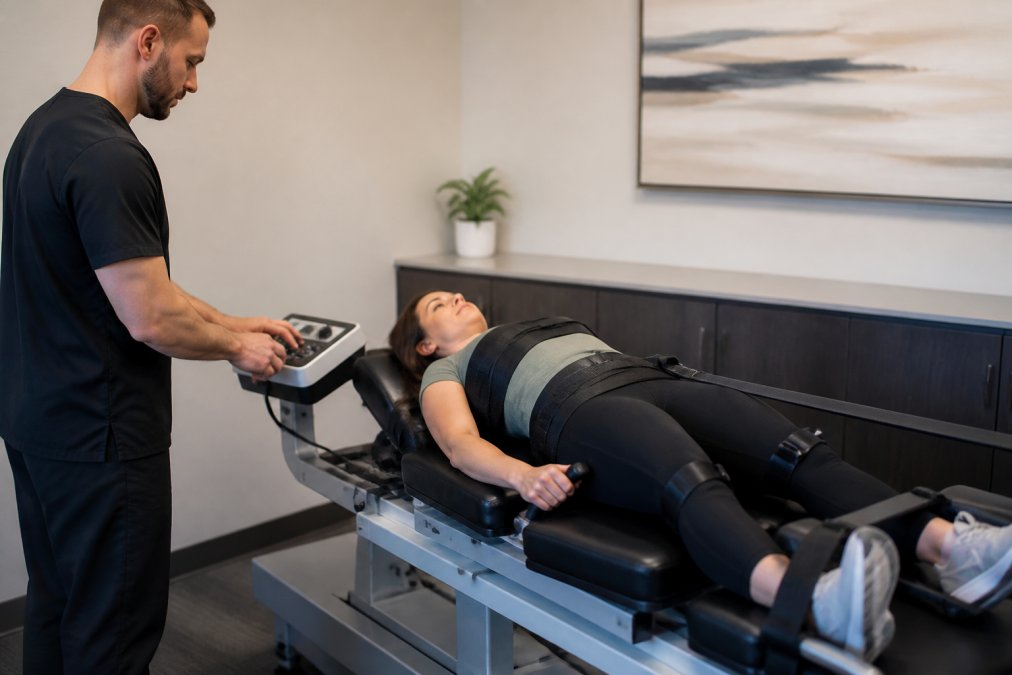
Understanding what spinal decompression actually does, versus what it promises, is essential for making an informed decision about whether this treatment aligns with your specific condition and health goals.
How Spinal Decompression Relieves Chronic Back Pain
The mechanism behind spinal decompression for chronic back pain centers on reducing intradiscal pressure and promoting healing of damaged nerve roots. When the spine experiences degenerative changes, herniated discs, or spinal stenosis, nerve impingement occurs, triggering pain, numbness, and weakness. The decompression process reverses this by creating a negative pressure gradient that encourages disc material to return to its proper position.
This therapeutic stretching also improves blood circulation to the affected area, delivering oxygen and nutrients necessary for tissue repair, increasing range of motion and reducing neurological symptoms associated with radiculopathy and other nerve compression conditions.
Most patients notice meaningful improvement after 10-15 sessions, as the therapy stimulates the body's own healing response rather than providing temporary symptom masking.
Conditions Treated by Spinal Decompression
Spinal decompression therapy addresses a range of conditions involving nerve impingement and disc pathology. Herniated discs, where disc material protrudes beyond the vertebral body, respond well to the negative pressure created during treatment. Bulging discs that haven't yet ruptured often show excellent results, as do cases of spinal stenosis where the spinal canal narrows and compresses nerve roots.
Sciatica, facet joint syndrome, degenerative disc disease, and radiculopathy respond well to decompression therapy when nerve compression is the primary driver of pain.
Spinal decompression isn't a one-size-fits-all solution; diagnostic imaging and clinical assessment are essential to determine whether your specific condition will respond to this approach.
| Condition | Primary Cause | Decompression Suitability | Alternative Consideration |
|---|---|---|---|
| Herniated disc | Disc material protrusion | Excellent | Requires confirmed diagnosis |
| Spinal stenosis | Narrowed spinal canal | Very good | May need imaging verification |
| Sciatica | Sciatic nerve compression | Excellent | Address underlying disc issue |
| Facet syndrome | Joint degeneration | Good | May combine with other therapy |
| Degenerative disc disease | Disc deterioration | Good | Long-term management focus |
Spinal Decompression Therapy Recovery Time and Expectations
Typical Treatment Course:
Most patients complete 15-25 sessions over 4-6 weeks, attending two to three times per week. Improvement typically becomes noticeable after 8-12 sessions, though severe stenosis or multiple levels of involvement may require the full course.
Patients often experience initial rapid improvement, followed by a plateau phase where progress appears to stall, then a second phase of improvement as cumulative healing effects compound. Discontinuing during the plateau phase causes patients to miss the secondary improvement window.
Cost and Financial Planning:
Without insurance, spinal decompression typically ranges from $100-$200 per session ($2,000-$4,000 for a full course). Many insurance plans classify it as experimental and deny coverage. Some providers offer package pricing that reduces per-session cost.
Request an itemized cost estimate and contact your insurance provider to determine coverage status, prior authorization requirements, and approved session limits. A complete decompression course typically costs substantially less than surgical intervention (which can exceed $50,000-$100,000).
Post-Treatment Care and the Critical First 4 Weeks:
The first 4 weeks post-treatment are critical; maintaining proper posture, avoiding heavy lifting, and performing prescribed maintenance exercises prevent re-injury and determine whether improvements stick or regress.
Maintenance Exercise Protocol:
Most practitioners recommend a personalized maintenance program of 10-15 minutes daily, 4-5 days per week. Lumbar cases benefit from prone cobra stretches, bird dogs, pelvic tilts, and quadruped rocking. Cervical cases respond to gentle neck isometrics, scapular stabilization, and chin tucks. All cases should include core stabilization and postural awareness training.
Consistency trumps intensity. Patients who maintain exercises for 6-12 months post-treatment report sustained relief, while those who stop after 4-6 weeks often experience symptom return within 3-6 months.
Ergonomic and Lifestyle Modifications:
Proper desk setup, sleeping position, and activity pacing (movement breaks every 30-45 minutes) influence spinal alignment and long-term pain management.
If chronic back pain originated from occupational posture issues, addressing those environmental factors is as important as the therapy itself to prevent symptom recurrence.
Long-Term Outlook:
Patients who complete the full treatment course, perform maintenance exercises consistently, and modify stressful activities typically maintain relief for 6-24 months or longer. Some require annual booster sessions, while others achieve lasting relief without additional treatment.
Chiropractic Spinal Decompression vs. Surgery: Key Differences
Surgery physically alters spinal anatomy by removing disc material, bone, or fusing vertebrae. Spinal decompression therapy is non-invasive and reversible, reducing pressure and promoting natural healing without tissue removal.
Surgery offers immediate structural change for severe cases with progressive neurological deficit or cauda equina syndrome, but carries risks including infection, nerve damage, and adjacent segment degeneration. Spinal decompression avoids these risks but requires more time and patient commitment.
Many patients who eventually pursue surgery had not attempted adequate conservative care first, including spinal decompression chronic back pain therapy combined with physical therapy and activity modification. Spinal decompression therapy combined with physical therapy and activity modification resolves the majority of chronic back pain cases without surgical intervention.
The cost structure also differs significantly. Decompression therapy involves multiple sessions over weeks, while surgery is a single event. Insurance coverage varies, and out-of-pocket costs depend on your plan and provider. Discussing financial implications with your healthcare provider ensures you understand the full picture before committing to either path.
Safety, Risks, and Who Is a Good Candidate
Spinal decompression therapy is generally well-tolerated, but it is not appropriate for everyone. Understanding both absolute contraindications (conditions where treatment must be avoided entirely) and relative contraindications (conditions requiring careful evaluation) is essential before beginning therapy.
Absolute Contraindications:
Patients with the following conditions should not undergo spinal decompression therapy:
- Pregnancy, Traction forces and positioning are unsafe for the developing fetus and pregnant spine.
- Active spinal infection or osteomyelitis, Mechanical stretching can spread infection and worsen bone pathology.
- Severe osteoporosis or bone density loss, Traction forces risk pathological fracture in compromised bone. Screening via DEXA scan is recommended for patients over 65 or with risk factors (the CDC).
- Spinal tumors or metastatic cancer, Mechanical stress can accelerate tumor progression or cause structural failure.
- Cauda equina syndrome, This surgical emergency requires immediate intervention, not conservative care.
- Severe spinal instability or spondylolisthesis (Grade 3 or higher), Traction can exacerbate vertebral slippage.
- Recent spinal fusion surgery (within 6-12 months), Hardware integration is incomplete, and traction forces can compromise fusion integrity.
Relative Contraindications (Require Medical Clearance):
Patients with these conditions may be candidates but need thorough evaluation and physician approval:
- Multiple prior spinal surgeries, Scar tissue and altered anatomy may limit treatment effectiveness or increase risk.
- Severe degenerative changes with instability, Advanced arthritis combined with ligamentous laxity requires imaging confirmation before proceeding.
- Uncontrolled hypertension or cardiovascular disease, Positional changes during treatment can affect blood pressure; cardiac clearance may be needed.
- Severe obesity (BMI >40), Equipment weight limits and positioning challenges may prevent safe treatment.
- Spinal cord myelopathy, Compression of the spinal cord itself (not just nerve roots) requires specialist evaluation to rule out surgical indication.
- Anticoagulation therapy, Blood thinners increase bruising risk; dosing adjustments may be necessary.
Ideal Candidate Profile:
Adults aged 40-75 with documented nerve impingement on imaging (MRI or CT showing disc herniation, stenosis, or nerve root compression), chronic back or neck pain unresponsive to at least 4-6 weeks of conservative care (physical therapy, NSAIDs, activity modification), and realistic expectations about treatment duration tend to see the best results.
Spinal decompression is contraindicated in pregnancy, active spinal infection, severe osteoporosis, spinal tumors, and cauda equina syndrome. Always obtain a proper diagnosis via imaging and medical clearance before beginning treatment. If you experience progressive neurological symptoms (weakness, loss of bowel or bladder control, severe unrelenting pain, or gait disturbance), seek emergency medical evaluation rather than pursuing conservative care.
Maintenance Exercises and Long-Term Care
Schedule maintenance exercises at the same time each day, morning or evening, to build the habit. Most people who succeed with long-term spinal health treat it like brushing their teeth: non-negotiable daily practice, not optional activity. Skipping weeks almost always leads to symptom return.
Beyond exercise, ergonomic modifications at work and home prevent re-injury. Proper desk setup, monitor height, chair support, and sleeping position all influence spinal alignment and long-term pain management. If your chronic back pain originated from occupational posture issues, addressing those environmental factors is as important as the therapy itself.
Frequently Asked Questions
How does spinal decompression therapy work to relieve chronic back pain?
Spinal decompression therapy uses motorized traction to gently stretch the spine, creating negative pressure within the intervertebral discs. This reduces pressure on nerves and promotes fluid exchange, allowing herniated or bulging discs to retract. The process improves nerve function and blood flow to affected areas, reducing pain and inflammation associated with chronic back pain conditions like sciatica and spinal stenosis.
What is the typical spinal decompression therapy recovery time?
Most patients begin experiencing relief within 2-4 weeks of consistent treatment, though full recovery varies by condition severity. Treatment typically involves 15-30 sessions over 4-8 weeks. Recovery time depends on the underlying condition, your age, and adherence to post-treatment maintenance exercises. Some patients see significant improvement within 6 weeks, while others may need 8-12 weeks for substantial pain reduction.
Is spinal decompression safe, and what are the risks?
Spinal decompression is generally safe when performed by qualified professionals, with minimal side effects. Some patients experience mild soreness or temporary increased pain initially. However, it is contraindicated for certain conditions including pregnancy, severe osteoporosis, spinal fractures, or metal implants in the spine. Consult a qualified healthcare provider to determine if you're a suitable candidate and discuss any existing health conditions.
How does chiropractic spinal decompression compare to spine surgery?
Chiropractic spinal decompression is a non-surgical, minimally invasive treatment that avoids the risks and recovery time associated with surgery. While surgical intervention may be necessary for severe cases, spinal decompression therapy offers a conservative approach with fewer complications, shorter recovery periods, and lower costs. Many patients achieve pain relief and improved mobility without surgical intervention, though some conditions may ultimately require surgical evaluation.
Learn more about flexion-distraction therapy at our Montgomery, AL clinic, or book an evaluation.
Table of Contents
- What Sciatica Nerve Pain Actually Is
- The Sciatica Recovery Timeline: Acute vs. Chronic
- What Determines How Long Sciatica Nerve Pain Lasts
- Sciatica Pain Relief Exercises You Can Do at Home
- When to See a Doctor for Sciatica
- How Chiropractic Care Fits Into Sciatica Recovery
- Frequently Asked Questions
Last Updated: September 26, 2026
What Sciatica Nerve Pain Actually Is
Sciatica nerve pain is a symptom, not a diagnosis: it is pain that travels along the path of the sciatic nerve, which runs from the lower back through the buttock and down each leg. Most people who ask how long does sciatica nerve pain last are really asking how long the underlying cause takes to calm down, and the honest answer is that it varies by cause, not by willpower.
This guide explains the recovery timeline, what speeds it up, and when to seek care.
The National Institute of Neurological Disorders and Stroke overview of back pain confirms that most cases improve without surgery, though timelines differ.
How the Sciatic Nerve Gets Irritated
The sciatic nerve is the longest nerve in the body. It forms from nerve roots in the lower spine and passes through the buttock before branching down the leg.
Irritation usually happens in one of three places:
- A slipped disk or herniated disk presses on a nerve root
- Muscle strain or trigger points in the piriformis muscle pinch the nerve
- Arthritis or facet joint changes narrow the space the nerve travels through
The location of the irritation often predicts how long symptoms last.
The Sciatica Recovery Timeline: Acute vs. Chronic
Acute sciatica typically resolves within four to eight weeks, while chronic sciatica persists beyond three months. That split matters because the two respond to different approaches, and because the underlying cause, not the calendar, drives most of the variation.
A useful way to frame it: the nerve itself does not heal on a schedule. What changes is the pressure or irritation on the nerve root. When that pressure eases, symptoms fade. When it does not, symptoms persist regardless of how many weeks have passed.
Typical Week-by-Week Healing Stages
Recovery generally follows a predictable arc, though individual cases vary widely:
- Weeks 1-2: Sharpest pain, most limited range of motion, frequent muscle spasms. Standing or sitting for long periods is hardest.
- Weeks 3-4: Pain shifts from sharp to dull, radiating pain shortens in distance, it may retreat from the foot to the calf, or from the calf to the buttock.
- Weeks 5-8: Residual tightness eases, walking distance improves, and most people can return to desk work and light activity.
- Beyond 8 weeks: If pain remains, evaluation for chronic pain drivers, disk herniation, spinal stenosis, or facet joint changes, is warranted.
A common pattern is that pain retreats from the farthest point inward. If the pain was reaching the foot and now stops at the knee, that is usually a sign of improvement even if the remaining pain feels just as intense.
What Changes the Timeline
Three factors tend to shift the answer most:
- Cause. A muscle strain or piriformis-related irritation often calms in two to four weeks. A slipped disk with true nerve-root compression more often takes six to twelve weeks. Arthritis or spinal stenosis can produce symptoms that fluctuate for months.
- Nerve involvement. A pinched nerve with neurological symptoms such as numbness, tingling, or weakness takes longer than pain alone, because nerve recovery lags behind pain relief.
- Response to conservative care. People who stay gently active in the first two weeks tend to recover faster than those who rest in bed.
The Small Share of Cases That Need More
Most people improve without surgery. A minority, typically those with progressive weakness, cauda equina symptoms, or pain that has not budged after six to eight weeks of conservative care, are evaluated for injections or surgical decompression. That decision is made on function and neurological findings, not on how many weeks have passed.
The single best predictor of recovery speed is how quickly you keep moving gently. Bed rest beyond two days tends to lengthen recovery, not shorten it.
If pain is getting worse week over week rather than better, or if new weakness appears, that is not a normal timeline, get evaluated.
What Determines How Long Sciatica Nerve Pain Lasts
Several factors change the answer to how long does sciatica nerve pain last. The most influential:
- Cause: A muscle strain resolves faster than a slipped disk or arthritis change
- Nerve involvement: A pinched nerve with neurological symptoms such as numbness or weakness takes longer
- Age and general health: Musculoskeletal recovery slows with age
- Activity level: Consistent, gentle movement beats prolonged rest
- Ergonomics: Desk setup and daily posture either help or hinder healing
A common mistake is judging progress by pain alone. Referred pain can fade before the underlying nerve irritation does, which is why flare-ups return.
Sciatica Pain Relief Exercises You Can Do at Home
The most effective home routine combines gentle stretching, controlled strengthening, and nerve gliding. None of it should cause sharp pain.

Try these sciatica pain relief exercises:
- Piriformis stretch: Lie on your back, cross one ankle over the opposite knee, pull the thigh toward your chest. Hold 30 seconds per side.
- Knee-to-chest: Lie on your back, pull one knee toward your chest, hold 20 seconds, switch sides.
- Cat-cow: On hands and knees, alternate arching and rounding your spine for 10 slow repetitions.
- Sciatic nerve glide: Sit tall, extend one leg, and gently flex and point the foot 10 times.
- Bridge: Lie on your back, knees bent, lift your hips, hold 5 seconds, lower. Repeat 10 times.
Stop any exercise that increases sharp or shooting pain down the leg. Pushing through nerve pain can worsen nerve irritation and extend recovery by weeks.
When to See a Doctor for Sciatica
See a doctor promptly if you experience weakness in the leg, loss of bladder or bowel control, or numbness in the groin area. These are red flags that require urgent evaluation.
For most other cases, when to see a doctor for sciatica comes down to duration and function. If pain has not improved after four to six weeks, or if it interferes with sleep and daily activity, a professional evaluation is appropriate.
A clinician may use diagnostic imaging, a nerve block, or anti-inflammatory medication as part of pain management. The American Academy of Orthopaedic Surgeons guidance on lumbar radiculopathy outlines when imaging is warranted.
How Chiropractic Care Fits Into Sciatica Recovery
Chiropractic care focuses on restoring normal motion in the vertebrae and reducing the muscle spasms and trigger points that keep pain signals active. It does not replace medical evaluation, but it often complements it.
At chiropracticcare.clinic, we approach recovery by assessing posture, range of motion, and daily ergonomics rather than treating pain in isolation. That matters because chronic pain usually has more than one driver.
The National Center for Complementary and Integrative Health on spinal manipulation notes that spinal manipulation may help some people with low back pain, though results vary.
A Home-Based Ergonomic Audit
A home-based ergonomic audit is one of the most underused tools. Check these:
- Monitor at eye level, about an arm's length away
- Feet flat on the floor or a footrest
- Chair supports the lower back curve
- Phone not cradled between ear and shoulder
- Standing break every 30 minutes
- Wallet out of the back pocket when sitting
That last item is easy to overlook. A thick wallet under one hip tilts the pelvis and can aggravate the same nerve path that produces sciatica.
Sleep Position and Pillow Choice: The Gap Most Guides Skip
Most sciatica articles stop at stretching and posture. Sleep is where a large share of re-irritation happens, because you spend six to eight hours in one position with no ability to adjust.
Three sleep setups tend to work best:
- On your back: Place a pillow under the knees to flatten the lower back. A thin pillow under the head keeps the neck neutral.
- On your side: Put a pillow between the knees so the top leg does not drop forward and rotate the pelvis. A medium-firm pillow supports the head without pushing it up.
- On your stomach: This is the hardest position for the lower back. If you sleep this way, a thin pillow under the hips can reduce the arch.
Pillow firmness matters more than pillow type.
Recovery speed depends less on the specific technique used and more on consistency: gentle movement, corrected posture, and sleep positioning that does not re-irritate the nerve.
Frequently Asked Questions
How long does a typical sciatica flare-up last?
Most acute sciatica flare-ups ease within 4 to 6 weeks, with sharp pain often improving after 1 to 2 weeks. Chronic cases can persist for 12 weeks or longer, especially if a herniated disk or spinal stenosis is involved. Recovery depends on the underlying cause, your activity level, and how consistently you follow a treatment plan. If pain lasts beyond 6 weeks, a medical evaluation is recommended.
Can sciatica go away on its own without treatment?
Many mild cases of sciatica improve on their own within a few weeks as inflammation settles and the nerve irritation decreases. However, if the pain is severe, keeps returning, or comes with numbness or weakness, self-care may not be enough. A qualified professional can assess whether the cause needs targeted treatment rather than waiting it out.
What are the red flags for sciatica that require immediate medical attention?
Seek urgent care if you lose bladder or bowel control, feel numbness in the groin or inner thigh area, or develop sudden weakness in one or both legs. These can signal cauda equina syndrome, a rare but serious condition. Also get prompt help for fever, unexplained weight loss, or pain following a fall or accident.
How can I speed up the healing process for sciatica nerve pain?
Stay gently active with walking and targeted stretches, avoid prolonged sitting, and use heat or ice for comfort. A qualified professional can guide you through exercises that reduce nerve irritation. Most people notice improvement within a few weeks when they combine movement, posture changes, and professional care. Skipping activity entirely can slow recovery.
Recovery from sciatica is rarely linear, and the timeline depends on the cause, your daily habits, and how consistently you address posture and movement. chiropracticcare.clinic evaluates the whole picture, including spinal alignment, ergonomics, and sleep positioning, rather than chasing symptoms. If pain has lingered past six weeks, get started with chiropracticcare.clinic and build a recovery plan around your actual daily routine.
If you would like this looked at in person, you can book an evaluation at our Montgomery, AL clinic.
Table of Contents
- What Is a Cervicogenic Headache?
- Cervicogenic Headache Symptoms: How to Tell It's From Your Neck
- The Anatomy Behind Why Neck Pain Causes Headaches
- Causes: From Poor Posture to Whiplash and Arthritis
- Neck Pain Headache Relief Exercises You Can Do at Home
- How to Fix Chronic Back Pain and Prevent Neck-Related Headaches
- When to See a Doctor and What to Expect
- Frequently Asked Questions
Last Updated: September 25, 2026
What Is a Cervicogenic Headache?
A cervicogenic headache is a secondary headache caused by a disorder of the cervical spine, meaning the pain originates in the neck and refers upward into the head rather than starting in the brain itself. This distinction matters: it is why neck pain causes headaches, and it is why treatments that target the neck often succeed where general painkillers fail.
Cervicogenic Headache Symptoms: How to Tell It's From Your Neck
Cervicogenic headache symptoms follow a recognizable pattern that separates them from migraine and tension-type headache. The tell is mechanical: the headache changes when the neck changes position.
Look for these signs:
- Pain that starts at the base of the skull and radiates forward
- One-sided head pain that does not switch sides
- Reduced range of motion in the neck
- Neck stiffness and muscle spasms between episodes
- Pain triggered by sustained postures, such as desk work or driving
- Pressure over the upper cervical spine reproducing the headache
The Anatomy Behind Why Neck Pain Causes Headaches
The upper cervical spine shares its nerve supply with the head, which is the anatomical reason why neck pain causes headaches. The first three cervical nerves carry sensation from the neck joints and muscles, and they converge on the same brainstem region that receives signals from the head and face. When those neck structures send pain signals, the brain cannot always tell where they came from.
How C1-C3 Nerves Refer Pain to the Head
The C1, C2, and C3 nerves are the mechanism behind referred pain. These nerves innervate the facet joints, discs, and deep muscles of the upper cervical spine. Because they connect to the trigeminocervical nucleus in the brainstem, irritation in the neck is interpreted as pain in the head. This is why a pinched nerve or inflamed facet joint in the neck can produce a headache felt behind the eye or at the temple.
Causes: From Poor Posture to Whiplash and Arthritis
The causes of cervicogenic headache are mechanical and structural, not random. A common mistake is assuming recurring headaches are purely stress-related when the neck is the real source.
The usual culprits:
- Poor posture. Forward head position loads the upper cervical spine for hours at a time.
- Whiplash. A car accident injures the cervical muscles and joints, sometimes causing cervical instability.
- Arthritis. Age-related changes in the facet joints narrow the space around nerves.
- Slipped disk. A cervical disk can press on a nerve root, producing radiating pain.
- Muscle strain and trigger points. Tight muscles refer pain into the head.
- Cervical radiculopathy. Nerve irritation in the neck can send symptoms down the arm as well.
Ignoring a mechanical neck problem while treating only the headache rarely resolves it. The pain returns because the source was never addressed.
Neck Pain Headache Relief Exercises You Can Do at Home
Neck pain headache relief exercises work by restoring range of motion, calming overactive upper cervical muscles, and rebuilding endurance in the deep neck flexors, the small muscles that hold your head steady. The goal is not to stretch hard. It is to move often, gently, and consistently.

Screen yourself first
Skip exercises and see a clinician if you have any of the following:
- Pain, numbness, or tingling that shoots down an arm
- Weakness in the hand or arm, or dropping objects
- Dizziness, double vision, or difficulty swallowing with the headache
- A headache that began after a fall, car accident, or blow to the head
- Fever, unexplained weight loss, or a headache that wakes you from sleep
The four core exercises, with dosage
Do these in short, frequent sessions rather than one long one. The neck responds better to consistent, gentle movement than to occasional aggressive stretching. A common pattern is two to three rounds per day, five days a week, for two to three weeks before judging results.
- Chin tucks (deep neck flexor activation). Sit or lie on your back. Draw the chin straight back as if making a double chin, do not nod down. Hold five seconds, relax, repeat ten times. This trains the deep muscles that counter forward head posture.
- Neck rotations (range of motion). Turn the head slowly left and right within a comfortable range. Hold two seconds at each end, ten reps per side. Stop before the point of sharp pain; a mild stretch is fine.
- Shoulder blade squeezes (scapular retraction). Pull the shoulder blades down and together, hold five seconds, repeat ten times. This offloads the upper trapezius, which often refers pain into the head.
- Upper trapezius stretch. Tilt the head gently to one side, using the hand for light overpressure only if it feels comfortable. Hold thirty seconds, two reps per side.
Progressions once pain settles
When the basics feel easy and headaches are less frequent, add:
- Chin tuck holds for ten seconds, ten reps
- Prone Y-T-W raises to build mid-back strength that supports the neck
- Wall angels to improve thoracic extension, which reduces the load the neck has to carry
What to avoid
- Aggressive end-range stretching that reproduces the headache
- Heavy overhead lifting during a flare
- Prolonged static stretching of already tight muscles without strengthening the opposing ones
A simple rule: if an exercise makes the headache worse within an hour, reduce the range or the reps next time. If it makes it better, keep the dose the same for a week before increasing.
When to add professional guidance
If two to three weeks of consistent home exercise does not reduce headache frequency or intensity, a physical therapist can assess cervical joint mobility, muscle endurance, and posture, then build a targeted program. Manual therapy combined with a home program tends to outperform either alone for cervicogenic headache.
How to Fix Chronic Back Pain and Prevent Neck-Related Headaches
Learning how to fix chronic back pain and prevent neck headaches comes down to the same principle: reduce sustained load on the spine. The habits that protect the lower back protect the neck. What most articles skip is the how, the specific setup, the specific pillow, and the specific stress loop that keeps the cycle alive.
A five-minute ergonomic audit you can run today
Walk through this checklist at your desk. Each item maps to a load the upper cervical spine has to absorb.
- Monitor height. The top third of the screen should sit at eye level. If you look down, the head drifts forward and the neck extensors work overtime.
- Monitor distance. Arm's length away. Closer pulls the head forward; farther pushes it forward to read.
- Chair back support. The lower back should be supported so you are not slumping, which drags the head forward.
- Elbow angle. Roughly 90 degrees, forearms parallel to the floor, shoulders relaxed.
- Feet. Flat on the floor or a footrest. Dangling feet tilt the pelvis and cascade upward.
- Phone. Raise it to eye level instead of looking down. Text neck is the same forward-head load in a smaller package.
- Movement breaks. Stand or change position every thirty minutes. Sustained posture, not bad posture alone, is the driver.
If you fix only one thing, fix monitor height. It is the single adjustment that most reliably reduces forward head posture during desk work.
Pillow and sleep position
Sleep hygiene matters more than most people expect. A pillow that is too high or too flat holds the neck in a strained position for hours, feeding the same pain cycle you are trying to break.
- Back sleepers need a pillow that fills the gap between the neck and the mattress, often a contoured cervical pillow or a rolled towel inside a pillowcase. Too thick pushes the head forward all night.
- Side sleepers need a pillow thick enough to keep the nose in line with the sternum. A pillow that is too thin lets the head drop; too thick bends the neck sideways.
- Stomach sleepers put the neck in rotation for hours. This is the hardest position to make neutral. A very thin pillow or none at all, plus a focus on switching to side or back sleeping, is the usual recommendation.
The stress-pain cycle
Most articles treat stress as a side note. It is not. Stress increases muscle tension in the upper trapezius and suboccipitals, which increases neck pain, which increases headache, which increases stress. The loop is self-reinforcing.
Breaking it usually means addressing both ends:
- Physical end: the exercises and ergonomic changes above
- Psychological end: sleep, breathing, and, for chronic pain, cognitive behavioral approaches that reduce the fear and vigilance that amplify pain signals
Build capacity, not just comfort
Prevention is not only about avoiding bad positions. It is about building the strength and endurance to tolerate normal positions for longer.
- Strengthen the deep neck flexors and mid-back with the progressions in the exercise section
- Keep the core and hips strong so the spine is not the only load-bearing structure
- Stay generally active, walking, swimming, and low-impact cardio all support spinal health
When self-care is not enough
If headaches are frequent, disabling, or worsening despite consistent self-care, a clinician can assess whether the neck is the primary driver or one of several contributors. Persistent cases often need a combination of physical therapy, ergonomic change, and, when appropriate, medical management.
When to See a Doctor and What to Expect
See a doctor promptly if a headache follows a head or neck injury, or if it comes with neurological symptoms such as weakness, numbness, or vision changes. Those signs warrant medical evaluation before any hands-on treatment.
Frequently Asked Questions
How to stop headaches caused by neck pain?
Start with gentle range-of-motion exercises and heat or ice to relax muscle spasms. Over-the-counter anti-inflammatories can reduce pain signals. Check your workstation setup so your screen sits at eye level. If headaches persist beyond a few weeks or come with neurological symptoms, see a healthcare provider.
How to tell if a headache is from neck pain?
Cervicogenic headache symptoms usually appear on one side and start at the base of the skull before radiating forward. Neck stiffness, reduced range of motion, and pain triggered by specific neck movements are strong clues. Unlike tension-type headache, the pain often worsens with sustained postures. A provider can confirm the diagnosis through physical exam and, when needed, diagnostic imaging.
Can poor posture lead to cervicogenic headaches?
Yes. Forward head posture places continuous strain on the upper cervical spine and surrounding muscles, which can irritate the C1-C3 nerves and refer pain to the head. Office workers who spend hours looking down at screens are especially prone. Ergonomic adjustments, frequent breaks, and posture-strengthening exercises reduce this strain. A home ergonomic audit can identify the specific setup issues driving your symptoms.
When should I see a doctor for neck-related headaches?
Seek care if headaches follow a whiplash injury, worsen over time, or come with numbness, weakness, or vision changes. Red flags include fever, unexplained weight loss, or pain that wakes you at night. For chronic cases, a provider may recommend physical therapy, nerve block procedures, or diagnostic imaging. If you are also dealing with how to fix chronic back pain, ask about a combined evaluation.
Chronic neck-related headaches rarely resolve on their own when the underlying mechanical cause goes untreated. At chiropracticcare.clinic, we focus on identifying where the pain actually starts rather than chasing the symptom. If recurring headaches and neck stiffness are part of your daily routine, a proper evaluation is the sensible first step. Get started with chiropracticcare.clinic and address the source, not just the headache.
Learn more about headache care at our Montgomery, AL clinic, or book an evaluation.
Table of Contents
- Why Certain Yoga Poses Aggravate Back Pain
- Yoga Poses to Avoid With Chronic Back Pain
- Yoga Modifications for Lower Back Pain
- Safe Yoga Stretches for Chronic Back Pain
- The Role of Props in Back-Safe Yoga Practice
- When to See a Chiropractor for Back Pain
- Frequently Asked Questions
Last Updated: September 24, 2026
Why Certain Yoga Poses Aggravate Back Pain
Yoga can be an excellent tool for flexibility and mindfulness, but certain poses place excessive stress on the lumbar spine. Understanding which yoga poses to avoid with chronic back pain becomes essential to preventing further injury, since many instructors don't account for individual spinal conditions when recommending poses. (Source: herniated discs)
Poses involving excessive flexion (forward bending), extension (backward bending), or torsion (twisting) can compress spinal discs or irritate nerve roots, triggering pain that lasts for days after a single session.
Different conditions require different approaches: sciatica, disc degeneration, and muscle strain each respond differently to poses. Forward folds therapeutic for a healthy spine can be problematic for disc degeneration. Modifications and props become essential, but first you need to know which poses pose the greatest risk.
Yoga Poses to Avoid With Chronic Back Pain
Certain yoga poses to avoid with chronic back pain appear repeatedly in discussions with chiropractors and physical therapists because they create the most common problems for people managing chronic back conditions.
Full Forward Folds and Hamstring Stretches
Forward folds feel deceptively safe, but a full forward fold places significant strain on the lumbar spine and stretches the posterior chain aggressively.
Forward folding increases intervertebral disc pressure and can push disc material toward nerve roots in people with herniated discs, triggering acute pain or radiating symptoms down the leg.
Keep knees slightly bent and place hands on blocks to reduce range of motion; hold for no more than a few seconds and never bounce.
Deep Backbends and Spinal Extension
Deep backbends compress the posterior elements of vertebrae and aggravate facet joints. For people with spinal stenosis or arthritis, this compression reduces the already-limited space around nerve roots.
Many practitioners arch from their lower back instead of distributing the bend evenly, concentrating movement in the lumbar region and increasing injury risk.
Modify backbends by holding them briefly, engaging your core, and using props to limit range of motion.
Twists and Spinal Rotation
Deep spinal rotation, especially combined with flexion, stresses intervertebral discs and irritates facet joints. Poses like Parivrtta Parsvakonasana or deep seated twists create torsion that compromised discs cannot tolerate.
Twisting while in flexion creates the highest disc pressure and greatest injury risk (Checking your browser).
Use gentle, supported twists with props to limit rotation depth.
Unsupported Core Work
Poses like Boat Pose or extended Plank variations can aggravate chronic back pain if poor form shifts stress to the lower back instead of the abdominal muscles.
Jumping directly into demanding core poses without modification damages the spine further, even though core strength is needed to protect it.
Use blocks, straps, and modifications to maintain alignment while building core strength gradually.
Yoga Modifications for Lower Back Pain
The solution is learning to practice safely with modifications tailored to your specific condition. Modifications reduce spinal load, limit range of motion, and maintain neutral alignment, but the adjustment you need depends on your diagnosis: herniated disc, sciatica, facet joint irritation, or muscle strain.
Modifications for Herniated Disc Pain
For herniated discs, place hands on blocks at highest height (reducing flexion 40-50%), keep knees bent 15-20 degrees, and hold 20-30 seconds. For seated folds, sit on a blanket to tilt pelvis forward and reduce flexion demand.
For herniated discs, twist only in neutral spine with core engaged, rotating from thoracic spine only. Use a strap to limit rotation depth and never twist while flexed.
Modifications for Sciatica and Nerve Root Irritation
For sciatica, keep knees bent 30-45 degrees and hands on blocks to reduce nerve stretch. Reclined hamstring stretches with a strap work better than seated versions because gravity doesn't add intensity.
Gentle spinal extension can reduce nerve root compression from disc bulges. Use a bolster under your chest in supported backbends, holding 30-45 seconds, and avoid aggressive backbends.
Modify Pigeon Pose by using a block under your hip and limiting forward fold depth. Reclined Figure Four often provides better relief because it stretches the piriformis without nerve stretch.
Modifications for Facet Joint Pain and Stenosis
For facet joint pain or stenosis, minimize backbends. If practicing them, keep extremely gentle: Sphinx Pose for 15-20 seconds with bolster under chest. Avoid deep backbends like Wheel.
Twists should be performed in slight spinal flexion to open facet joints. Use props to limit rotation depth.
General Modification Principles Across All Conditions
All modifications should maintain neutral spine alignment: preserve natural curves without flattening or exaggerating them.
Engage deep abdominal muscles before entering any pose by drawing your navel toward your spine; maintain this engagement throughout.
Hold modified poses for 20-45 seconds initially, gradually increasing as your condition improves. Never progress deeper until you can hold the modified version comfortably for 45 seconds without pain.
Progress gradually and pain-responsively. If a modified pose causes pain during or within 2 hours after practice, reduce the modification or skip it for 1-2 weeks.
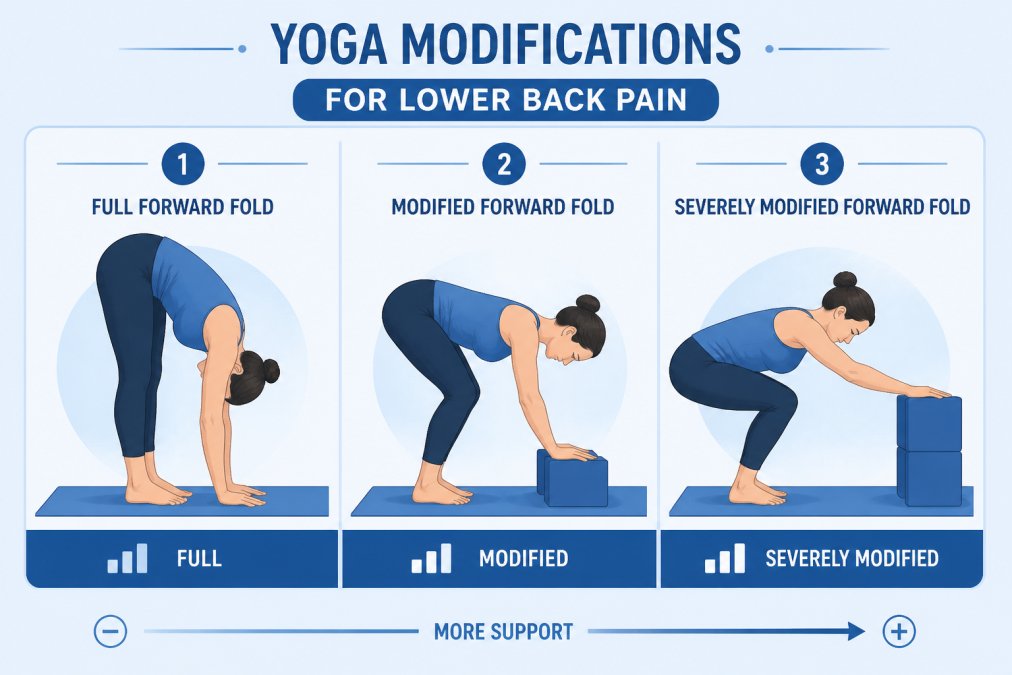
Safe Yoga Stretches for Chronic Back Pain
Some stretches actively help chronic back pain by improving flexibility and reducing muscle tension through gentle lengthening without compression.
Child's Pose with bolster support gently decompresses the lumbar spine; keep hips high to avoid excessive flexion and hold 30-60 seconds.
Supine Figure Four stretches hip flexors and glutes without spinal stress; hold each side 30-45 seconds. (Source: National Institute of Arthritis and Musculoskeletal and Skin Diseases (NIAMS))
Cat-Cow poses improve spinal mobility through controlled flexion and extension; move gently, synchronizing breath with movement, and never bounce.
Sphinx Pose offers gentle spinal extension without full backbend intensity; hold 20-30 seconds.
The Role of Props in Back-Safe Yoga Practice
Props are essential tools for anyone managing chronic back pain, recommended by physical therapists and chiropractors. They reduce range of motion, distribute load evenly, and allow therapeutic benefits without excessive spinal stress.
Yoga Blocks: Reducing Range of Motion and Disc Pressure
Yoga blocks reduce spinal flexion by 30-50% in forward folds when hands are placed on blocks instead of the floor.
Start with blocks on highest setting to reduce spinal flexion most aggressively; gradually lower height as your condition improves.
In forward folds, place hands on blocks at hip width. In Downward Dog, blocks elevate torso and reduce spinal flexion. In Child's Pose, place block under forehead to prevent excessive lumbar flexion.
In supported backbends, place a block lengthwise under your thoracic spine to limit arch depth and prevent lumbar compression.
Straps: Controlling Stretch Intensity and Maintaining Alignment
Straps allow you to control stretch intensity in seated forward folds by looping around feet and adjusting pull, letting you lengthen your spine while stretching hamstrings.
In reclined hamstring stretches, loop strap around foot and pull to bring leg toward torso while keeping lower back flat; hold 45-60 seconds per side.
Wrap strap around torso at rib height to limit rotation depth and prevent forcing deeper than is safe.
Bolsters: Supporting Gentle Extension and Restorative Poses
In supported backbends, place bolster lengthwise under thoracic spine with head supported by blanket; hold 2-3 minutes for gentle therapeutic extension.
In twists, place bolster vertically beside hip and rest torso against it to limit rotation depth; hold 30-45 seconds per side.
In Child's Pose, place bolster between thighs and torso to elevate torso and reduce spinal flexion; hold 1-2 minutes.
Blankets: Positioning, Cushioning, and Alignment
A folded blanket under hips in seated poses tilts pelvis forward and reduces lumbar flexion demand, transforming uncomfortable poses into sustainable ones.
Blankets also cushion your knees in kneeling poses. Kneeling without cushioning can create compensatory tension in your lower back as your body tries to balance. A folded blanket under your knees reduces this compensation. In poses like Camel, place a blanket under your knees to reduce the intensity of spinal extension.
Use blankets to support your head and neck in restorative poses. Proper head support prevents your neck from extending excessively, which can create referred pain in your lower back through postural compensation.
Prop Combinations for Maximum Effectiveness
Using multiple props together creates synergistic effects. In a modified forward fold, combine blocks (under hands), a blanket (under hips), and a strap (around feet) to create a fully supported, low-intensity stretch. This combination allows you to hold the pose longer while maintaining perfect alignment.
In supported backbends, combine a bolster (under thoracic spine), a blanket (under head), and another blanket (under knees) to create a fully supported, therapeutic pose. This setup allows 3-5 minutes of gentle extension without any strain.
Selecting Props Based on Your Condition
Investing in Quality Props
When to See a Chiropractor for Back Pain
Yoga modifications help many people, but chronic back pain sometimes requires professional assessment. Knowing when to see a chiropractor for back pain prevents minor issues from becoming serious injuries and ensures you're practicing safely given your specific condition.
Frequently Asked Questions
Which yoga poses are bad for lower back pain?
Full forward folds, unsupported backbends, deep twists, and poses that load the lumbar spine without core engagement typically aggravate chronic back pain. Poses that involve spinal flexion (rounding forward) or excessive extension (arching backward) compress vertebrae and can irritate existing disc issues or muscle strain. The safest approach is to work with a qualified instructor who can assess your specific condition and recommend modifications.
Can yoga make chronic back pain worse?
Yes. Practicing yoga poses without proper alignment, modifications, or core engagement can worsen chronic back pain. Movements that increase spinal compression, overstretching the posterior chain, or forcing range of motion beyond your current capacity may trigger pain flare-ups or create new injuries. This is why modifications and professional guidance are essential for anyone with existing back conditions.
What are the best yoga modifications for back pain?
The best modifications use props (blocks, straps, bolsters) to reduce spinal load and maintain neutral spine alignment. Shortening your range of motion, bending knees in forward folds, and engaging your core during all poses protects your lumbar spine. Therapeutic yoga focusing on gentle stretching, pelvic stability, and mindful movement is safer than dynamic or power yoga styles for chronic pain.
When should I see a chiropractor for back pain?
See a chiropractor if your back pain persists beyond a few weeks, limits daily activities, or worsens with certain movements like yoga. A chiropractor can assess spinal alignment, identify biomechanical issues, and determine whether pain stems from disc problems, muscle strain, or other causes. They can also provide guidance for yoga practice and recommend specific modifications based on your condition.
Learn more about back pain care at our Montgomery, AL clinic, or book an evaluation.
