

Yoga Poses to Avoid With Chronic Back Pain
Yoga poses to avoid with chronic back pain: Learn which yoga poses aggravate chronic back pain, why they're risky, and safe modifications to keep.
Read More →
Last Updated: September 23, 2026
If you're wondering why sciatica pain at night gets worse, you're not imagining it. The sciatic nerve runs from your lower back through your hips and down each leg, and lying down changes how pressure builds along that path. This guide explains the mechanics behind nighttime flare-ups and what you can do about them. (Source: research on spinal biomechanics)
Daytime movement keeps your spine moving and your muscles active.
Three things happen once you lie down:
Where your body weight lands changes everything. On your back, pressure spreads across the mattress. On your side, it shifts to your hip and shoulder. On your stomach, it arches your lumbar spine.
Inflammation doesn't follow a clock, but your body's response to it does. Levels of inflammatory markers often shift with your circadian rhythm, and for some people that means nerve sensitivity climbs in the evening.
Cortisol is your body's main anti-inflammatory hormone, and it follows a daily curve. Levels typically peak in the early morning and fall to their lowest point late at night.
The best sleeping positions for sciatica keep your spine neutral and take pressure off the nerve. Side sleeping with support and back sleeping with a pillow under the knees are the two most reliable options.
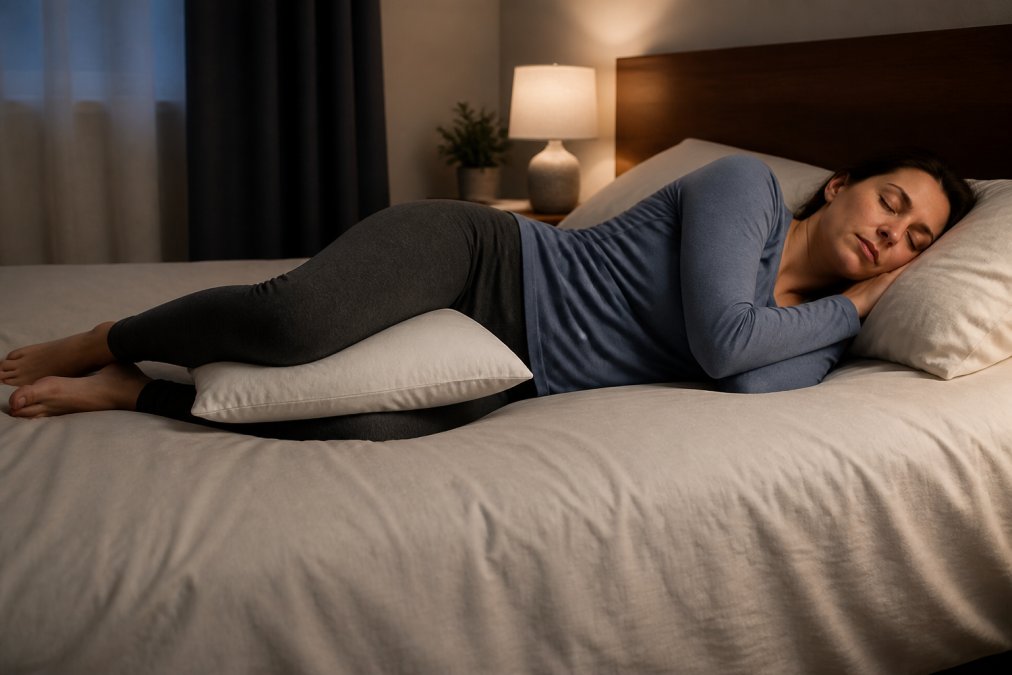
Lie on the side that hurts less, or on the side that doesn't hurt at all if you can manage it. Bend your knees slightly and place a pillow between them.
Back sleeping works well if you place a pillow under your knees. This slightly flattens your lumbar curve and takes load off the discs.
Fast relief comes from reducing nerve compression and calming the irritated tissue. A few techniques work better than others when you're already in bed, and the order matters.
Try these in order:
If you use an over-the-counter anti-inflammatory like ibuprofen or naproxen, timing it to bedtime is a common strategy, but it isn't automatic. These medications typically take 30 to 60 minutes to reach peak effect, so taking one right as you get into bed means the peak lands after you've already been lying still for a while. Many practitioners suggest taking it 30 to 45 minutes before your target sleep time so the effect overlaps with the hours you're most likely to be woken.
See a doctor promptly if you notice any of the following, because these point to something more serious than typical sciatica:
Sleep hygiene for sciatica means setting up the hours before bed so your nervous system is calm before you lie down. The position matters. So does everything that happens before it. Generic sleep advice gets you part of the way; the sciatica-specific adjustments are what actually move the needle.
What to build into your evening:
A short nerve-flossing routine 30 to 60 minutes before bed can reduce the baseline irritation that builds into a nighttime flare. The goal isn't to stretch, it's to glide the nerve through its surrounding tissue so it isn't sitting in a compressed position all night.
Two things most sciatica guides never mention:
Room temperature. A cool room (roughly 60 to 67 degrees Fahrenheit is the commonly cited range for sleep) supports the body's natural temperature drop that triggers sleep onset. For sciatica specifically, a warm lower back paired with a cool room is often the sweet spot, a heating pad on the lumbar area for 15 minutes before bed, then off, so the room stays cool.
A small setup reduces middle-of-the-night scrambling:
If you take medication for nerve pain, ask your clinician about timing. Some medications work better taken earlier in the evening so peak effect lands when you need it. Never change a dose or schedule on your own.
The first ten minutes after waking are when most people reinjure a calm back. Overnight, your discs absorb fluid and your spine is stiffer. Sudden movement on a stiff spine is how a good night turns into a bad morning.
A simple sequence helps:
Nighttime sciatica is a mechanical and hormonal problem, not a mystery. Pressure distribution, dropping cortisol, and nerve sensitivity all stack up after dark, and the fix starts with position, support, and a calmer evening routine.
Start with a supported sleeping position: lie on your side with a pillow between your knees to keep your spine neutral. Apply a cold pack for 15 minutes to calm inflammation, then switch to a warm compress to relax muscles. Over-the-counter anti-inflammatories may help if your doctor approves. Avoid sleeping flat on your back without knee support. If pain keeps you awake most nights, see a healthcare provider to rule out serious nerve compression.
The worst thing is to stay in bed for long periods. Prolonged inactivity weakens supporting muscles and can make nerve compression worse. Also avoid sleeping on your stomach, which arches the lower back and increases pressure on the lumbar spine. Do not ignore worsening symptoms like leg weakness or numbness. Gentle movement, physical therapy, and proper sleep positions are better than complete rest.
It depends on your position. Lying flat on your back without knee support can flatten the lumbar curve and increase pressure on the sciatic nerve. Side sleeping with a pillow between the knees or back sleeping with a pillow under the knees helps maintain spinal alignment and reduces nerve root irritation. A mattress that is too soft or too firm can also worsen compression. The right setup usually eases symptoms rather than aggravating them.
See a doctor if pain prevents sleep for more than a few nights, or if you notice numbness, tingling, or weakness in your leg or foot. Seek urgent care for loss of bladder or bowel control, which may signal cauda equina syndrome. Also consult a professional if over-the-counter remedies and position changes do not help within a week. A doctor can assess for herniated disc, spinal stenosis, or other causes and recommend treatment.
A quick note on sources: For general background on sciatic nerve anatomy and conservative care, see the National Institute of Neurological Disorders and Stroke overview of back pain and the MedlinePlus guide to sciatica. For guidance on when back pain needs urgent attention, the American Association of Neurological Surgeons patient information on cauda equina syndrome is a useful reference.


