

Yoga Poses to Avoid With Chronic Back Pain
Yoga poses to avoid with chronic back pain: Learn which yoga poses aggravate chronic back pain, why they're risky, and safe modifications to keep.
Read More →
Last Updated: August 16, 2026
Sciatica occurs when the sciatic nerve becomes compressed or irritated, causing radiating pain that typically travels from the lower back through the buttocks and down one leg. The sciatic nerve is the longest nerve in the human body, and when vertebral misalignment or a herniated disc places pressure on it, the result is often sharp, burning, or tingling sensations that extend well beyond the spine itself.
For those whose sciatica has become a chronic challenge, our companion post on managing persistent sciatica provides deeper insights into creating a sustainable well-being plan through chiropractic care tailored for long-term comfort and balance.
For those experiencing radiating low back discomfort, we specialize in providing sciatica pain relief through manual care.
Nerve impingement happens when surrounding tissues, bone, disc material, or inflamed muscles, narrow the space where the sciatic nerve travels. This compression triggers inflammation and irritation, causing pain signals that radiate down the leg. What distinguishes sciatica from general lower back pain is its specific pathway: pain typically follows the sciatic nerve's course into the thigh, calf, or foot, which helps clinicians identify exactly which nerve is involved and where compression is occurring.
Rather than masking pain with medication, chiropractic care for sciatica relief focuses on addressing the underlying mechanical problem. When vertebral alignment is restored through spinal manipulation, the pressure on the sciatic nerve decreases. A chiropractor examines how your vertebrae are positioned relative to one another. Misalignment, called subluxation in chiropractic terminology, can pinch nerve roots as they exit the spinal column. By applying controlled force to restore proper alignment, adjustments reduce nerve compression and allow inflammation to subside.
Your initial appointment will involve a comprehensive clinical examination designed to identify the specific source of your nerve compression. This thorough evaluation typically takes 30 to 60 minutes and forms the foundation for your personalized treatment plan.
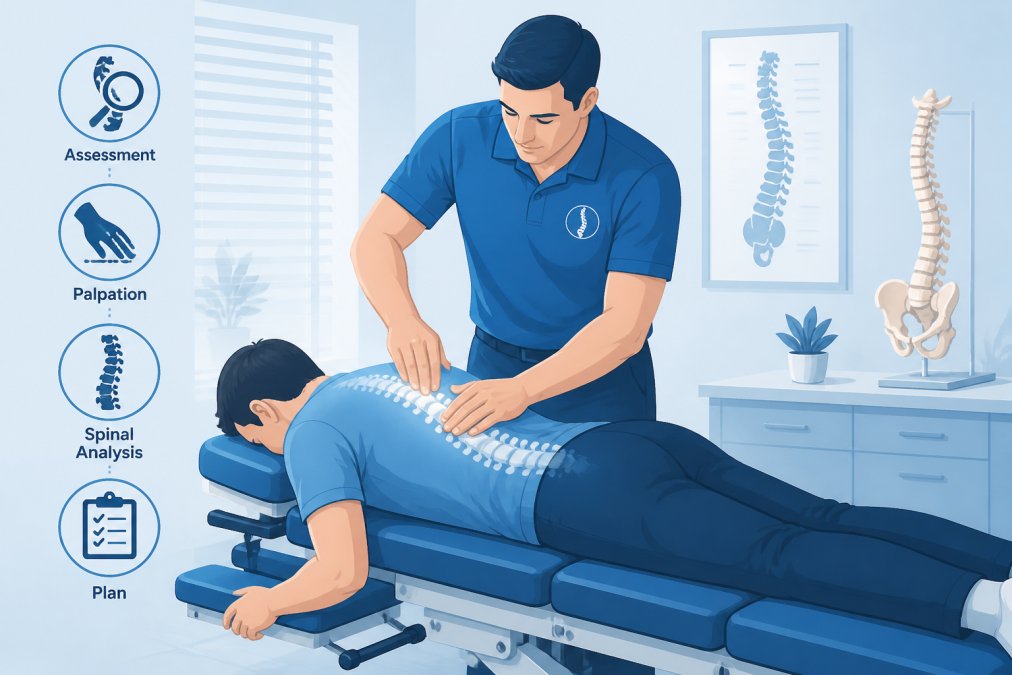
During your first visit, the chiropractor will conduct a detailed neurological assessment to confirm that your symptoms are indeed sciatica. This includes testing your reflexes, muscle strength, and sensation in the affected leg, as well as asking you to perform specific movements to identify which motions worsen or improve your symptoms.
Many cases benefit from diagnostic imaging to visualize the exact location of nerve compression. X-rays can reveal vertebral misalignment and degenerative changes, while MRI imaging provides detailed soft tissue visualization to identify herniated discs. Your chiropractor will determine whether imaging is necessary based on your examination findings and symptom duration.
The clinical examination also includes discussion of your medical history, previous injuries, occupation, and daily habits. Postural issues, repetitive strain, or past trauma often contribute to sciatica development, and understanding these factors helps your chiropractor develop a tailored treatment approach.
Once the examination is complete, your chiropractor will explain their findings and outline a proposed treatment plan specifying the frequency of adjustments, expected timeline for improvement, and any complementary therapies or home exercises.
A typical acute sciatica case might involve 2-3 visits per week initially, while chronic cases often benefit from a longer-term maintenance approach. Your chiropractor will set realistic expectations and adjust the plan based on your progress during the first few weeks of treatment.
Both chiropractic care for sciatica relief and physical therapy address nerve compression through different mechanisms. Physical therapy emphasizes therapeutic exercises, stretching, and strengthening to stabilize the spine and reduce nerve irritation. Chiropractors focus on direct spinal manipulation to restore vertebral alignment and reduce nerve impingement.
Spinal manipulation may provide relief for some patients by helping reduce nerve compression, though the degree and timing of relief vary by individual. If your MRI shows a herniated disc pressing on the sciatic nerve, or if your X-rays reveal vertebral misalignment, chiropractic adjustment addresses that mechanical problem directly. This approach works particularly well for acute sciatica triggered by a specific incident, a car accident, fall, or awkward lifting movement. Patients with chronic sciatica lasting months or years may also benefit from adjustments, though their recovery timeline typically extends longer.
The most effective strategy often involves both chiropractic care and physical therapy working in tandem. Your chiropractor reduces nerve compression through adjustment, while your physical therapist teaches you exercises that stabilize your spine and prevent future misalignment. Many patients begin with more frequent chiropractic visits to reduce acute pain, then transition to physical therapy as symptoms improve.
Combining manual therapy with targeted exercise is a common approach some care providers use to support musculoskeletal health.
The question most patients ask first is: how long will this take? The answer depends on whether your sciatica is acute or chronic, how severe the nerve compression is, and how well your body responds to treatment.
Acute sciatica, pain that began recently and was triggered by a specific injury, typically responds faster to chiropractic care for sciatica relief. Some patients report noticeable improvement within 2-4 weeks of consistent treatment; a typical acute care plan may involve 8-12 visits spread over 4-6 weeks, though this varies by individual.
Chronic sciatica, lasting three months or longer, requires a longer treatment timeline. Your nerve has been irritated for an extended period, inflammation has become persistent, and your body has developed compensatory movement patterns. Chronic cases often involve a longer care plan, sometimes 12-20 visits over 8-12 weeks, adjusted to the individual's progress. Individual variation is significant, your age, overall health, the severity of nerve compression, and how consistently you follow home care recommendations all influence your recovery timeline.
Once your acute pain resolves, periodic maintenance adjustments, typically 1 visit per month, may help support spinal function and reduce the likelihood of recurrence by addressing minor vertebral misalignments early. The decision between stopping treatment and continuing maintenance depends on your job demands, your age, and your personal risk factors.
Your chiropractor's work in the clinic is only half the equation. What you do at home, your posture, movement patterns, and daily exercises, determines whether pain relief lasts or whether sciatica recurs.

Specific exercises target the muscles and soft tissues contributing to nerve compression. A piriformis stretch addresses the deep gluteal muscle that often irritates the sciatic nerve. Lying on your back, pull one knee toward your chest while keeping the other leg extended, and hold for 30 seconds. Repeat 3 times on each side, several times daily.
Hamstring stretches are equally important. Tight hamstrings pull on the ischial tuberosity, creating tension that affects the sciatic nerve. Seated hamstring stretches or standing forward folds, performed gently and held for 30 seconds, gradually restore flexibility.
Core strengthening exercises stabilize your lumbar spine and reduce stress on your vertebrae. Gentle planks, bird dogs, and dead bugs, performed under your physical therapist's guidance, build endurance in your deep abdominal muscles without triggering pain. Your chiropractor or physical therapist will demonstrate proper form, as incorrect technique can worsen symptoms.
How you sit, stand, and move throughout the day directly impacts nerve compression. Poor posture, slouching at your desk, leaning forward while looking at your phone, or standing with your weight on one leg, perpetuates the vertebral misalignment that caused your sciatica.
Ergonomic improvements at your workspace reduce daily stress on your lumbar spine. Your monitor should be at eye level, your chair should support your lower back's natural curve, and your feet should rest flat on the floor. Stand and walk for 5 minutes every hour to interrupt static loading on your discs.
Sleeping position matters significantly. Sleeping on your back with a pillow under your knees reduces stress on your lower back. Side sleeping works if you place a pillow between your knees to keep your spine aligned. Avoid sleeping on your stomach, which twists your spine and increases nerve compression.
Daily walking, swimming, or other low-impact activities maintain flexibility and strength without triggering pain.
After a spinal adjustment, your body undergoes changes that require brief recovery time.
Immediately after an adjustment, some patients experience mild soreness similar to muscle soreness after exercise, which typically resolves within 24-48 hours. Some patients feel immediate relief, while others notice gradual improvement over several hours or days as inflammation decreases and nerve pressure reduces.
Your chiropractor may recommend ice or heat application depending on your symptoms. Staying well-hydrated supports your body's healing processes and helps flush inflammatory compounds.
Certain conditions make spinal adjustment inappropriate or require modification. Severe osteoporosis significantly increases fracture risk with manipulation. Patients on blood thinners face increased bruising risk. Active infections or fever contraindicate treatment until resolved.
Cauda equina syndrome, characterized by saddle anesthesia, bilateral leg pain, loss of bowel or bladder control, or progressive bilateral leg weakness, is an absolute contraindication requiring emergency medical evaluation instead of chiropractic care.
Age alone doesn't contraindicate chiropractic treatment. Older adults benefit from adjusted techniques that account for reduced bone density. Pregnancy requires specialized techniques, and many chiropractors have additional training in prenatal care.
Beyond pain reduction, spinal adjustments provide measurable improvements in function and quality of life.
When nerve compression decreases, inflammation naturally subsides. Your body stops producing inflammatory compounds in response to constant nerve irritation. Range of motion improvements follow naturally as vertebral alignment improves and nerve irritation decreases. Some patients report being able to return to activities they'd stepped back from, gardening, golf, playing with grandchildren, as their symptoms improve with treatment, though results and timelines vary by individual.
Reduced inflammation also supports better sleep. Chronic pain disrupts sleep quality, creating a vicious cycle where poor sleep increases pain sensitivity. As pain decreases through chiropractic care for sciatica relief, sleep quality improves, which further accelerates healing.
Proper vertebral alignment is the foundation of nerve health. When your spine is correctly aligned, the spaces where nerve roots exit the spinal column remain open and uncompressed. Spinal adjustments restore this alignment through controlled manipulation, reducing nerve impingement and creating conditions for long-term pain relief.
Maintaining this alignment requires ongoing attention. Your daily habits, posture, activity level, and exercise routine all influence whether your spine stays properly aligned. This is why long-term success often requires both professional treatment and consistent home care.
Patients who combine professional adjustments with home exercises and postural awareness often report feeling better, though results are individual and vary by person.
Sciatica can feel like a permanent condition, but care options exist to address the mechanical contributors. If you have experienced limited relief from previous therapies, chiropractic care may support the musculoskeletal system by addressing structural imbalances. At chiropracticcare.clinic, we evaluate each patient's unique situation, your age, symptoms, imaging findings, and goals, to develop a treatment plan with realistic timelines and measurable progress markers. The combination of professional spinal adjustments, guided therapeutic exercises, and postural modifications may help support improved function for many patients. Contact chiropracticcare.clinic to schedule a consultation with Dr. Elaine McNally and begin your path toward improved mobility.
Chiropractic care can be effective for sciatica relief, particularly when sciatic nerve compression stems from vertebral misalignment or herniated disc. A qualified chiropractor performs clinical examination and diagnostic imaging to determine whether spinal adjustment is appropriate for your condition. However, some cases require medical evaluation first, especially if you have severe neurological symptoms, recent trauma, or conditions that contraindicate manipulation. Consult with a healthcare provider to confirm chiropractic care is suitable for your specific situation.
Recovery timeline varies significantly based on sciatica severity. Acute sciatica may improve within 2-4 weeks of regular adjustments, while chronic cases often require 6-12 weeks or longer. Chiropractic adjustment for sciatica duration depends on factors like nerve compression degree, underlying musculoskeletal health, and adherence to post-adjustment recovery protocols. Some patients notice pain reduction within the first few visits, while complete resolution requires consistent treatment and at-home therapeutic exercise, and individual results vary.
Avoid activities that increase nerve irritation or inflammation, such as heavy lifting, prolonged sitting, forward bending, and high-impact exercise. Poor postural habits worsen nerve impingement, so maintain proper spinal alignment throughout the day. Skip treatments or exercises that cause sharp radiating pain. If you're undergoing chiropractic care, follow your chiropractor's post-adjustment recovery instructions precisely. Avoid self-treating with aggressive stretching or manipulation without professional guidance, as these can aggravate the sciatic nerve.
Spinal adjustment carries minimal risk when performed by a qualified chiropractor on appropriate candidates. However, improper technique, inadequate diagnostic assessment, or treatment of contraindicated conditions can temporarily increase symptoms. Some patients experience mild soreness 24-48 hours after adjustment, which is normal. Serious complications are rare but possible if the chiropractor fails to identify conditions like cauda equina syndrome or severe nerve root compression. This underscores the importance of thorough clinical examination and diagnostic imaging before treatment begins.


