

How to Choose an Ergonomic Chair for Lower Back Arthritis
If lower back arthritis makes sitting painful, match chair support to stiff joints. Compare seat depth, lumbar adjustment and long-hour comfort.
Read More →
Last Updated: September 27, 2026
Spinal decompression therapy is a non-surgical treatment that uses motorized traction to gently stretch the spine, reducing pressure on compressed nerves and intervertebral discs. The process works by creating negative pressure within the disc space, which can help retract bulging or herniated disc material and improve blood flow to damaged tissues. (Source: National Institute of Neurological Disorders and Stroke (NINDS))
The therapy typically involves the patient lying on a specialized decompression table while a computer-controlled system applies precise traction forces to the lumbar or cervical spine. Treatment sessions usually last 20-45 minutes, and most patients undergo a series of sessions over several weeks. This approach has become increasingly popular as an alternative for individuals seeking relief through spinal decompression chronic back pain treatment without surgical intervention.
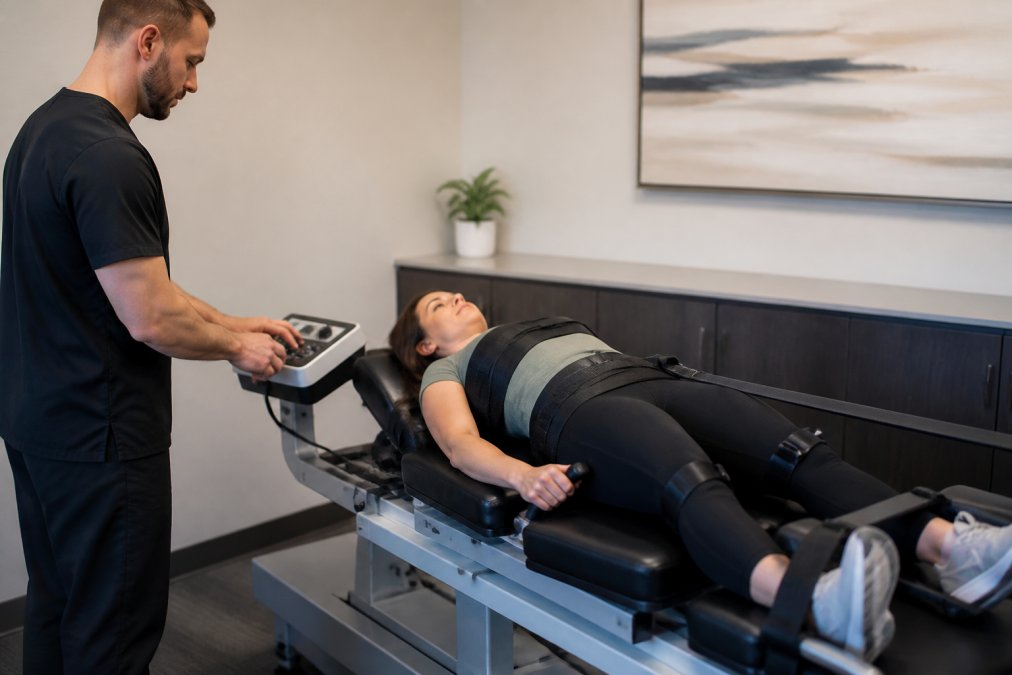
Understanding what spinal decompression actually does, versus what it promises, is essential for making an informed decision about whether this treatment aligns with your specific condition and health goals.
The mechanism behind spinal decompression for chronic back pain centers on reducing intradiscal pressure and promoting healing of damaged nerve roots. When the spine experiences degenerative changes, herniated discs, or spinal stenosis, nerve impingement occurs, triggering pain, numbness, and weakness. The decompression process reverses this by creating a negative pressure gradient that encourages disc material to return to its proper position.
This therapeutic stretching also improves blood circulation to the affected area, delivering oxygen and nutrients necessary for tissue repair, increasing range of motion and reducing neurological symptoms associated with radiculopathy and other nerve compression conditions.
Most patients notice meaningful improvement after 10-15 sessions, as the therapy stimulates the body's own healing response rather than providing temporary symptom masking.
Spinal decompression therapy addresses a range of conditions involving nerve impingement and disc pathology. Herniated discs, where disc material protrudes beyond the vertebral body, respond well to the negative pressure created during treatment. Bulging discs that haven't yet ruptured often show excellent results, as do cases of spinal stenosis where the spinal canal narrows and compresses nerve roots.
Sciatica, facet joint syndrome, degenerative disc disease, and radiculopathy respond well to decompression therapy when nerve compression is the primary driver of pain.
Spinal decompression isn't a one-size-fits-all solution; diagnostic imaging and clinical assessment are essential to determine whether your specific condition will respond to this approach.
| Condition | Primary Cause | Decompression Suitability | Alternative Consideration |
|---|---|---|---|
| Herniated disc | Disc material protrusion | Excellent | Requires confirmed diagnosis |
| Spinal stenosis | Narrowed spinal canal | Very good | May need imaging verification |
| Sciatica | Sciatic nerve compression | Excellent | Address underlying disc issue |
| Facet syndrome | Joint degeneration | Good | May combine with other therapy |
| Degenerative disc disease | Disc deterioration | Good | Long-term management focus |
Typical Treatment Course:
Most patients complete 15-25 sessions over 4-6 weeks, attending two to three times per week. Improvement typically becomes noticeable after 8-12 sessions, though severe stenosis or multiple levels of involvement may require the full course.
Patients often experience initial rapid improvement, followed by a plateau phase where progress appears to stall, then a second phase of improvement as cumulative healing effects compound. Discontinuing during the plateau phase causes patients to miss the secondary improvement window.
Cost and Financial Planning:
Without insurance, spinal decompression typically ranges from $100-$200 per session ($2,000-$4,000 for a full course). Many insurance plans classify it as experimental and deny coverage. Some providers offer package pricing that reduces per-session cost.
Request an itemized cost estimate and contact your insurance provider to determine coverage status, prior authorization requirements, and approved session limits. A complete decompression course typically costs substantially less than surgical intervention (which can exceed $50,000-$100,000).
Post-Treatment Care and the Critical First 4 Weeks:
The first 4 weeks post-treatment are critical; maintaining proper posture, avoiding heavy lifting, and performing prescribed maintenance exercises prevent re-injury and determine whether improvements stick or regress.
Maintenance Exercise Protocol:
Most practitioners recommend a personalized maintenance program of 10-15 minutes daily, 4-5 days per week. Lumbar cases benefit from prone cobra stretches, bird dogs, pelvic tilts, and quadruped rocking. Cervical cases respond to gentle neck isometrics, scapular stabilization, and chin tucks. All cases should include core stabilization and postural awareness training.
Consistency trumps intensity. Patients who maintain exercises for 6-12 months post-treatment report sustained relief, while those who stop after 4-6 weeks often experience symptom return within 3-6 months.
Ergonomic and Lifestyle Modifications:
Proper desk setup, sleeping position, and activity pacing (movement breaks every 30-45 minutes) influence spinal alignment and long-term pain management.
If chronic back pain originated from occupational posture issues, addressing those environmental factors is as important as the therapy itself to prevent symptom recurrence.
Long-Term Outlook:
Patients who complete the full treatment course, perform maintenance exercises consistently, and modify stressful activities typically maintain relief for 6-24 months or longer. Some require annual booster sessions, while others achieve lasting relief without additional treatment.
Surgery physically alters spinal anatomy by removing disc material, bone, or fusing vertebrae. Spinal decompression therapy is non-invasive and reversible, reducing pressure and promoting natural healing without tissue removal.
Surgery offers immediate structural change for severe cases with progressive neurological deficit or cauda equina syndrome, but carries risks including infection, nerve damage, and adjacent segment degeneration. Spinal decompression avoids these risks but requires more time and patient commitment.
Many patients who eventually pursue surgery had not attempted adequate conservative care first, including spinal decompression chronic back pain therapy combined with physical therapy and activity modification. Spinal decompression therapy combined with physical therapy and activity modification resolves the majority of chronic back pain cases without surgical intervention.
The cost structure also differs significantly. Decompression therapy involves multiple sessions over weeks, while surgery is a single event. Insurance coverage varies, and out-of-pocket costs depend on your plan and provider. Discussing financial implications with your healthcare provider ensures you understand the full picture before committing to either path.
Spinal decompression therapy is generally well-tolerated, but it is not appropriate for everyone. Understanding both absolute contraindications (conditions where treatment must be avoided entirely) and relative contraindications (conditions requiring careful evaluation) is essential before beginning therapy.
Absolute Contraindications:
Patients with the following conditions should not undergo spinal decompression therapy:
Relative Contraindications (Require Medical Clearance):
Patients with these conditions may be candidates but need thorough evaluation and physician approval:
Ideal Candidate Profile:
Adults aged 40-75 with documented nerve impingement on imaging (MRI or CT showing disc herniation, stenosis, or nerve root compression), chronic back or neck pain unresponsive to at least 4-6 weeks of conservative care (physical therapy, NSAIDs, activity modification), and realistic expectations about treatment duration tend to see the best results.
Beyond exercise, ergonomic modifications at work and home prevent re-injury. Proper desk setup, monitor height, chair support, and sleeping position all influence spinal alignment and long-term pain management. If your chronic back pain originated from occupational posture issues, addressing those environmental factors is as important as the therapy itself.
Spinal decompression therapy uses motorized traction to gently stretch the spine, creating negative pressure within the intervertebral discs. This reduces pressure on nerves and promotes fluid exchange, allowing herniated or bulging discs to retract. The process improves nerve function and blood flow to affected areas, reducing pain and inflammation associated with chronic back pain conditions like sciatica and spinal stenosis.
Most patients begin experiencing relief within 2-4 weeks of consistent treatment, though full recovery varies by condition severity. Treatment typically involves 15-30 sessions over 4-8 weeks. Recovery time depends on the underlying condition, your age, and adherence to post-treatment maintenance exercises. Some patients see significant improvement within 6 weeks, while others may need 8-12 weeks for substantial pain reduction.
Spinal decompression is generally safe when performed by qualified professionals, with minimal side effects. Some patients experience mild soreness or temporary increased pain initially. However, it is contraindicated for certain conditions including pregnancy, severe osteoporosis, spinal fractures, or metal implants in the spine. Consult a qualified healthcare provider to determine if you're a suitable candidate and discuss any existing health conditions.
Chiropractic spinal decompression is a non-surgical, minimally invasive treatment that avoids the risks and recovery time associated with surgery. While surgical intervention may be necessary for severe cases, spinal decompression therapy offers a conservative approach with fewer complications, shorter recovery periods, and lower costs. Many patients achieve pain relief and improved mobility without surgical intervention, though some conditions may ultimately require surgical evaluation.
Learn more about flexion-distraction therapy at our Montgomery, AL clinic, or book an evaluation.


