

Yoga Poses to Avoid With Chronic Back Pain
Yoga poses to avoid with chronic back pain: Learn which yoga poses aggravate chronic back pain, why they're risky, and safe modifications to keep.
Read More →
Last Updated: August 6, 2026
Poor posture develops from sedentary lifestyles, prolonged desk work, and repetitive strain. When you spend hours hunched over a computer or looking down at a phone, your chest muscles tighten while your back muscles weaken, creating a muscle imbalance that becomes increasingly difficult to correct without intervention.
For those spending long hours sitting at their desks, office posture adjustments offer tailored insights into addressing these specific discomforts and preventing further issues.
Muscle imbalance is often a root cause behind posture-related pain. Your postural muscles, in your neck, shoulders, and lower back, are designed to support your spine against gravity. When underdeveloped or overworked, they can't maintain neutral spine alignment, forcing your vertebral column into compromised positions that compress nerves and irritate soft tissues. Considering postural stress, gentle chiropractic care is highly beneficial for office workers specifically.
For a deeper dive into whether poor posture specifically affects shoulder pain, explore our Can Poor Posture Cause Shoulder Pain? companion post to understand how maintaining spinal health can alleviate related discomfort.
Age, stress, and psychological factors also play significant roles. Stress causes you to unconsciously raise your shoulders and round your thoracic spine, creating a cycle where poor posture increases stress and stress worsens posture.
For those experiencing strain due to desk work, our complementary post on ergonomic desk-setup fixes offers valuable insights into creating a supportive workspace that complements chiropractic care by addressing environmental factors contributing to posture challenges.
The connection between posture and back pain is biomechanical and direct. Your spine's vertebrae are separated by discs that act as shock absorbers. When your posture is poor, your vertebral column shifts out of alignment, placing excessive stress on certain discs and joints.
Forward head posture is particularly damaging. As your head moves forward of neutral, the load on your cervical spine increases substantially — one reason forward head posture is linked to neck and shoulder pain. This is why people with severe forward head posture often experience chronic neck pain radiating into their shoulders and upper back.
Slouching creates similar problems in your lumbar spine. When you collapse your thoracic spine, your pelvis tilts backward and your lower back flattens, straining posterior ligaments and increasing disc pressure. Over time, this leads to disc degeneration, herniation, and chronic lower back pain.
Pain often emerges months or years after poor posture begins because your body has remarkable adaptive capacity. When pain finally emerges, most people don't connect it to their posture. Many practitioners observe that patients with more neutral spinal alignment tend to report less chronic pain, though posture is one of several contributing factors.
Before fixing posture pain, you need an honest assessment of your current alignment. This reveals which muscles are tight, which are weak, and where your spine deviates from neutral.
Start with the wall test. Stand with your back against a wall, heels about six inches away. Your head, shoulders, and buttocks should all touch the wall simultaneously. If your head pulls forward, you have forward head posture. If there's excessive space between your lower back and the wall, your pelvis is tilted. If your shoulders don't touch the wall, you have rounded shoulders.
Next, assess your range of motion. Turn your head slowly to each side, you should rotate about 90 degrees without pain. Bend forward and try to touch your toes; healthy spinal mobility allows most people to reach their shins or toes without bouncing. Check your shoulder positioning by letting your arms hang naturally; your palms should face forward. If they face backward, your shoulders are internally rotated.
Take a side-view photo or video of yourself standing naturally. Draw an imaginary vertical line from your ear through your shoulder, hip, knee, and ankle. In neutral alignment, this line should be relatively straight.
Posture correction exercises target specific muscle imbalances causing your pain. The goal is to strengthen weak muscles while stretching tight ones, gradually restoring balance. Most people need 4-6 weeks of consistent exercise before noticing significant improvement.
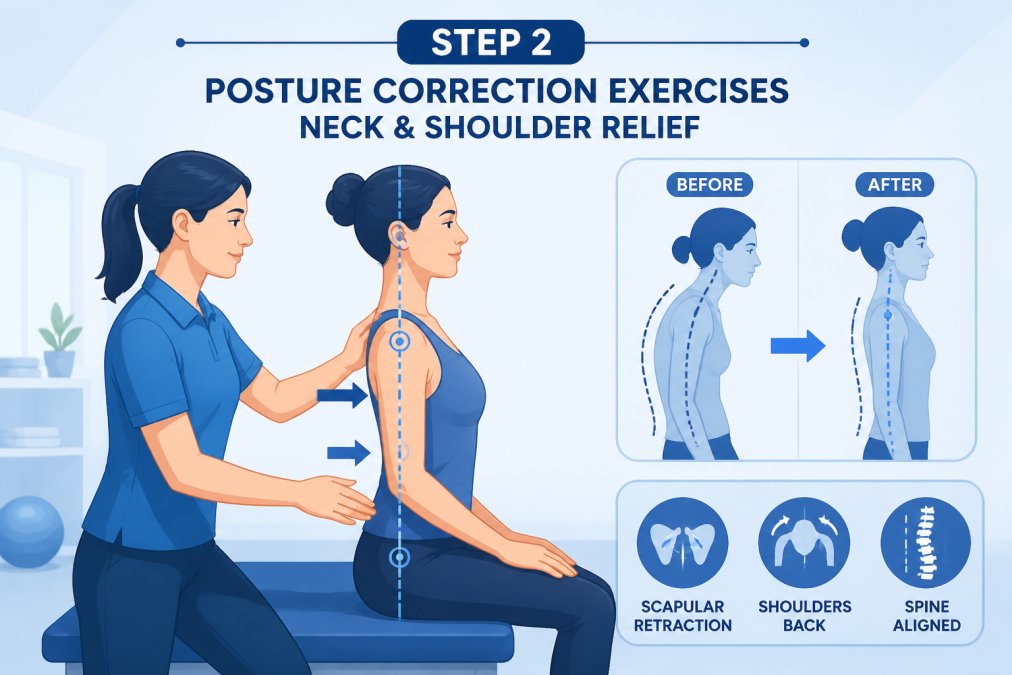
The wall slide exercise corrects scapular positioning directly. Stand with your back against a wall, feet about 12 inches away. Raise your arms to shoulder height with elbows bent 90 degrees. Slowly slide your arms upward along the wall until overhead, keeping your entire arm in contact with the wall. Do 3 sets of 12 repetitions daily.
The prone Y-T-W exercise targets the posterior chain comprehensively. Lie face-down on a bench with your chest hanging off the edge. Form a "Y" by raising your arms overhead at 45 degrees, squeezing your shoulder blades together. Then form a "T" by raising your arms perpendicular to your body, and finally a "W" by bending your elbows at shoulder height. Do 10 repetitions of each position, 3 times per week.
The foam roller thoracic extension exercise restores thoracic mobility. Lie on your back with a foam roller positioned under your mid-back, perpendicular to your spine. Slowly extend backward over the roller, opening your chest toward the ceiling. Spend 2-3 minutes working your entire thoracic spine, 3-4 times per week.
The upper trapezius stretch targets the muscle connecting your neck to your shoulder. Sit upright and drop your right ear toward your right shoulder. Place your right hand on top of your head and apply gentle pressure. Hold for 30 seconds and repeat 3 times daily.
The levator scapulae stretch addresses a muscle running from your upper shoulder blade to your neck. Sit upright and turn your head 45 degrees to the right. Drop your chin toward your chest and place your right hand on the back of your head, applying gentle pressure.
The scalene stretch targets muscles on the sides of your neck. Sit upright and tilt your head to the right, bringing your right ear toward your right shoulder. Rotate your face slightly downward and apply gentle pressure with your right hand.
Your core muscles are the foundation of spinal stability. When weak, your lumbar spine lacks the support needed to maintain neutral alignment, forcing your lower back muscles to work overtime and creating chronic tension and pain.
The dead bug exercise teaches core activation. Lie on your back with your knees bent and feet flat. Raise your arms toward the ceiling. Slowly extend your right leg straight while lowering your left arm overhead. Return to start and repeat on the opposite side. Do 3 sets of 10 repetitions per side, 4-5 times per week.
The bird dog exercise builds functional core strength. Get on your hands and knees with hands under your shoulders and knees under your hips. Slowly extend your right arm forward and left leg backward, creating a straight line. Hold for 2 seconds, keeping your spine neutral and pelvis level. Do 3 sets of 10 repetitions per side.
The plank is perhaps the most effective core exercise for lumbar support. Start in a push-up position with your forearms on the ground, elbows under your shoulders. Your body should form a straight line from head to heels. Engage your core and hold for 30-60 seconds, rest, and repeat 3 times. Do planks 4-5 times per week. We often see patients wondering if can poor posture cause shoulder pain, emphasizing the need for a professional evaluation.
Your work environment directly influences your posture and pain levels. Poor ergonomic desk setup forces your body into compromised positions for 8+ hours daily. Optimizing your workstation is as important as exercise for long-term pain management.
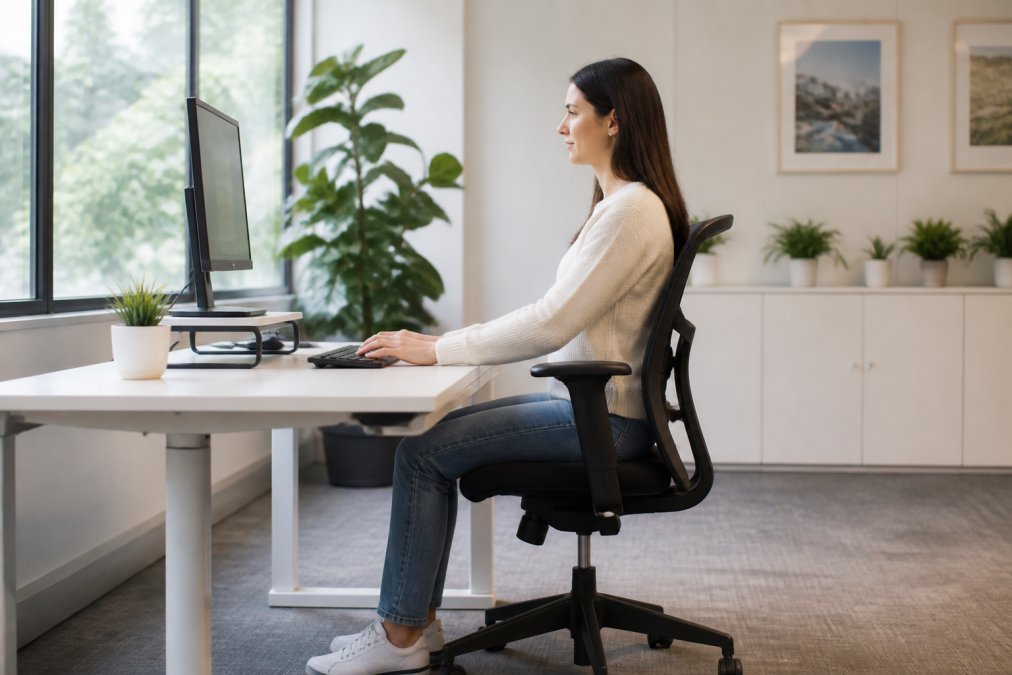
Your monitor height is critical. The top of your screen should be at or slightly below eye level when sitting upright. Position your monitor about an arm's length away, roughly 20-26 inches from your eyes. This reduces eye strain and encourages proper cervical spine alignment.
Your chair height determines pelvic alignment. Sit with your feet flat on the floor; your hips and knees should form 90-degree angles. Your lumbar spine should maintain its natural curve. Use a lumbar support pillow if your chair doesn't provide adequate lower back support.
Your keyboard and mouse position prevent repetitive strain injuries. Your elbows should be at 90 degrees when your hands rest on your keyboard. Your wrists should be neutral, not bent in any direction. Position your keyboard directly in front of you at elbow height, with your mouse at the same height directly beside it.
Take frequent breaks from sitting. Stand up and walk around every 30-60 minutes. Sitting compresses your lumbar discs and tightens your hip flexors, both contributing to lower back pain. Consider a standing desk or sit-stand desk for part of your workday to prevent the postural adaptation that occurs with prolonged sitting.
Fixing posture pain requires conscious attention to your posture throughout the day. Your nervous system has adapted to poor posture over months or years. Breaking this pattern requires deliberate practice until neutral spine alignment becomes your new default.
Postural awareness is the foundation. Throughout the day, periodically check your posture. Set phone reminders every hour if necessary. This accelerates the retraining process significantly.
Strengthen your postural muscles through daily activities. Practice standing against a wall for 5 minutes daily, maintaining contact at your head, shoulders, and buttocks. Walk with conscious attention to posture, imagining a string pulling the top of your head toward the ceiling.
Modify your phone and reading habits. Looking down at your phone creates extreme forward head posture. Bring your phone to eye level instead. When reading, use a book stand or prop your reading material at eye level.
Sleep position affects your posture during waking hours. Avoid sleeping on your stomach. Side sleeping is acceptable if you use a pillow that keeps your neck neutral and place a pillow between your knees. Back sleeping is ideal, use a pillow that supports your cervical curve without lifting your head excessively, and place a pillow under your knees to reduce lumbar stress.
Stay hydrated and maintain good nutrition. Dehydration reduces disc hydration, making your discs more prone to injury. Adequate protein supports muscle repair and growth.
How long does it take to fix posture pain? The answer depends on the severity of your postural deviations, your consistency with exercises, and how long you've maintained poor posture. Most people notice improvement within 2-4 weeks of consistent work. Significant postural correction typically requires 8-12 weeks.
Rounded shoulders respond well to targeted exercise. If you perform scapular retraction and thoracic mobility exercises 4-5 times per week, you should notice visible improvement within 4 weeks.
Forward head posture takes longer to correct because muscles have adapted significantly. Most people need 8-12 weeks to significantly improve forward head posture.
Lower back pain from poor posture responds relatively quickly to core strengthening and ergonomic improvements. Many patients notice meaningful improvement within 3-4 weeks if their pain stems primarily from weak core muscles and poor sitting posture, though results vary.
Postural awareness develops gradually. Initially, you'll need constant conscious effort to maintain good posture. After 6-8 weeks, good posture becomes easier. After 12 weeks, neutral spine alignment becomes your default.
Chronic posture pain often does not resolve without some form of intervention. The good news is that posture pain responds well to targeted exercise, ergonomic adjustment, and conscious postural awareness. A qualified practitioner can assess specific postural deviations, identify which muscles need strengthening versus stretching, and design a program tailored to a situation. If you're struggling with persistent posture-related pain, a professional evaluation can accelerate recovery and ensure proper form on exercises. Get started with an assessment to understand exactly what's driving your pain and develop a concrete plan for relief.
Posture pain can be improved significantly through consistent effort, though the timeline varies. Most people notice changes within 4-6 weeks of regular exercises and ergonomic adjustments. Chronic cases may require longer commitment. The key is addressing both the physical habits and the underlying muscle imbalances. Professional guidance helps accelerate results and prevents setbacks.
Rounded shoulders typically begin to improve within 3-4 weeks of targeted posture correction exercises, though noticeable postural changes often take 8-12 weeks. Consistency matters more than intensity. Daily stretching and strengthening of the thoracic spine and scapular muscles yield faster results. Combining exercises with ergonomic adjustments and postural awareness speeds up the process.
Posture corrector braces can provide temporary relief and remind you to maintain neutral spine alignment, but they are most effective as a short-term tool alongside exercises. Relying solely on braces without strengthening your core and improving flexibility may limit long-term results. Use them as a training aid while building postural awareness and muscle strength.
If pain persists beyond 4-6 weeks despite consistent effort, consult a healthcare professional. Underlying conditions like herniated discs, arthritis, or repetitive strain injuries may require specialized assessment. A qualified practitioner can rule out serious musculoskeletal issues and recommend appropriate treatment, which may include physical therapy or other interventions tailored to your specific condition. Discover personalized care that supports your body's natural healing process; book now to schedule your visit.


