

Ergonomic Desk Setup for Small Spaces: 2026 Guide
Build an ergonomic desk setup for small spaces with exact measurements, monitor arm benefits, and posture pain fixes. Get the fit right in tight rooms.
Read More →
Last Updated: September 16, 2026
The chiropractor vs osteopath difference comes down to training and legal scope: a Doctor of Chiropractic (DC) completes a four-year chiropractic program focused on musculoskeletal adjustment, while a Doctor of Osteopathic Medicine (DO) is a fully licensed physician who can prescribe medication and perform surgery. This guide breaks down training, techniques, insurance coverage, and what actually happens in the treatment room, so you can choose the right practitioner for your back or neck pain.
Both treat musculoskeletal complaints, but sit in different parts of the healthcare system: one specializes in spinal manipulation and joint mechanics, the other is a physician first with manual therapy training. Understanding that split prevents the most common mistake, assuming the two credentials are interchangeable.
| Category | Chiropractor (DC) | Osteopath (DO) |
|---|---|---|
| Credential | Doctor of Chiropractic | Doctor of Osteopathic Medicine |
| Licensed as physician | No | Yes, all states |
| Prescribe medication | No | Yes |
| Perform surgery | No | Yes |
| Core technique | Spinal manipulation, adjustment | Osteopathic manipulative treatment |
| Typical focus | Spine, joints, musculoskeletal | Whole-body medicine plus OMT |
| Best for | Mechanical back and neck pain | Pain plus broader medical needs |
A chiropractor is a licensed healthcare professional who diagnoses and treats musculoskeletal conditions, primarily through spinal manipulation and joint adjustment. Doctors of Chiropractic complete a four-year doctoral program after undergraduate study, with clinical training in biomechanics, neuromusculoskeletal diagnosis, and manual therapy.
Chiropractic care centers on the relationship between spinal alignment and nervous system function. A practitioner assesses range of motion, posture, and joint mobility, then applies a targeted adjustment to restore movement, often alongside soft tissue massage, joint mobilization, and posture correction.
The specialty is narrow by design: a DC does not prescribe medication or perform surgery. That limitation is also the strength, years of focused clinical training in one system of the body.
An osteopath in the United States is a Doctor of Osteopathic Medicine, a fully licensed physician who completed medical school plus residency. DOs practice in every specialty and are licensed in all 50 states.
Osteopathic training includes osteopathic manipulative treatment (OMT), a hands-on system for diagnosing and treating musculoskeletal dysfunction. Not every DO uses OMT, a cardiologist may never perform a manipulation, while a family medicine DO may use it regularly.
The confusion usually comes from outside the country. In many other countries, "osteopath" describes a practitioner who is not a physician and focuses on manual therapy alone; in the United States, the term means a licensed physician. That distinction changes what a visit can include.
The training paths diverge early and never fully converge. A DC enters a chiropractic doctoral program and graduates into a scope limited to musculoskeletal diagnosis and non-surgical, drug-free treatment. A DO enters medical school, completes residency, and graduates with the full scope of a physician.
| Training Element | DC Path | DO Path |
|---|---|---|
| Prerequisite | Undergraduate degree | Undergraduate degree |
| Professional program | 4-year chiropractic doctorate | 4-year medical school |
| Postgraduate | Optional residency | Required residency |
| Licensing exam | National board exams | Comprehensive medical licensing exams |
| Prescription rights | None | Full |
| Surgical rights | None | Full |
Scope of practice is regulated at the state level, so requirements vary. Patients should verify a practitioner's license through the relevant state board before booking. The Federation of State Medical Boards maintains licensing information for physicians, and state chiropractic boards publish DC licensure records.
The practical takeaway: if your problem might need medication, imaging, or a referral into the broader medical system, a DO can handle that in one visit. If it is mechanical and you want a specialist who does one thing well, a DC is built for exactly that.
Chiropractic adjustments for back pain use controlled, high-velocity thrusts to restore joint motion and reduce pain. A typical session may combine spinal manipulation with joint mobilization, soft tissue massage, and home exercises. The goal is improved range of motion and reduced nerve irritation, not a one-time fix.
A common mistake is expecting one visit to resolve years of chronic pain. A treatment plan usually runs several weeks, with frequency tapering as mobility improves; acute injury often responds faster than long-standing degenerative change.
Research on manual therapy for low back pain is mixed but not empty. The National Center for Complementary and Integrative Health summarizes the evidence on spinal manipulation, noting it can help some patients with low back pain while results vary by condition. Evidence-based practice means matching the technique to the diagnosis, not applying the same adjustment to everyone.
Three techniques you will encounter:
Coverage follows the credential, not the technique. Because a DO is a licensed physician, osteopathic visits bill under standard evaluation and management (E/M) codes, the same codes a primary care doctor uses, and OMT is billed as an add-on procedure code. A DO visit is processed like any other physician visit: subject to your deductible, coinsurance, and specialist or primary care copay. If OMT is performed, the practice typically appends the osteopathic manipulative treatment codes (the 98925-98929 series) to the E/M claim.
Chiropractic billing works differently.
What actually drives your out-of-pocket cost:
A first visit with either practitioner follows a recognizable arc: history, examination, hands-on assessment, treatment, and a plan. The differences show up in how long each stage takes and what the practitioner is allowed to do at the end.
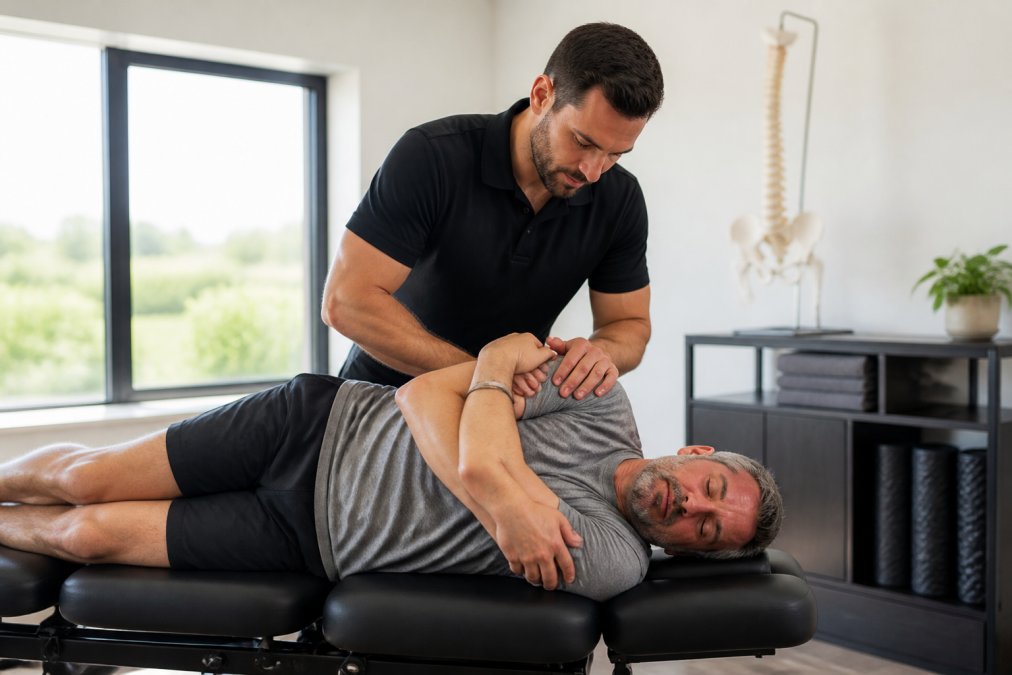
Choose a chiropractor when your problem is mechanical, localized to the spine or joints, and does not require medication or surgery. Choose a DO when you need a physician who can treat the musculoskeletal issue and manage your broader medical care in the same relationship.
A simple decision framework:
It depends on your condition and goals. Chiropractors focus on spinal alignment and joint mobility through manual adjustments, which can help with acute or chronic back and neck pain. Osteopaths take a whole-body approach and can use manual therapy plus medical treatments. For musculoskeletal issues, both may help. Consult a qualified professional to determine which is right for you.
A Doctor of Osteopathic Medicine (D.O.) completes four years of medical school, a residency, and can prescribe medication and perform surgery. A Doctor of Chiropractic (DC) completes a four-year chiropractic program focused on musculoskeletal diagnosis and non-invasive treatment. D.O.s are fully licensed physicians; DCs are not medical doctors but are licensed to practice chiropractic care.
Many insurance plans cover osteopathic manipulative treatment (OMT) when performed by a licensed D.O., but coverage varies by plan and state. Chiropractic care is also often covered, though with visit limits. Check with your specific insurer for details on coverage, copays, and referral requirements before scheduling.
Yes, osteopaths (D.O.s) can perform spinal adjustments as part of osteopathic manipulative treatment (OMT). They use hands-on techniques to improve mobility and reduce pain. However, not all D.O.s practice OMT regularly; some focus on other specialties. If you seek spinal manipulation, ask if the D.O. includes OMT in their practice.
Research suggests both chiropractic adjustments and osteopathic manipulative treatment can reduce chronic back pain, but individual results vary. Chiropractors often specialize in spinal adjustments, while osteopaths may combine manual therapy with other medical approaches. Your outcome depends on the provider's skill, your condition, and your adherence to the treatment plan.


