
Last Updated: October 27, 2026
Quick Summary
Spinal manipulation may help some people, but evidence for preventing chronic migraine specifically is limited. The strongest findings involve headaches that start in the neck, not migraine itself, and most migraine studies are small and short. It is best considered as an adjunct to established prevention rather than a replacement.
- A 2020 review of 7 studies with 601 participants found manipulation may reduce cervicogenic headache.
- Most chronic migraine studies enroll dozens of participants rather than hundreds, making results uncertain.
- Major headache guidelines do not list spinal manipulation as a first-line preventive treatment.
- Track monthly migraine days, attack duration, pain intensity, medication use and disability during care.
- Seek medical evaluation first for sudden severe headache, neurological symptoms, or known spinal instability.
Table of Contents
- What the Research Says About Spinal Manipulation and Migraine
- How Spinal Manipulation May Affect Migraine Frequency and Pain
- Spinal Manipulation vs. Amitriptyline for Migraine Prevention
- Side Effects and Contraindications of Spinal Manipulation
- How Spinal Manipulation Fits Among Migraine Prevention Treatments
- Who May Benefit and How to Track Your Results
- Booking a Consultation to Discuss Your Migraine Options
- Frequently Asked Questions
What the Research Says About Spinal Manipulation and Migraine
Spinal manipulation is a hands-on treatment in which a chiropractor applies a controlled thrust to the joints of the spine. People with chronic migraine often ask whether it can help prevent attacks. The honest answer is that the evidence is promising in some areas and still limited in others, and the quality of that evidence matters as much as the direction of the findings.
Several reviews have examined this question. National Center for Complementary and Integrative Health summary on spinal manipulation is a useful starting point for understanding what the research has and has not shown. The findings are most consistent for headaches that start in the neck, and less clear for chronic migraine specifically. That distinction is not a technicality, it changes what you should expect from care.
Evidence for Cervicogenic Headache
Cervicogenic headache is a headache that originates from problems in the neck. It is a different condition from migraine, though the two can feel similar, and some people have both.
A 2020 review of 7 studies involving 601 participants found that spinal manipulation may reduce the frequency and intensity of cervicogenic headache. NCCIH review of spinal manipulation research reports this finding. Because the studies focused on neck-origin headaches, the result does not directly prove that manipulation prevents chronic migraine.
Evidence Limits for Chronic Migraine
The evidence for chronic migraine is thinner and more uncertain. A 2019 systematic review noted that several small studies suggested spinal manipulation might reduce migraine pain and disability. systematic review and meta-analysis on spinal manipulation and migraine pain describes these studies. The review does not provide a pooled effect size, so the size of any benefit remains uncertain.
Three limitations deserve emphasis:
- Small samples and few trials. Most studies enroll dozens of participants, not hundreds, which makes it easy for chance to look like benefit.
- Short follow-up. Many trials measure outcomes over weeks, not the months or years relevant to chronic migraine prevention.
- Blinding is difficult. Participants usually know whether they received an adjustment, which can inflate reported improvement.
Preliminary evidence is not proof of prevention. A handful of small studies suggesting fewer migraine days is a reason to consider a trial of care and track your own results, not a guarantee that manipulation will prevent your attacks.
What Guidelines and Reviews Actually Say
Major headache guidelines do not list spinal manipulation as a first-line preventive treatment for chronic migraine. Medications, behavioral therapies, and other evidence-based options have larger and more consistent trial bases. At the same time, guidelines generally do not prohibit complementary approaches, and some patients report meaningful relief alongside standard care. The practical takeaway is that manipulation belongs in the conversation as a possible adjunct, not as a replacement for established prevention.
How to Read the Evidence for Yourself
When you encounter a claim about spinal manipulation and migraine, ask:
- Did the study enroll people with migraine, or with cervicogenic or tension-type headache?
- How many participants, and how long were they followed?
- Was there a comparison group, and what did that group receive?
- Did the authors report a pooled effect size, or only individual study results?
A clinician familiar with both headache medicine and manual therapy can help you interpret these details without overstating what is known.
How Spinal Manipulation May Affect Migraine Frequency and Pain
Researchers have proposed several ways manipulation could influence migraine. These include changes in joint mobility, muscle tension in the neck and shoulders, and nerve signaling. These explanations are theories. They have not been firmly established.
Spinal Manipulation vs. Amitriptyline for Migraine Prevention
Amitriptyline is a medication commonly used to prevent migraine. It has a long history of use, and its effects have been studied in many trials. Spinal manipulation has far less direct comparison data.
Because of this gap, the two should not be treated as interchangeable. A clinician can help you weigh the options based on your symptoms, medical history, and goals.
Side Effects and Contraindications of Spinal Manipulation
Spinal manipulation is generally considered low risk when performed by a trained provider. Mild soreness or stiffness after treatment is the most common complaint. Serious adverse events are rare, but they can occur.

Certain conditions make manipulation unsafe or require caution. These include some forms of spinal instability, certain types of fracture, and some vascular conditions. Pregnancy also calls for specific screening. If you notice arm numbness, shoulder-blade pain that spreads, or new neurological symptoms, a clinical evaluation is important to rule out nerve involvement.
How Spinal Manipulation Fits Among Migraine Prevention Treatments
Migraine prevention usually involves a combination of approaches. These may include medication, lifestyle changes such as sleep and hydration, stress management, and physical treatments. Spinal manipulation is one option within this range, not a replacement for established medical care.
Many patients use manipulation alongside their existing treatment plan. Any change should be discussed with the doctor managing your migraines.
Who May Benefit and How to Track Your Results
Response to spinal manipulation varies, and no clinician can promise a specific result. What a good prevention plan can do is identify whether you are a reasonable candidate, set measurable goals, and give you a clear way to decide after a fair trial whether care is helping.
Who Is a Reasonable Candidate
Manipulation may be worth discussing if:
- Your headaches seem to begin in the neck, or neck tension clearly precedes attacks.
- You have restricted neck motion or tenderness on one side.
- You are already under care for chronic migraine and want to add a non-drug option.
- You prefer to try conservative, hands-on care before or alongside medication changes.
It may be less suitable, or require medical evaluation first, if your headaches are primarily driven by factors that have not been ruled out, such as medication overuse, sleep apnea, or a secondary cause.
Red Flags That Call for Medical Evaluation First
Seek prompt evaluation before any manipulation if you have:
- A new or sudden severe headache, especially one that peaks within minutes.
- Headache with fever, stiff neck, rash, confusion, or neurological symptoms such as weakness, numbness, or vision change.
- Headache after head or neck trauma.
- A history of cancer, immune suppression, or unexplained weight loss.
- Known spinal instability, fracture, or a vascular condition affecting the neck.
Cervical manipulation is not appropriate for everyone. A trained provider should screen for these conditions before treatment, and you should disclose all medical history and medications.
What a Clinician-Guided Prevention Plan Looks Like
A sensible plan usually follows four steps:
- Assessment. A clinician reviews your headache history, examines your neck and spine, and confirms whether a neck component is present. This is also when migraine is distinguished from cervicogenic and tension-type headache.
- Trial of care. Treatment is scheduled for a defined period, commonly several weeks, with clear goals agreed in advance, such as reducing monthly migraine days or attack duration.
- Monitoring. You track outcomes consistently (see below) so the decision to continue, adjust, or stop is based on data rather than impression.
- Coordination. Your chiropractor and the clinician managing your migraines should share information. Manipulation is an adjunct to established prevention, not a replacement for it.
How to Track Whether Care Is Helping
Use a simple headache diary and review it every few weeks:
- Migraine days per month. This is the core prevention outcome.
- Attack duration. Note hours from onset to resolution.
- Pain intensity. Rate each attack on a 0 to 10 scale.
- Medication use. Track acute pain relievers and any preventive medications.
- Disability. Note missed work, school, or activities, and use a brief function scale if your clinician provides one.
A common pattern is to compare a four-week baseline before care with each four-week block during care. If migraine days, duration, or disability are not improving after a fair trial, it is reasonable to reconsider the approach.
When to Stop or Reassess
Reassess if attacks are worsening, if new neurological symptoms appear, if you are using acute medications more often, or if you see no meaningful change after the agreed trial period. Stopping care is not a failure, it is the plan working as intended.
Distinguishing migraine from tension-type headache is an important early step. Migraine Headaches vs. Tension Headaches guide from Chiropractic Care Clinic explains the differences in more detail.
The best prevention plan is one you can measure. Agree on goals, track monthly migraine days and disability, coordinate with your migraine clinician, and reassess after a defined trial.
Tracking the right measures makes it easier to tell whether care is actually helping.
| Measure | How to record it | Why it matters |
|---|---|---|
| Migraine days per month | Count days with an attack | Core prevention outcome |
| Attack duration | Hours from onset to resolution | Shows change in attack length |
| Pain intensity | Rate each attack 0 to 10 | Tracks severity over time |
| Medication use | Log acute and preventive drugs | Reveals reliance on relievers |
| Disability | Note missed work, school or activities | Captures functional impact |
Booking a Consultation to Discuss Your Migraine Options
Bring a headache diary and a list of current medications to your first visit. This gives the clinician the information needed to recommend a sensible next step.
Frequently Asked Questions
Can spinal manipulation prevent chronic migraines?
Current research does not establish that spinal manipulation prevents chronic migraines. A 2019 systematic review reported that several small studies suggested possible reductions in migraine pain and disability, but the evidence was limited by study size and quality. A 2020 review by the National Center for Complementary and Integrative Health found that spinal manipulation may reduce the frequency and intensity of cervicogenic headache, which is a different condition. Anyone considering this approach should discuss it with a qualified healthcare professional who can review their medical history.
How many spinal manipulation sessions are needed for migraines?
The research reviewed here does not establish a standard number of sessions for migraine prevention. A qualified clinician can assess your history and explain the expected course of care, including how progress will be measured.
What are the risks of spinal manipulation for migraine?
Spinal manipulation is generally considered low risk when performed by a trained provider, but it is not risk-free. Reported side effects can include temporary soreness, stiffness, and headache after treatment. Rare but serious complications, such as stroke associated with neck manipulation, have been reported in the literature. People with certain conditions, including some forms of osteoporosis, spinal instability, or recent trauma, may need a different approach. Discuss your full medical history with a qualified professional before starting care.
Is spinal manipulation better than medication for migraine prevention?
The available evidence does not show that spinal manipulation is better than medication for migraine prevention. A 2025 systematic review concluded that chiropractic spinal manipulation may be no more effective than alternative interventions for headaches, some of which may be safer. Established preventive medications, such as amitriptyline, have a longer research record for migraine prevention. Decisions about treatment should be made with a physician who can weigh your symptoms, medical history, and preferences.

Learn more about headache care at our Montgomery, AL clinic, or book an evaluation.
Last Updated: October 29, 2026
Quick Summary
Chiropractic care for pediatric migraine management is a non-drug option some families explore, but the evidence is limited. A 2021 randomized trial in children aged 7 to 14 suggested spinal manipulation may reduce headache days, yet the trial covered recurrent headaches broadly, not migraine specifically. Any child with ongoing headaches should first be evaluated by a licensed pediatric provider.
- The 2021 randomized trial enrolled 199 children aged 7 to 14 with recurrent headaches.
- The trial compared spinal manipulation with a sham procedure, not with standard medical care.
- The article does not give the size of the reduction in headache days, so no specific number should be assumed.
- Screen for red flags such as sudden severe headache, fever, stiff neck, or weakness before any adjustment.
- Keep a headache log with date, time, length, and triggers to track whether treatment makes a measurable difference.
Table of Contents
- What Pediatric Migraine and Recurrent Headaches Involve
- What the Research Shows About Chiropractic Care for Children's Headaches
- Pediatric Migraine Treatment Options Beyond Spinal Care
- Chiropractic Adjustment Safety for Children: Risks, Contraindications and Consent
- Non-Drug Migraine Management for Kids: Triggers, Sleep and Tracking
- Pediatric Migraine Prevention and When to See a Doctor First
- Booking Your Child's First Evaluation
- Frequently Asked Questions
What Pediatric Migraine and Recurrent Headaches Involve
Recurrent headaches in children are common, and many families struggle to find a clear explanation for them. A licensed pediatric provider should always evaluate a child with ongoing headaches before any treatment starts. (Source: 2021 randomized controlled trial (RCT) published in JAMA Network Open)
Chiropractic care for pediatric migraine management is one non-drug approach some families explore. This guide explains what the evidence shows, where it is uncertain, and when a doctor should come first.
Migraine-Type Headache Versus Cervicogenic Headache
Migraine-type headaches are primary headaches. They are not caused by a problem in the neck. Cervicogenic headaches, by contrast, start from the neck's joints or soft tissues and refer pain to the head. Telling them apart is the first step in deciding whether neck-focused care is relevant at all.
- Migraine-type headache: Often throbbing, sometimes with nausea or light sensitivity.
- Cervicogenic headache: Usually one-sided, triggered or worsened by neck movement or posture.
- Overlap: Some children have features of both, which is why a full evaluation matters.
What the Research Shows About Chiropractic Care for Children's Headaches
The research on chiropractic care for children's headaches is real but limited, and the single most useful thing a parent can learn is how to read it. Not all studies carry the same weight, and a clinic page that says "studies show" without telling you which kind of study is not giving you enough to decide.
How to Read the Evidence: A Three-Tier Hierarchy
Think of pediatric headache research in three tiers, from weakest to strongest:
- Case reports and case series. These describe one child or a small group who improved. They are useful for spotting possibilities and for illustrating what care looks like, but they cannot show how often the approach works, because there is no comparison group and no control for expectation. A child in a case report might have improved anyway.
- Observational studies. These follow larger groups over time and can show associations, for example, that children receiving spinal care reported fewer headache days. They still cannot prove the care caused the change, because families who seek care differ from those who do not.
- Randomized controlled trials (RCTs). These assign children to real care or a sham/placebo comparison and are the strongest design for separating a true treatment effect from expectation. Even RCTs can be small, short, or narrowly focused, which limits how far their results generalize.
When you read any claim about chiropractic care for pediatric migraine, ask: Which tier is this? How many children? How long? Was there a comparison group? Was the outcome specifically migraine, or headaches in general?
The 2021 Randomized Trial in Children Aged 7 to 14
A randomized trial of chiropractic manipulation versus sham manipulation in children with recurrent headaches enrolled 199 children aged 7 to 14 and compared spinal manipulation with a sham procedure. This is the strongest single piece of pediatric evidence available, and it is worth understanding what it did and did not show.
A later review of treatment-effect modifiers reported that these children had a significant reduction in headache days and a better global perceived effect, according to review of potential effect modifiers for chiropractic manipulation. First, the available summary does not give the size of that reduction, so families should not assume a specific number of headache days saved. Second, the trial enrolled children with recurrent headaches broadly, it does not establish that the results apply specifically to migraine.
What Case Reports Can and Cannot Tell You
These reports are useful for illustration, they show what a coordinated approach can look like in practice, but they cannot show how often the approach works, whether it beats standard care alone, or which children are most likely to benefit. Treat them as anecdotes with clinical detail, not as proof.
The honest summary: there is one moderate-sized randomized trial suggesting spinal manipulation may reduce headache days in children with recurrent headaches, plus supportive but weaker observational and case-level reports. That is enough to justify a cautious conversation with a pediatric provider, not enough to promise a child will improve.
Why the Uncertainty Matters for Your Decision
Limited evidence does not mean "no evidence," and it does not mean chiropractic care is unsafe. It means the expected benefit is uncertain and should be weighed against the time, cost, and disruption of treatment. A reasonable approach is to set a defined trial period, often several weeks, with clear before-and-after tracking (see the tracking guidance below), and to reassess with the pediatrician if there is no measurable change.
The table below summarises the three evidence tiers the article describes, from weakest to strongest.
| Evidence tier | What it shows | Key limitation |
|---|---|---|
| Case reports and case series | One child or a small group who improved | No comparison group; cannot show how often it works |
| Observational studies | Associations, such as fewer headache days in children receiving spinal care | Cannot prove the care caused the change |
| Randomized controlled trials | Separates true treatment effect from expectation | Can be small, short, or narrowly focused |
| 2021 randomized trial (ages 7 to 14) | 199 children; spinal manipulation vs. sham procedure | Enrolled recurrent headaches broadly, not migraine specifically |
Pediatric Migraine Treatment Options Beyond Spinal Care
Spinal care is only one option. Families often combine several approaches under a pediatrician or neurologist.
- Medical evaluation: Confirms the diagnosis and rules out serious causes.
- Lifestyle changes: Regular sleep, hydration, and meal timing.
- Headache diaries: Track frequency, duration, and possible triggers.
Any plan should be discussed with the child's doctor, especially if medication is already in use.
Chiropractic Adjustment Safety for Children: Risks, Contraindications and Consent
Safety is the section parents read most carefully, and it deserves more than "generally low risk." Spinal adjustments in children are considered low risk when a qualified provider performs them after proper screening, but "low risk" is not "no risk," and the details are what let a parent give real informed consent. (Source: American Academy of Pediatrics (AAP) provides guidelines)

What Screening Should Happen Before Any Adjustment
A responsible provider screens before touching the spine. Screening is not a formality, it is the step that separates children who may benefit from gentle care from children who need medical evaluation first. A thorough screen typically includes:
- A full health history, including headache pattern, prior injuries, and any diagnosed conditions.
- A neurological and orthopedic exam checking strength, sensation, reflexes, and neck range of motion.
- Questions about symptoms that suggest a non-musculoskeletal cause (see the red-flag list in the next section).
Contraindications: When Spinal Manipulation Should Wait or Be Avoided
Certain conditions rule out or delay spinal manipulation until a physician has evaluated them. These include:
- Fracture or suspected fracture of the spine or skull.
- Infection involving the spine, joints, or surrounding tissue.
- Certain vascular problems affecting the neck, where manipulation could pose a risk.
If any of these are present or suspected, the correct next step is medical evaluation, not an adjustment. A provider who skips this screening, or who discourages you from seeing a physician, is a reason to pause.
How Technique Differs for Children
Pediatric care is not adult care scaled down. Providers trained in pediatric technique typically use lower-force, lower-velocity methods, spend more time on soft-tissue and mobility work, and may use positioning that keeps the child relaxed and cooperative. Some techniques involve no thrust at all. Ask what specific methods will be used and whether the provider has pediatric-specific training.
Realistic Risks
The most common after-effects are mild and short-lived: temporary soreness, mild fatigue, or a brief increase in headache frequency before things settle. Serious complications are rare but possible, which is exactly why screening and appropriate technique matter. No provider can promise zero risk, and any provider who does should be viewed with caution.
Informed Consent: Questions Parents Should Ask
Informed consent means a parent understands the proposed care, its expected benefits and limits, the alternatives, and the risks, and has had a chance to ask questions. Before agreeing, ask:
- What is the working diagnosis, and how was it reached?
- What specific techniques will be used, and are they adapted for my child's age?
- What are the expected benefits, and how will we measure them?
Chiropractic care should never replace medical diagnosis or emergency evaluation. If a provider is uncomfortable with these questions or pressures you to commit to a long visit package before any reassessment, that is a signal to get a second opinion.
Non-Drug Migraine Management for Kids: Triggers, Sleep and Tracking
Non-drug care works best as part of a broader plan. Many children benefit from simple, consistent habits.
- Keep sleep and wake times steady, including weekends.
- Drink water throughout the day, not just during headaches.
- Eat regular meals to avoid long gaps.
A log gives the doctor concrete data to review. It also shows whether a treatment is making a measurable difference over several weeks.
Pediatric Migraine Prevention and When to See a Doctor First
Some symptoms need prompt medical attention before any chiropractic visit. Seek care right away if a child has a sudden, severe headache, headache with fever, stiff neck, confusion, weakness, numbness, vision changes, trouble speaking, or a headache after a head injury.
A pediatrician or neurologist can check for these red flags and confirm whether migraine is the likely cause. Chiropractic care should never replace that medical assessment.
Booking Your Child's First Evaluation
A first visit usually starts with a health history, a review of the headache log, and a physical exam. The provider should explain findings in plain terms and describe a proposed plan with its goals.
If your child's headaches are recurring, start by sharing your records with the pediatrician. Then ask the chiropractic office to review the same information. Contact the chiropractic provider you are considering to ask about scheduling and what to bring.
Frequently Asked Questions
Can chiropractic care help children with migraines?
A 2021 randomized trial enrolled 199 children aged 7 to 14 with recurrent headaches and compared chiropractic spinal manipulation with sham manipulation. The published excerpts do not give effect sizes, and the evidence has not established a quantified benefit specifically for pediatric migraine. Families should treat chiropractic care as one option to discuss with a physician, not a proven migraine cure, and should confirm the plan with a qualified clinician.
Is chiropractic treatment safe for children with migraines?
Safety depends on the child's history, the type of technique used, and whether the provider performs a proper evaluation first. Before any spinal manipulation, a qualified provider should review medical history, examine the neck and spine, and screen for conditions that make manipulation inappropriate. Parents should ask about the techniques used for their child's age, what side effects are possible, and how consent is documented. Describing care as risk-free is not accurate; the aim is informed consent and clear referral when a child needs medical care.
When should a child with a headache see a doctor?
A child should see a physician promptly for headaches that are sudden and severe, that wake the child from sleep, that worsen steadily, or that come with confusion, weakness, numbness, vision changes, repeated vomiting, fever with a stiff neck, or a head injury. Any new neurological symptom needs medical assessment. Chiropractic care is not a substitute for this evaluation. Families should bring a headache diary to the doctor so the pattern, frequency and triggers can be reviewed.
What should parents expect at a pediatric chiropractic appointment?
Parents considering any provider can ask what a first visit includes, which techniques are proposed and whether they are adapted for children, how many visits are planned, and how progress will be measured. A reputable provider should also explain when the child should be referred back to a physician.
Recurrent headaches in children deserve careful, evidence-based evaluation. Chiropractic care may be one option for some families, but it works best alongside medical guidance, a clear safety review, and steady tracking of results.
Last Updated: October 28, 2026
Quick Summary
No single number of chiropractic sessions fits everyone, and the research does not give one. Visit counts vary widely by condition and individual response, so ask a qualified provider for a schedule with a reassessment date.
- Ongoing chiropractic care users averaged 2.3 visits per month in a 2021 study
- A neck pain evaluation reported an average of 25 visits, with some patients receiving far more
- One low back pain protocol used 18 sessions over six weeks, with 12 spinal manipulative therapy sessions
- Set a measurable target and a review date before starting any plan
- Seek medical care promptly for numbness, weakness, or bladder or bowel changes
Table of Contents
- What the Research Says About Average Visit Counts
- How Often Should You Go to a Chiropractor?
- How Many Chiropractor Visits Before You Feel Better?
- Factors That Change the Number of Chiropractic Sessions
- Building a Chiropractic Treatment Plan You Can Evaluate
- Red Flags for Chiropractors: When to Seek Other Medical Care
- Scheduling Your Next Step With a Qualified Provider
- Frequently Asked Questions
What the Research Says About Average Visit Counts
Most people searching for the average number of chiropractic sessions needed want one clean number. The research does not give one. A 2021 study of people using ongoing chiropractic care found participants averaged Herman et al., visit frequency and outcomes for patients using ongoing chiropractic care 2.3 visits per month. That figure describes ongoing use, not how many sessions it takes to resolve a new problem.
Visit counts also vary a lot from one patient to the next. If you are wondering how many sessions you personally need, see how many chiropractic sessions you need in Montgomery for a local breakdown. The same study noted that visit frequency changed with patient characteristics, including how well a person was functioning. So a single average tells you very little about your own case.
Older critical reviews show the same range. One Edzard Ernst critical evaluation of chiropractic reported an average of 25 visits for neck pain, while noting that a small share of patients received far more. That spread is the real lesson.
- Ongoing care averages differ from short-term treatment courses
- Condition type changes how many visits make sense
- Individual response matters more than any published average
The figures below come from the research cited in this section and show how much visit counts vary.
| Source | Reported figure | What it describes |
|---|---|---|
| Herman et al., 2021 | 2.3 visits per month | Ongoing chiropractic care users |
| Edzard Ernst critical evaluation | 25 visits on average | Neck pain patients |
| Structured low back pain program | 12 sessions most favorable | Spinal manipulative therapy within an 18-session, six-week plan |
How Often Should You Go to a Chiropractor?
Visit frequency varies. A fixed visit count does not apply to every person or condition.
One study of a structured low back pain program scheduled participants for Palmer College of Chiropractic blog on visit counts 18 sessions over six weeks, including 12 spinal manipulative therapy sessions, and reported the most favorable pain reduction with the 12-session approach. Treat that as one data point for one protocol, not a universal rule, the study does not establish that 12 sessions is right for every patient or every condition.
Ask for the schedule in writing, with the phase, the visit count per phase, and the reassessment date. A plan that cannot state when it will be reviewed is a plan you cannot evaluate.
Ask a qualified provider to explain the reasoning for any proposed schedule. Check with your health plan about coverage and any requirements that apply.
Frequency recommendations from a clinic are not the same as clinical guidelines. Ask whether the proposed schedule is based on your exam findings, on a published protocol, or on clinic routine, and whether a shorter trial would answer the same question.
How Many Chiropractor Visits Before You Feel Better?
Individual responses and timelines vary. A qualified professional can discuss expectations in light of an individual assessment.
A practical way to frame it:
Ask a qualified professional what changes, if any, will be assessed and when the plan will be reviewed.
Track Progress With Measures You Can See
Rather than relying on how you feel on a given day, track a few concrete markers and record them the same way at each visit:
- Pain score on a 0-10 scale at the same time of day
- Range of motion for the affected area (for example, how far you can turn your head or bend forward)
- A functional task: distance walked, stairs climbed, or weight lifted without pain
- Days of work or activity missed
- Sleep quality and how often pain wakes you
A qualified professional can discuss whether the plan should be reviewed and what costs may apply.
Set a stopping rule before you start: a specific measure, a target, and a date. If the target is not met by that date, reassess rather than adding visits by default.
If symptoms do not improve, worsen, or change, seek assessment from a qualified medical professional.
Factors That Change the Number of Chiropractic Sessions
Several factors shift how many visits you might need:
Building a Chiropractic Treatment Plan You Can Evaluate
When considering care, ask a qualified professional about goals, reassessment, and what would prompt a change in the plan. To learn how to vet providers, read how to find a qualified chiropractor for injury recovery.

Ask these questions before you agree to a plan:
- What result are we aiming for, and how will we measure it?
- How many visits do you expect in the first month?
- When will we reassess, and what will change the plan?
- What other care or referrals might this condition need?
- What will this cost, and what will insurance cover?
For practical guidance on choosing a qualified provider, see How to find a qualified chiropractor for injury recovery. You can also browse book a chiropractic consultation to compare options near you.
Reassessing Progress With Objective Measures
Track progress with measures you can see, not just how you feel on a given day. Useful examples include range of motion, the distance you can walk or lift, the number of days missed from work, and pain scores recorded the same way each visit.
Review these numbers every few weeks. If they are not moving in the right direction, the plan needs a closer look.
Red Flags for Chiropractors: When to Seek Other Medical Care
Chiropractic care is not the right first step for every symptom. Seek prompt medical attention if you have any of the following:
- Numbness, weakness, or loss of bladder or bowel control
- Severe pain that is getting worse despite treatment
- Fever, unexplained weight loss, or a history of cancer with new back pain
- Pain after a fall, car accident, or other significant trauma
- Symptoms that spread down a limb or affect both sides of the body
If symptoms do not improve or worsen during care, stop and check in with a physician. A chiropractor who is working within their scope should refer you out when needed.
Scheduling Your Next Step With a Qualified Provider
A qualified professional can discuss your history and goals and whether chiropractic care may be appropriate.
Frequently Asked Questions
How often do you have to go to a chiropractor?
There is no single answer. Visit frequency varies, and a published average does not establish how many sessions an individual needs. A qualified professional can discuss an individual situation.
How many chiropractic visits does it usually take to feel better?
Published figures do not establish how many visits an individual needs. A qualified professional can discuss expectations and reassessment.
What are red flags for chiropractors?
This general information does not replace an individual examination by a qualified medical professional.
What should you do if chiropractic care is not helping?
If symptoms do not improve or worsen, seek assessment from a qualified medical professional.
Chiropracticcare.clinic can help you map out visit frequency, set measurable goals, and review progress with a provider who explains each step before you commit.
Learn more about what to expect as a new patient at our Montgomery, AL clinic, or book an evaluation.
Last Updated: October 25, 2026
Quick Summary
The best compact furniture ergonomic home office combines an adjustable chair with seat depth between 16 and 18 inches, a standing desk under 40 inches wide, and built-in storage to eliminate separate cabinets. Pair these with wall-mounted shelves, monitor arms, and proper positioning to support your spine's natural curve while maximizing floor space.
- Ergonomic chairs should have adjustable lumbar support and breathable mesh backs, with seat depth of 16 to 18 inches for compact spaces.
- Electric standing desks under 40 inches wide let you alternate between sitting and standing in 20 to 30 minute intervals.
- Desk height should be 28 to 30 inches with monitors positioned 20 to 26 inches from your eyes at or slightly below eye level.
- Wall-mounted shelves and monitor arms reclaim floor space while keeping frequently used items accessible without consuming desk surface.
- A footrest 4 to 5 inches high stabilizes your pelvis and reduces lower back strain during long work sessions.
Table of Contents
- Why Compact Furniture Matters for Ergonomic Home Offices
- Choosing a Small Space Ergonomic Office Chair
- Compact Standing Desk for Home Office Setup
- Small Home Office Desk with Storage Solutions
- Ergonomic Home Office Setup for Small Spaces
- Essential Accessories for Posture and Comfort in Tight Spaces
- Optimizing Your Compact Workspace Layout
- Setting Up Your Ergonomic Home Office Consultation
- Frequently Asked Questions
Why Compact Furniture Matters for Ergonomic Home Offices
Working from home doesn't mean sacrificing ergonomic support. The solution isn't moving to a larger home, it's choosing the right compact furniture ergonomic home office setup. (Source: a 2022 market analysis)
Space constraints are real. A 2022 market analysis estimated the ergonomic furniture market at USD 9.80 billion, with projections to reach USD 16.88 billion by 2030.
Working from home often leads to poor posture, twisted necks, and lower back strain. The culprit is almost always furniture that doesn't fit the body or the room.
A systematic review of research on sitting and working furniture ergonomics confirms that furniture design influences posture and musculoskeletal stress. The right setup reduces strain. The wrong one compounds it daily.
This guide covers seven categories of compact furniture solutions that deliver ergonomic support without consuming your entire office. We'll focus on measured dimensions, adjustability, and how each piece fits into a functional workspace. For readers dealing with chronic pain, it is recommended to consult a qualified professional to assess specific needs.
Choosing a Small Space Ergonomic Office Chair
Your chair is the foundation. Learn about the best ergonomic office chairs for chronic back pain to find options that address your specific needs. A small space ergonomic office chair must support your spine's natural curve while fitting under your desk and leaving room to move.
WIRED named the Branch Ergonomic Chair Pro its favorite office chair for most people, listing it at $499. That price point sits above budget options but reflects the cost of genuine lumbar support and adjustability. For compact spaces, prioritize these features over a wide seat:
- Seat depth between 16 and 18 inches. This supports your thighs without pressing the back of your knees, which cuts circulation and causes pain during long sitting sessions.
- Adjustable lumbar support. Your lower back needs targeted support at the curve. Fixed lumbar support won't fit everyone; adjustable systems let you dial in your spine's natural shape.
- Breathable mesh back. Mesh prevents heat buildup and allows you to see the chair's structure, making it easier to assess whether it actually supports your posture or just looks supportive.
- Armrests that adjust or remove. Compact desks often lack space for standard armrests. Look for options that fold up, slide inward, or detach entirely.
As Tip Top Furniture guidance on compact ergonomic choices advises, a chair's outside width alone is not enough to determine whether it suits a compact space.
Learn how to adjust office chair for posture after selecting your chair. Proper adjustment is half the battle, many people buy good chairs but never optimize the settings.
Compact Standing Desk for Home Office Setup
Sitting all day strains your spine. A compact standing desk for home office setups lets you alternate positions without eating up floor space. The key is finding one that fits your room's dimensions and your body's proportions.
Look for desks with these traits:
- Footprint under 40 inches wide. This fits against most office walls and leaves room for a chair to roll back.
- Electric adjustment. Manual cranks are cheaper but slow and frustrating. You'll use the desk less if switching positions feels like work.
- Stable at full height. Wobbling while standing undermines posture. Test stability before buying, or read detailed reviews about sway at maximum extension.
Portable or modular standing desks work well for very tight spaces. Some fold or collapse when not in use. Others nest under other furniture.
The real ergonomic win comes from alternating. Stand for 20 to 30 minutes, then sit for 20 to 30 minutes. This rhythm reduces the static strain that causes chronic pain. A compact standing desk makes that rhythm possible in a small room.
Small Home Office Desk with Storage Solutions
A small home office desk with storage eliminates the need for separate filing cabinets or shelving units, freeing up floor space while keeping supplies within arm's reach. This dual function is critical in compact rooms.
Desks designed for small spaces often feature:
- Built-in drawers or shelves below the work surface. These keep items close without cluttering your desk top, which reduces reaching and twisting.
- Vertical storage above the desk. Wall-mounted shelves or hutch-style tops let you store frequently used items at eye level, minimizing the need to stand and hunt.
- Cable management channels. Wires tangled under a small desk create tripping hazards and make adjustments harder. Built-in channels keep cables organized and out of sight.
Corner desks maximize unused space in many rooms. L-shaped designs give you more work surface without increasing the footprint. Just ensure the corner placement doesn't force you to twist your torso to reach your monitor or keyboard, that's a posture trap.
Depth matters more than width in compact spaces. A desk that's 24 inches deep is often sufficient for a monitor and keyboard, whereas one that's 30 inches deep eats into your room. Measure your space first, then choose accordingly.
Ergonomic Home Office Setup for Small Spaces
Putting the pieces together requires a plan. Compact furniture ergonomic home office design isn't just about individual items, it's about how they work together to support your posture and movement.
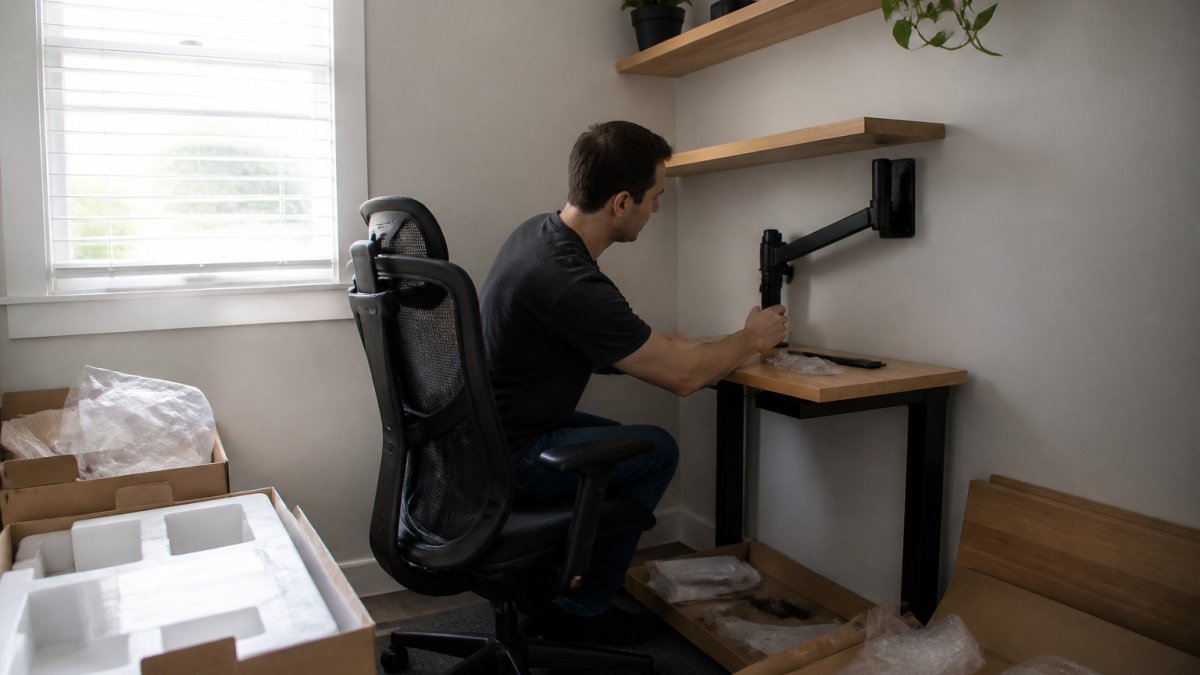
Start by measuring your room and your body. Chair seat height, desk height, monitor distance, and keyboard position all interact. If your chair is too high or too low, even the best desk won't help. If your monitor is too far away, you'll lean forward to see it, straining your neck.
The basic formula:
- Desk height: 28 to 30 inches for most people. Your elbows should bend at roughly 90 degrees when your hands rest on the keyboard.
- Monitor distance: 20 to 26 inches from your eyes. The top of the screen should be at or slightly below eye level.
- Chair height: Adjust so your feet rest flat on the floor or a footrest, and your thighs are parallel to the ground.
Vertical Storage and Wall-Mounted Options
Vertical space is your secret weapon in a compact room. Wall-mounted shelves, pegboards, and floating desks reclaim floor space and reduce visual clutter, which also reduces mental strain.
Install shelves above your desk for reference books, supplies, and equipment you use daily. Mount your monitor on an adjustable arm rather than placing it on a stand, this frees up desk space and lets you angle the screen to reduce glare and neck strain. (Source: a systematic review of research on sitting and working furniture ergonomics)
Pegboards work well for frequently used items like headphones, cables, and notepads. They're adjustable, so you can rearrange as your needs change. Over time, you'll refine what works best for your workflow.
Multi-Functional Furniture and Modular Seating
When square footage is limited, every piece should earn its place. Multi-functional furniture does double duty without doubling your footprint.
A desk with integrated storage is one example. A filing cabinet that doubles as a side table is another. Modular seating, like ottomans or small benches that tuck under desks, provides extra seating for guests without permanent floor space commitment.
Look for items that nest, fold, or stack. A rolling cart stores supplies and moves where needed. A small stool becomes a footrest during work and extra seating during calls. This flexibility is what separates a functional compact office from a cramped one.
Essential Accessories for Posture and Comfort in Tight Spaces
Your furniture foundation is solid. Now add targeted accessories that fine-tune your setup and protect your spine during long work sessions.
A footrest keeps your feet flat and supported, which stabilizes your pelvis and reduces lower back strain.
A monitor arm mounts your screen at the correct distance and height, preventing neck strain from looking down or reaching forward.
A keyboard tray keeps your wrists neutral and your elbows at the right angle. If your desk is too high or too low, a keyboard tray bridges the gap.
An external keyboard and mouse are non-negotiable if you use a laptop. Laptop screens force you to look down and hunch forward, a recipe for neck and shoulder pain.
Lighting matters too.
Optimizing Your Compact Workspace Layout
Layout determines whether your furniture actually works together or works against you. A well-arranged compact office feels spacious and supports movement.
Position your desk perpendicular to windows when possible. This reduces glare on your monitor and lets you look out periodically, which rests your eyes and breaks up static posture.
Leave walking space. You need at least 24 inches of clearance to move your chair back and stand up.
Cable management isn't just aesthetic, it's functional. Tangled cables catch your feet, snag your chair wheels, and make adjustments harder.
Noise and distractions compound physical strain. If you share your space with others or live in a noisy area, add acoustic panels or soft furnishings to absorb sound.
Setting Up Your Ergonomic Home Office Consultation
You've assembled the pieces. Now make sure they're optimized for your body. Every spine is different. What works for your colleague might create problems for you.
A professional assessment can help identify issues. Book a chiropractic consultation online to get personalized guidance on your compact workspace setup.
Research on sitting and working furniture ergonomics emphasizes that furniture design alone doesn't guarantee good ergonomics, how you use the furniture matters equally.
Consult a qualified professional to assess your compact workspace and get personalized recommendations.
Building an ergonomic home office in a small space is achievable. It requires intentional choices about furniture, layout, and accessories, but the payoff is a workspace that supports your health instead of undermining it.
| Furniture Category | Key Feature | Best For Compact Spaces | Typical Footprint |
|---|---|---|---|
| Ergonomic Office Chair | Adjustable lumbar support | Under 26" seat width | 24-28" wide |
| Compact Standing Desk | Electric height adjustment | Desks under 40" wide | 36-40" wide |
| Small Desk with Storage | Built-in drawers or shelves | Eliminates need for cabinets | 48-60" wide |
| Wall-Mounted Shelves | Vertical storage | Frees floor space | 12-24" deep |
| Monitor Arm | Adjustable positioning | Reduces desk clutter | Mounts to wall or desk |
| Footrest | Neutral foot support | Stabilizes posture | 18-24" wide |
Frequently Asked Questions
Can a small desk still be ergonomic?
Yes. A small desk can be ergonomic if it positions your monitor at eye level, keeps your keyboard and mouse at elbow height, and provides enough surface area for your primary work tasks. The key is adjustability and proper placement of accessories like monitor arms and keyboard trays. Compact furniture for ergonomic home offices prioritizes these alignment factors over overall size.
What should I look for in a compact ergonomic office chair?
Look for a small space ergonomic office chair with lumbar support, breathable mesh or fabric, adjustable seat height, and a base small enough for your room. Ensure the seat depth fits your thigh length without pressing into the back of your knees. Armrests should be adjustable or removable to save space while supporting your arms at desk height. Test the chair's swivel and mobility to confirm it doesn't obstruct doorways or pathways.
How do I maximize vertical space in a small home office?
Use wall-mounted shelves above your desk for storage and keep frequently used items within arm's reach. Install a monitor arm to free up desk surface area. Add floating shelves or wall-mounted filing systems to store documents and supplies without consuming floor space. Vertical storage reduces clutter, improves your ergonomic home office setup for small spaces, and creates a more functional workspace.
Is a standing desk practical for a compact home office?
A compact standing desk for home office use can work well if it has a small footprint and adjusts smoothly between sitting and standing heights. Look for models with cable management built in and a surface large enough for your monitor and keyboard. Alternating between sitting and standing reduces static posture strain and can improve circulation, though a quality chair remains essential for seated work periods.
Learn more about back pain care at our Montgomery, AL clinic, or book an evaluation.
Last Updated: October 22, 2026
Quick Summary
Vitamin D deficiency chronic pain shows strong statistical association in large populations, but clinical evidence reveals supplementation produces mixed results for pain relief. Low vitamin D may contribute to pain through effects on neuromuscular function, yet correcting deficiency doesn't automatically resolve chronic pain in individual patients.
- A 2024 study of 349,221 adults found severe vitamin D deficiency significantly linked to chronic widespread pain after adjusting for confounding factors.
- Clinical trials show roughly half of patients with documented deficiency see pain improvement after supplementation, while the other half see little to no change.
- Vitamin D deficiency below 20 ng/mL impairs muscle contraction efficiency and increases pain sensitivity, but association does not equal causation.
- Testing for vitamin D deficiency is recommended for chronic pain patients, but supplementation requires 8-12 weeks to evaluate effectiveness and professional guidance.
- Chronic pain typically involves multiple factors; vitamin D status may be one contributing element among structural, neurological, and inflammatory causes.
Table of Contents
- Understanding the Connection Between Vitamin D Deficiency and Chronic Pain
- How Vitamin D Deficiency Symptoms Manifest in Pain Conditions
- Association vs. Causation: What Research Actually Tells Us
- Getting a Vitamin D Test for Deficiency
- Vitamin D Supplements for Chronic Pain: Evidence and Expectations
- When to Seek Professional Evaluation
- Conclusion
- Frequently Asked Questions
Understanding the Connection Between Vitamin D Deficiency and Chronic Pain
Vitamin D deficiency chronic pain represents one of the most studied yet misunderstood connections in modern pain management. A cross-sectional study of 349,221 adults found that severe vitamin D deficiency remained significantly linked to chronic widespread pain after adjustment for confounding factors, yet the relationship between low vitamin D and pain intensity remains far more complex than headlines suggest.
The evidence shows clear associations, but what most patients don't realize is that association and causation are entirely different things. You can have vitamin D deficiency and chronic pain simultaneously without one causing the other. Understanding this distinction changes how you approach testing, supplementation, and treatment expectations.
The role of vitamin D in bone and muscle health is well-documented. Your muscles require adequate vitamin D for proper neuromuscular function. Your skeletal system depends on vitamin D to regulate calcium absorption.
Association does not equal causation. Vitamin D deficiency correlates with chronic pain in large populations, but supplementation doesn't reliably reverse pain in individual patients.
How Vitamin D Deficiency Symptoms Manifest in Pain Conditions
Vitamin D deficiency symptoms vary widely, and pain is just one manifestation among many. Low serum vitamin D levels affect your neuromuscular function, pain sensitivity threshold, and how your body processes inflammatory signals. The question isn't whether deficiency can contribute to pain, it's whether it's your pain.
Musculoskeletal Pain and Weakness
Muscle pain and muscle weakness represent the most common pain-related complaints associated with vitamin D deficiency. When your serum vitamin D drops below 20 ng/mL, your muscles lose their ability to contract efficiently. This doesn't necessarily mean you'll develop chronic pain, but it does mean your pain sensitivity increases and your recovery from injury slows.
Patients with low vitamin D often report diffuse muscle aches that worsen with activity. The pain typically affects large muscle groups, your back, shoulders, and legs. What complicates diagnosis is that this same pattern appears in dozens of other conditions: fibromyalgia, autoimmune disorders, thyroid dysfunction, and simple deconditioning.
The muscle weakness associated with deficiency is measurable and real. Studies show that correcting deficiency improves neuromuscular function. But improved function doesn't always translate to pain relief, especially if your pain has been present for years and other structural or neurological factors are at play.
Chronic Widespread Pain
Chronic widespread pain, pain affecting multiple body regions for more than three months, shows stronger statistical association with vitamin D insufficiency than localized pain does. The 2024 study of 349,221 adults found this connection held even after researchers adjusted for confounding factors like age, BMI, and physical activity levels.
Yet here's what the research also emphasizes: evidence does not establish vitamin D supplementation as an effective treatment for chronic pain. This distinction matters enormously. An association in a large population study doesn't predict individual response to treatment. Some patients with deficiency-related widespread pain improve dramatically with supplementation. Others see no change.
The pain sensitivity threshold, how much stimulus it takes to trigger pain signals, appears lower in people with vitamin D deficiency. Your nervous system becomes more reactive. This explains why deficiency might worsen existing pain conditions, but it doesn't explain why correcting the deficiency fails to resolve pain in many patients.
Widespread pain with low vitamin D doesn't automatically mean supplementation will help. Mixed results in clinical studies show that roughly half of patients with documented deficiency see pain improvement after supplementation, while the other half see little to no change.
Association vs. Causation: What Research Actually Tells Us
This is the part most guides get wrong, and it's critical for setting realistic expectations about testing and treatment.
The research data shows clear associations. Vitamin D deficiency correlates with increased pain intensity. Low vitamin D associates with higher rates of chronic pain development. These statistical relationships are real and reproducible across large populations.
Consider what a cross-sectional study actually measures: it captures vitamin D levels and pain reports at a single point in time, then looks for patterns. If people with low vitamin D report more pain, that's an association. But that same pattern could exist because:
- Chronic pain causes people to stay indoors, reducing sun exposure and lowering vitamin D
- An underlying inflammatory condition causes both low vitamin D and pain
- Sedentary behavior from pain leads to lower vitamin D and worse musculoskeletal function
- The two conditions are completely unrelated in that particular person
Clinical trials testing supplementation tell a different story than population studies. Clinical studies of vitamin D supplementation in people with known deficiency have produced mixed results for pain improvement. Some patients improve. Many don't.
This is why testing makes sense, but supplementation without baseline testing and monitoring doesn't. You need to know your actual vitamin D status. You need realistic expectations about what correction might achieve.
Getting a Vitamin D Test for Deficiency
Testing for vitamin D deficiency is straightforward, but interpreting results requires context.
The standard test measures serum 25-hydroxyvitamin D, often called 25(OH)D. This is the storage form of vitamin D in your blood, and it's what clinicians use to assess your vitamin D status.

Reference ranges vary slightly between labs, but most use these benchmarks:
- Below 20 ng/mL: Deficiency
- 20-29 ng/mL: Insufficiency
- 30-100 ng/mL: Sufficient
- Above 100 ng/mL: Potentially excessive
If your test shows deficiency or insufficiency, the next step isn't automatic supplementation, it's understanding why your level is low. Dietary intake, sun exposure, skin tone, age, and certain medical conditions all affect vitamin D status.
When you bring low vitamin D results to your healthcare provider, ask these questions: Is this deficiency causing my pain, or is something else? What's the timeline for improvement if I supplement?
Vitamin D Supplements for Chronic Pain: Evidence and Expectations
If your vitamin D is low and you have chronic pain, supplementation seems logical. The evidence, however, doesn't support the straightforward "low vitamin D causes pain, so supplementing fixes pain" narrative.
Vitamin D supplements come in two forms: D2 (ergocalciferol) and D3 (cholecalciferol). D3 is more effective at raising serum vitamin D levels. Standard supplementation ranges from 1,000 IU daily for maintenance to 4,000-10,000 IU daily for correcting deficiency, though some protocols use higher doses temporarily.
The critical finding from clinical research: correcting vitamin D deficiency improves your vitamin D status. A 2015 review examining clinical evidence concluded that supplementation studies in patients with known vitamin D deficiency had mixed results for improving chronic pain.
Why? Because pain is multifactorial. If your pain stems primarily from vitamin D deficiency affecting neuromuscular function, supplementation helps. If your pain stems from structural damage, nerve sensitization, or inflammatory conditions unrelated to vitamin D, supplementation won't touch it.
This doesn't mean supplementation is pointless. If you're deficient, correcting the deficiency improves your musculoskeletal health, bone density, and immune function, all worthwhile outcomes independent of pain relief. But approaching supplementation as a pain treatment is setting yourself up for disappointment.
If you supplement for vitamin D deficiency, give it 8-12 weeks before evaluating whether it's helping your pain. Changes in pain sensitivity occur gradually. Keep a simple log of pain intensity and activity level to track whether supplementation correlates with actual improvement in your specific situation.
| Supplementation Scenario | Realistic Expectation | Timeline |
|---|---|---|
| Correcting documented deficiency | Improved musculoskeletal function, variable pain relief | 8-12 weeks |
| Chronic pain with normal vitamin D | Minimal pain benefit from supplementation | N/A, not indicated |
| Acute pain with low vitamin D | Deficiency correction may help recovery | 6-12 weeks |
| Widespread pain with insufficiency | Mixed results; improvement possible but not guaranteed | 12+ weeks |
When to Seek Professional Evaluation
Chronic pain warrants professional assessment regardless of your vitamin D status. The question isn't whether to see someone, it's who and when.
If you've had chronic pain for months without diagnosis, vitamin D testing is reasonable. Low vitamin D is easy to correct, and it's one variable you can control. But testing alone doesn't solve chronic pain.
Red flags that require urgent professional evaluation:
- Pain accompanied by fever, unexplained weight loss, or night sweats
- Pain following trauma or injury that isn't improving
- Pain with progressive neurological symptoms (numbness, weakness, loss of function)
- Pain severe enough to interfere with basic daily activities or sleep
- Pain that doesn't fit typical patterns or changes significantly over short periods
Vitamin D deficiency doesn't cause these presentations. If these symptoms are present, vitamin D testing is secondary to more urgent diagnostic work.
For chronic musculoskeletal pain without red flags, a systematic approach works: document your pain patterns, get baseline vitamin D testing, assess your current activity and sun exposure, and work with a qualified provider to address modifiable factors.
A qualified healthcare provider can help patients distinguish between vitamin D deficiency as a primary pain driver versus one factor in a complex pain picture. This clarity changes your treatment approach and sets realistic expectations for improvement.
Conclusion
The connection between vitamin D deficiency and chronic pain is real but more nuanced than most discussions suggest. Large population studies show clear associations, yet clinical evidence reveals that supplementation produces mixed results. Testing for vitamin D deficiency makes sense if you have chronic pain, but correcting a deficiency doesn't automatically resolve pain. Your chronic pain likely involves multiple factors, structural, neurological, inflammatory, and behavioral. Vitamin D status may be one. A qualified healthcare provider can help you determine whether it's yours. A comprehensive approach to chronic pain often includes assessing vitamin D status alongside structural evaluation, movement patterns, and your complete medical picture to develop a treatment plan tailored to your actual pain drivers.
Frequently Asked Questions
Can vitamin D deficiency cause chronic pain?
Research shows an association between severe vitamin D deficiency and chronic widespread pain in observational studies. A 2024 study of 349,221 adults found this link remained significant even after accounting for confounding factors. However, association does not prove deficiency causes pain. Clinical trials of vitamin D supplementation in people with known deficiency have produced mixed results, and a 2017 review found no concrete evidence that supplementation effectively treats chronic pain. If you have chronic pain, testing your vitamin D status is reasonable, but supplementation alone may not resolve pain.
What types of pain are associated with low vitamin D?
Low vitamin D has been linked to musculoskeletal pain (bone and muscle pain), chronic widespread pain, muscle weakness, and pain sensitivity. Some research suggests it may relate to neuropathic pain and the transition from acute to chronic pain after surgery. However, many other factors cause these pain types, so vitamin D status is one consideration among many in understanding your pain.
How is vitamin D deficiency diagnosed?
Vitamin D deficiency is diagnosed through a blood test measuring 25-hydroxyvitamin D (serum vitamin D). Your healthcare provider typically orders this test if you have symptoms suggesting deficiency or risk factors like limited sun exposure, dietary restrictions, or chronic pain. Results are interpreted as: sufficient (generally above 30 ng/mL), insufficient (20-29 ng/mL), or deficient (below 20 ng/mL). If you have chronic pain and suspect low vitamin D, ask your doctor whether testing makes sense for your situation.
Can vitamin D supplements help with chronic pain?
Evidence is mixed. A 2015 review of clinical studies found that vitamin D supplementation in people with known deficiency produced mixed results for pain improvement. A 2017 review concluded there is no concrete evidence that supplementation effectively treats chronic pain. If you have confirmed vitamin D deficiency, correcting it is important for bone and muscle health, but supplementation alone may not resolve chronic pain. Work with your healthcare provider to address vitamin D status as part of a broader pain management plan.
Learn more about our full range of services at our Montgomery, AL clinic, or book an evaluation.
Table of Contents
- How Spinal Misalignment May Contribute to Tension Migraines
- Cervicogenic Headache Symptoms and How They Differ
- Tension Headache Causes: The Role of Cervical Alignment
- Distinguishing Migraines, Tension Headaches, and Cervicogenic Headaches
- Headache Red Flags: When to Seek Urgent Care
- How to Relieve Tension Headaches: Evidence-Based Approaches
- What the Evidence Actually Shows
- Realistic Expectations and Next Steps
- Frequently Asked Questions
Last Updated: October 20, 2026
How Spinal Misalignment May Contribute to Tension Migraines
Can spinal misalignment cause tension migraines? Misalignment in the cervical spine (your neck) can trigger muscle tension, nerve irritation, and postural strain that contribute to recurring headaches and migraines. Understanding the mechanism helps you know whether it's your actual problem. (Source: the National Institute of Neurological Disorders and Stroke (NINDS))
The cervical spine supports your head and coordinates movement between your neck and shoulders. When vertebrae shift out of alignment, surrounding muscles, ligaments, and nerves tighten and inflame. This cascade, misalignment triggers muscle tension, which restricts blood flow and irritates nerves, producing headache pain, explains the connection.
But here's what most guides miss: not all headaches that happen alongside neck problems are caused by the neck. Distinguishing a true cervicogenic headache (originating from the spine and supporting structures) from a tension-type headache or migraine that happens to coexist with neck issues is critical.
Neck Muscles and Postural Strain
Your neck muscles work constantly to hold your head upright.
Poor posture amplifies this. Hours with your head forward (common with desk work and phone use) pull the cervical spine out of alignment while overloading neck and upper back muscles, and the pattern becomes chronic.
A common mistake is assuming that stretching alone fixes this. Stretching helps temporarily, but if the underlying spinal misalignment remains, the muscles simply tighten again. The supporting structures need to be repositioned first.
Nerve Irritation and Blood Flow Changes
Misaligned vertebrae can compress or irritate nerves passing through the cervical spine, which carry signals to and from your head, neck, and shoulders.
Misalignment also affects blood vessels alongside the spine. Restricted blood flow reduces oxygen to muscles and nerve tissue, increasing pain sensitivity and slowing recovery, which is why headaches often feel worse when you're tired or stressed, since those conditions further tighten muscles and reduce circulation.
This blood flow relationship explains why some people report relief after an adjustment: realigning the vertebrae can release nerve compression and restore normal blood flow, potentially reducing headache intensity.
Cervicogenic Headache Symptoms and How They Differ
A cervicogenic headache originates from the cervical spine and supporting structures. Its symptoms help you know whether your migraines or tension headaches are actually cervicogenic.
Cervicogenic headaches typically present with these characteristics:
- Pain on one side of the head (often the same side as the neck misalignment)
- Pain that starts in the neck and radiates upward toward the temples or back of the head
- Reduced neck movement or stiffness, especially when turning or tilting your head
- Pain that worsens with prolonged neck positions (like looking down at a phone)
- Muscle tightness in the neck, shoulders, or upper back
- Pain that improves temporarily after neck massage or adjustment
The pain is usually a dull ache or pressure rather than throbbing, often worse in the morning or after neck-straining activities.
What distinguishes cervicogenic headaches is their mechanical trigger: pain directly linked to neck position or movement. If your headache improves when you rest your neck or change positions, the cervical spine is likely involved.
Tension Headache Causes: The Role of Cervical Alignment
Tension-type headaches, the most common headache type, produce a tight, pressing sensation across the forehead, temples, or back of the head, often described as a band of pressure.
Misalignment disrupts the normal resting length of neck muscles, which stay partially contracted even at rest.
Tension headaches linked to cervical misalignment typically:
- Feel like a band of pressure around the head
- Develop gradually through the day, especially after work or prolonged neck strain
- Improve temporarily with rest or neck movement
- Coexist with neck stiffness or shoulder tension
- Worsen with poor posture or stress (which tightens muscles further)
The distinction matters: tension headaches caused by stress alone respond differently than those caused by misalignment. If yours persist despite stress management, the cervical spine may be the actual problem.
Distinguishing Migraines, Tension Headaches, and Cervicogenic Headaches
Many people use "migraine," "tension headache," and "cervicogenic headache" interchangeably, but they're distinct conditions with different causes and treatments. Knowing which type you have is essential.
Migraines are neurological events with intense, throbbing pain, often one-sided, sometimes with light, sound, or nausea sensitivity.
Tension-type headaches produce a pressing, band-like sensation, usually bilateral and gradual, most commonly caused by muscle tension, stress, and poor posture, including posture problems caused by spinal misalignment.
A key difference: migraines and tension headaches can occur without any neck involvement, while cervicogenic headaches by definition involve the cervical spine.
| Headache Type | Pain Character | Location | Triggers | Neck Connection |
|---|---|---|---|---|
| Migraine | Throbbing, intense | One side, temples | Stress, hormones, foods | Indirect (irritation can trigger) |
| Tension-type | Pressing, band-like | Both sides, forehead/temples | Stress, muscle tension | Often involved (posture, misalignment) |
| Cervicogenic | Dull, radiating | One side, neck to head | Neck position, movement | Direct (originates from spine) |
Headache Red Flags: When to Seek Urgent Care
Most headaches linked to spinal misalignment are manageable with appropriate treatment, but certain patterns require immediate medical evaluation. (Source: the American Migraine Foundation)
Seek urgent care if you experience:
- A sudden, severe headache unlike any you've had before (worst headache of your life)
- Headaches accompanied by fever, stiff neck, confusion, or difficulty speaking (the CDC)
- Headaches with vision changes, weakness, numbness, or loss of coordination
- A headache that worsens despite treatment or changes in pattern
- Headaches after a head injury or trauma
- Headaches with persistent vomiting or inability to keep food down
- New headaches in people over 50 with no prior headache history
These symptoms can indicate meningitis, stroke, or other serious neurological issues requiring immediate medical attention, not chiropractic care.
Additionally, if you have severe neck pain with headaches, especially after trauma, get evaluated by a physician before pursuing spinal manipulation. Certain neck injuries contraindicate adjustment and require different treatment.
How to Relieve Tension Headaches: Evidence-Based Approaches
Relieving tension headaches caused by spinal misalignment requires a multi-step approach combining postural correction, muscle rehabilitation, and professional spinal alignment.
Posture and Ergonomic Adjustments
Your posture directly affects cervical alignment. Forward head posture, head sitting forward of your shoulders, is one of the most common contributors to neck misalignment and headaches.
Start by evaluating your work setup:
- Monitor height: Position your screen at eye level, about arm's length away. Your eyes should look slightly downward at the center of the screen, not up or down significantly.
- Chair support: Use a chair that supports the natural curve of your lower back. Your feet should rest flat on the floor or footrest.
- Keyboard and mouse: Keep them at elbow height so your shoulders stay relaxed.
- Phone use: Avoid cradling your phone between your ear and shoulder. Use a headset or speaker instead.
- Frequent position changes: Shift positions every 30 minutes. Stand, stretch, or walk briefly.

Throughout the day, when you notice your head drifting forward, gently pull your chin back and straighten your neck. This conscious correction, repeated daily, gradually retrains your posture.
Neck Muscle Strengthening and Flexibility
Weak neck muscles can't support the cervical spine properly, allowing misalignment to develop or worsen. Strengthening them while improving flexibility creates stability and reduces tension.
Basic neck exercises you can do at home:
- Neck isometric holds: Place your hand against the side of your head. Press your head into your hand without moving your neck. Hold for 5 seconds. Repeat on all four sides (left, right, forward, backward). Do 3 sets of 10 repetitions daily.
- Neck stretches: Gently tilt your head toward each shoulder, holding for 20-30 seconds. Repeat on both sides, 2-3 times daily.
- Shoulder rolls: Roll your shoulders backward slowly, 10 times. This releases upper back and neck tension.
- Chin tucks: Sit upright and gently pull your chin straight back, creating a slight double-chin appearance. Hold for 3 seconds. Repeat 10 times, 2-3 times daily.
Start with gentle movements. If any exercise increases your headache pain, stop and consult a healthcare provider. Consistency matters more than intensity, 5-10 minutes of daily exercise produces better results than occasional intense sessions.
Professional Spinal Adjustment and Manipulation
When misalignment is present, self-care alone often isn't sufficient. Professional spinal adjustment realigns vertebrae, reducing nerve irritation and muscle tension more effectively than stretching or exercise alone.
Spinal manipulation involves applying controlled force to misaligned vertebrae to restore proper position and movement. The procedure may produce relief in muscle tension and can contribute to headache improvement.
Realistic expectations: some people feel significantly better after one or two adjustments. Others require a course of treatment over several weeks.
Important considerations before pursuing spinal manipulation: certain conditions contraindicate adjustment, including severe osteoporosis, spinal cord compression, or recent significant trauma.
What the Evidence Actually Shows
Research consistently shows that cervicogenic headaches respond to spinal manipulation and postural correction.
For tension headaches and migraines, the evidence is more nuanced. Spinal manipulation can help when neck involvement is a contributing factor, but it's not a universal cure.
The key insight: spinal misalignment can cause or significantly contribute to headaches, but it's not the only cause.
This is where self-diagnosis often fails. Many people assume their headaches are stress-related or genetic without considering cervical involvement.
Realistic Expectations and Next Steps
If you suspect spinal misalignment is contributing to your headaches, here's what to realistically expect from treatment:
Timeline for improvement: Some people experience significant relief within days of spinal adjustment. Others require 2-4 weeks of consistent treatment before noticing substantial improvement. This depends on how long the misalignment existed, your age, overall health, and whether you're making postural corrections.
Ongoing management: Fixing the misalignment is only half the solution. Maintaining proper posture and doing neck strengthening exercises prevents recurrence.
Cost and commitment: Treatment involves both time and financial investment. The exact cost depends on your specific situation and insurance coverage.
When to reconsider: If you've completed a course of treatment and your headaches haven't improved, the cervical spine may not be the primary cause.
The most important step is getting a proper evaluation. A proper evaluation can assess whether your headaches have a cervical component and help develop a treatment plan based on your specific situation.
Frequently Asked Questions
Can neck problems actually trigger migraine symptoms?
Neck misalignment and muscle tension can trigger or worsen headaches, particularly tension-type headaches and cervicogenic headaches originating from the cervical spine. The connection involves muscle strain, nerve irritation, and changes in blood flow. However, migraines have multiple causes, stress, hormonal changes, diet, and genetics, so cervical issues may be one factor among several. A qualified healthcare provider can help determine whether your headaches have a cervical component.
How do you tell the difference between a tension headache and a migraine caused by spinal misalignment?
Tension headaches typically cause a dull, pressing sensation across the forehead, temples, or back of the head and neck, often triggered by muscle tightness. Migraines produce throbbing pain, usually on one side, and may include nausea, light sensitivity, or visual disturbances. Cervicogenic headaches originate from the neck and are often one-sided. Keeping a headache diary noting pain location, intensity, triggers, and accompanying symptoms helps identify the pattern. Your healthcare provider can use this information to distinguish between types and guide appropriate treatment.
What are the red flags that mean I should see a doctor immediately for a headache?
Seek urgent medical attention if you experience sudden severe headache unlike any you've had before, headache with fever and stiff neck, vision changes, confusion, weakness, numbness, difficulty speaking, or headache after a head injury. Also contact a doctor if headaches change pattern significantly, occur daily without previous history, worsen despite treatment, or are accompanied by vomiting. These symptoms may indicate conditions requiring immediate evaluation beyond musculoskeletal causes.
How many chiropractic visits would I need before feeling better from tension migraines?
Recovery timelines vary significantly based on headache cause, severity, how long symptoms have persisted, and individual healing response. Some people experience improvement within a few visits, while others require weeks of treatment combined with posture corrections and self-care. A qualified healthcare provider can develop a personalized plan and monitor progress, adjusting frequency and duration based on individual response. Discuss realistic expectations and treatment goals during a consultation to understand the estimated timeline for your specific situation.
Chronic headaches and migraines significantly impact your quality of life. If spinal misalignment is contributing to your pain, addressing it can provide meaningful relief. The key is distinguishing whether your headaches are actually cervical in origin and pursuing treatment accordingly. Contact chiropracticcare.clinic to schedule an evaluation and determine the best path forward for your specific situation.
Learn more about headache care at our Montgomery, AL clinic, or book an evaluation.
Table of Contents
- Why Finding Affordable Chiropractic Care Near Me Takes More Than a Map Search
- Step 1: Run a Local Search That Filters for Real Options
- Step 2: Check Credentials Before You Check Prices
- Step 3: Understand the Cost of Chiropractic Care Without Insurance
- Step 4: Learn How to Compare Chiropractor Prices Fairly
- Step 5: Ask About Chiropractor Payment Plans and Coverage Options
- Step 6: Book a First Visit That Answers Your Questions
- Frequently Asked Questions
Last Updated: October 18, 2026
Why Finding Affordable Chiropractic Care Near Me Takes More Than a Map Search
Finding affordable chiropractic care near me is harder than typing a phrase into a map app and calling the first clinic that appears. This guide walks through a six-step process for turning nearby clinics into a shortlist you can afford and trust. (Source: a chiropractor's license and disciplinary actions)
The problem is not supply, most areas have plenty of clinics. Directory pages rank providers by proximity and review count, not total cost or fit.
The goal is simple: know what you will pay and who is treating you before you sit in an exam room.
Step 1: Run a Local Search That Filters for Real Options
Start with a search engine or map app, but treat results as raw material, not a shortlist.

Don't stop at the first page; paid placements sit alongside organic results. Cross-check two sources, such as a map app and a state licensing lookup, so you compare the same clinics rather than whoever paid for visibility that week.
What to Capture in Your First Pass
Build a tracking sheet before you call anyone. For each provider, record:
- Clinic name and street address
- Phone number and whether they offer a walk-in appointment option
- Distance in miles from your home or office
A five-star rating from eight reviewers tells you far less than a four-star clinic with two hundred reviews, review count signals how many people have actually been through the door.
Search by location using a few different phrases, such as "chiropractic clinic [your neighborhood]" and "chiropractor near me open Saturday." Clinics that rank for specific availability terms often have more flexible scheduling, which matters if you need follow-up visits around a work schedule.
Step 2: Check Credentials Before You Check Prices
A cheap visit from an unlicensed provider is not a bargain. Before comparing costs, confirm every clinic employs a licensed chiropractor in good standing. Most states publish a free license lookup through their professional licensing board, and it takes under a minute per provider.
Ask directly when you call: who will perform the adjustment, what are their credentials, and how long have they practiced? A licensed chiropractor should be able to state their license number without hesitation.
Licensing, Safety, and Questions to Ask
Use this checklist on every call:
- Confirm the provider's license is active and unrestricted
- Ask what conditions they commonly treat and which they refer out
- Ask whether they take X-rays on site or refer to imaging centers
That last question matters most. A provider who quotes a visit range up front is transparent; one who says "let's see how it goes" for weeks without a plan is a warning sign.
Be cautious with any clinic that asks you to sign a long-term treatment contract or prepay for a large block of visits before an initial consultation. A reputable provider will assess you first, explain the findings, and let you decide on a treatment plan afterward.
Step 3: Understand the Cost of Chiropractic Care Without Insurance
The cost of chiropractic care without insurance varies widely by region, provider experience, and visit type, so treat any single number online with suspicion. What you can control is knowing which charges to ask about and how to assemble them into a comparable total.
Most clinics separate fees into an initial visit and follow-ups; the initial visit costs more because it bundles a consultation, examination, and sometimes imaging.
Build a Total-Cost Estimate, Not a Headline Comparison
Ask each clinic to quote these line items separately, then do the arithmetic yourself:
- Initial consultation and examination fee
- Adjustment or treatment fee per follow-up visit
- Imaging costs, if X-rays are recommended (ask whether they are taken on site or referred out)
Get the quote in writing, even just an email confirmation; a verbal "around" figure is not comparable.
Then calculate the first-phase total for each clinic: initial visit fee plus follow-up fee multiplied by the number of visits the provider projects. A clinic quoting a low initial fee but projecting twelve follow-ups can cost more than one with a higher first visit and a four-visit plan.
What Actually Drives Price Variation
A few mechanisms explain most of the spread:
- Visit length and provider type. A brief adjustment-only visit is priced differently from a longer visit that includes therapies or a reassessment. Ask what is included in the quoted follow-up fee.
- Imaging policy. Some clinics take X-rays routinely on the first visit; others refer out only when clinically indicated. Routine imaging adds cost, so ask whether it is included in the quoted initial fee or billed separately.
- Plan length. Providers differ in how many visits they project for a similar complaint. The projected count multiplies your per-visit cost, so it matters as much as the fee itself.
When a clinic advertises a low new-patient offer, ask two follow-up questions before booking: What does the second visit cost, and how many visits do you typically recommend for my situation? Those two answers turn a promotional number into a comparable estimate.
Separate Necessary Charges from Optional Add-Ons
Not every charge is required for your care. Ask the provider to distinguish what is clinically necessary from what is an add-on; a transparent clinic explains the difference without pressure, while one that bundles everything into a single non-itemized package is harder to compare and decline. (Source: the average cost of chiropractic visits)
If imaging is recommended, ask why, what finding would change the treatment plan? That keeps you from paying for routine X-rays that do not affect your care, and any reputable provider will answer it.
Step 4: Learn How to Compare Chiropractor Prices Fairly
Comparing headline visit prices is the most common mistake patients make.
To compare chiropractor prices fairly, calculate the estimated total for the first phase of care at each clinic: initial visit fee plus follow-up fee multiplied by the number of visits the provider projects.
| What to Compare | Why It Matters | What to Ask |
|---|---|---|
| Initial visit fee | Often the largest single charge | Does it include the exam and any imaging? |
| Follow-up visit fee | Drives total cost over a plan | Is it the same for every visit type? |
| Projected visit count | Multiplies the per-visit fee | What is the range, and what changes it? |
| Bundled services | Can inflate or simplify pricing | Are therapies included or added on? |
| Payment terms | Affects out-of-pocket timing | Is payment due per visit or in advance? |
A clinic with a slightly higher per-visit fee but a shorter projected plan can cost less overall. Run the math before you judge on the headline number.
Step 5: Ask About Chiropractor Payment Plans and Coverage Options
Insurance coverage for chiropractic services depends on your specific plan, so verify it yourself rather than trusting a clinic's front desk. The front desk knows what it bills, not your deductible status, visit cap, or referral requirements, those details live with your insurer, and a five-minute call saves a surprise at checkout.
Verify Your Benefits Before You Book
Call the member services number on your insurance card and ask these questions in this order:
- Is chiropractic care a covered benefit under my plan?
- Is a referral or prior authorization required?
- What is my copay per visit, and does it differ for the initial visit versus follow-ups?
Write the answers down with the date you called; a record helps if a bill later disagrees with what you were told.
Understand How Deductibles and Visit Caps Change Your Real Cost
Two plan features drive most of the difference between what you expect to pay and what you actually pay:
- Deductible. If you have not met your deductible, you may owe the full negotiated rate for each visit until you do. A plan with a low copay but a high unmet deductible can cost far more up front than the copay suggests.
- Annual visit cap. Many plans limit the number of covered chiropractic visits per year. Once you hit the cap, visits become self-pay. Ask how many visits you have remaining before you start a multi-visit plan.
A clinic that bills insurance correctly will confirm these details before the first visit. If a clinic promises a specific coverage outcome without checking your plan, verify independently.
Ask How the Clinic Handles Billing and Payment
A good chiropractor payment plan conversation covers:
- Whether they bill insurance directly or require you to pay up front and seek reimbursement
- Whether they offer an in-house payment plan for out-of-pocket balances, and whether it carries interest or fees
- Whether a promotional offer applies to the initial visit and what the regular rate is afterward
Get the payment terms in writing. "We can work with you" is not comparable; a specific schedule is.
Health Savings Accounts and Flexible Spending Accounts
If you have a health savings account (HSA) or flexible spending account (FSA), chiropractic care is generally an eligible medical expense when used to treat a medical condition, so you may pay with pre-tax dollars and effectively lower your out-of-pocket cost. Confirm eligibility with your plan administrator and keep receipts and itemized statements.
Medicare and Other Coverage Notes
For patients on Medicare, ask whether the clinic accepts assignment, since Medicare generally covers manual manipulation of the spine to correct a subluxation when medically necessary, but not all related services. On a Medicare Advantage plan, verify chiropractic benefits with that plan directly, as they can differ from Original Medicare.
The cheapest path is rarely the lowest per-visit fee. It is the clinic that bills your insurance correctly, quotes a realistic visit count, and offers a payment plan you can sustain through the full course of care. Verify your benefits, know your deductible and visit cap, and get the payment terms in writing before the first adjustment.
Step 6: Book a First Visit That Answers Your Questions
Book only after you have a written cost estimate and a clear answer on credentials.
Ask these questions during the consultation:
- What is your working diagnosis, and how confident are you in it?
- What is the treatment plan, including visit frequency and a review point?
- What outcome would tell us this is working, and by when?
A provider who welcomes these questions is showing you how they practice; one who deflects them is telling you something too.
If you are comparing several clinics, book consultations at your top two and choose based on how each explains the plan.
Finding affordable chiropractic care takes a little legwork, but the payoff is a treatment plan you understand and a bill you can predict.
Frequently Asked Questions
How much does a chiropractic visit cost without insurance?
Out-of-pocket costs for chiropractic care vary by clinic, location, and the type of visit. An initial visit usually costs more than a follow-up because it includes a consultation and exam. Because pricing is not standardized, ask each clinic for its cash rate for an initial visit and a standard follow-up, and confirm whether exams or imaging are billed separately. Compare the full cost of a short course of care rather than a single visit, since the visit frequency in your treatment plan drives the total.
Does health insurance cover chiropractic care?
Many health plans include some chiropractic coverage, but the details differ widely. Before booking, call your insurer and ask whether chiropractic is covered, whether you need a referral, what your copay and deductible are, and how many visits per year are allowed. Then confirm with the clinic that it accepts your plan. If coverage is limited or you have a high deductible, ask about cash rates and chiropractor payment plans so you can compare the out-of-pocket cost of care.
What should I ask a chiropractor before my first appointment?
Ask whether the chiropractor is licensed in your state, how many years they have practiced, and how they handle conditions like yours. Request a written treatment plan with the expected number of visits and a review point so you are not committing to open-ended care. Ask what an initial visit and follow-up cost, whether imaging or exams are extra, and whether they offer payment plans. Also ask how they coordinate with your other doctors and how they record visits.
How do I check whether a chiropractor is licensed?
Chiropractors are licensed at the state level, so check your state's licensing board or health professional regulator website. Search the practitioner by name and confirm the license is active and in good standing, and note any public disciplinary actions. You can also ask the clinic directly for the chiropractor's license number and credentials. A licensed chiropractor should be willing to share this information before you book an appointment.
Learn more about insurance and payment options at our Montgomery, AL clinic, or book an evaluation.
Table of Contents
- Why Prolonged Sitting Flares Sciatica at Work
- Seated Stretches for Sciatica Pain at Work
- Chair Stretches for Sciatica You Can Do Without Leaving Your Desk
- The Best Sitting Position for Sciatica Pain Relief
- Office Exercises for Sciatica: Nerve Glides and Gentle Mobility
- Standing Stretches for Sciatica and Movement Breaks
- A Practical Workday Routine for Sciatica Stretches
- When to Stop: Modifications, Red Flags, and Professional Care
- Frequently Asked Questions
Last Updated: October 15, 2026
Why Prolonged Sitting Flares Sciatica at Work
Sciatica is nerve pain travelling along the sciatic nerve, from the lower back through the buttock and down the leg.
The sciatic nerve passes directly under the piriformis muscle in the buttock.
Movement breaks help: many office workers find a short stretch every 30 to 45 minutes reduces symptoms more than one long session at day's end.
Desk workers often report a pattern where pain builds through the afternoon, then fades once they get up and move.
The pain pattern matters more than the pain level. If your leg pain eases within minutes of standing, the cause is likely pressure from sitting, and stretches for sciatica pain at work will help.
Seated Stretches for Sciatica Pain at Work
Seated stretches for sciatica pain at work release nerve pressure without leaving your chair by lengthening the piriformis and hamstring muscles that tighten during long sitting sessions.
Do these slowly. Hold each one for 20 to 30 seconds and breathe normally. If you feel sharp pain, back off.

Seated Piriformis and Figure-Four Stretch
The figure-four stretch is the most effective seated move for sciatic nerve irritation, targeting the piriformis directly.
How to do it:
- Sit upright with feet flat on the floor, hip-width apart.
- Place your right ankle over your left knee.
- Keep your back straight and lean forward slightly from the hips.
- Hold for 20 to 30 seconds. You should feel a stretch in the right buttock.
- Switch sides and repeat two to three times each.
Stop if the pain shoots down your leg. A gentle pull is fine; a sharp zap is not.
Seated Hamstring and Knee-to-Chest Stretch
Tight hamstrings pull on the lower back and worsen nerve pressure. This stretch addresses both.
- Sit at the edge of your chair.
- Extend one leg forward and rest the heel on the floor.
- Straighten the knee as far as comfortable and bend the ankle toward you.
- Sit upright and lean forward from the hips until you feel a stretch behind the thigh.
- Hold 20 to 30 seconds, then switch legs.
For the knee-to-chest version, sit back and pull one knee toward your chest with both hands. Hold 20 seconds. This takes pressure off the lower back.
Chair Stretches for Sciatica You Can Do Without Leaving Your Desk
Chair stretches for sciatica work best as a reset, not a workout, the goal is to interrupt the sitting cycle before pressure builds.
Try these three moves in sequence:
- Seated spinal twist: Sit tall, place your right hand on the left armrest, and rotate your torso gently to the left. Hold 15 seconds per side.
- Seated glute stretch: Cross one ankle over the opposite knee and lean forward. Hold 20 seconds per side.
- Neck and shoulder roll: Drop your chin, roll your shoulders back slowly, and release tension in the upper back.
A common mistake is holding your breath. Breathe out as you settle into each stretch so the muscle releases instead of guarding.
Set a timer for every 30 minutes. Stand, do one chair stretch, and sit back down. Workers who break up sitting this way often notice less leg pain by mid-afternoon than those who stretch once at lunch.
The Best Sitting Position for Sciatica Pain Relief
The best sitting position for sciatica pain relief keeps hips level and the lower back supported; a neutral spine reduces the pressure that feeds nerve irritation.
Set up your workstation like this:
- Feet flat on the floor, or on a footrest if your chair is too high.
- Knees bent at roughly 90 degrees, level with or slightly below the hips.
- Lower back supported by the chair's lumbar curve or a small cushion.
Avoid crossing your legs for long periods. It tilts the pelvis and tightens one side of the piriformis.
Also skip the thick wallet in your back pocket; sitting on it creates an uneven tilt that many never connect to their one-sided pain.
If your chair has no lumbar support, a rolled towel behind the lower back works fine.
Office Exercises for Sciatica: Nerve Glides and Gentle Mobility
Office exercises for sciatica should include nerve glides, or nerve flossing, which help the sciatic nerve slide freely through surrounding tissue instead of catching on tight muscle.
Sciatic nerve flossing is a gentle, controlled motion. It is not a stretch you push into.
Seated nerve glide:
- Sit tall with both feet flat on the floor.
- Extend one leg forward and slowly straighten the knee while you bend the ankle toward you.
- At the same time, tilt your head back slightly.
- Reverse the motion: bend the knee, point the ankle away, and tuck your chin.
- Repeat 10 slow reps per leg.
The motion should feel smooth; if tingling lingers, reduce the range or skip it that day.
For mobility, add slow hip circles while seated and gentle ankle pumps. According to MedlinePlus on sciatica, most people with sciatica improve with conservative care and self-management rather than surgery.
Standing Stretches for Sciatica and Movement Breaks
Standing stretches for sciatica add a different angle of pull when seated moves stop giving relief, and getting out of the chair alone often reduces symptoms.
Try these standing moves:
- Standing hamstring stretch: Rest one heel on a low stool, keep the leg straight, and hinge forward from the hips. Hold 20 to 30 seconds.
- Standing calf stretch: Step one foot back, keep the heel down, and lean into a wall. Hold 20 seconds per side.
- Standing piriformis stretch: Cross one ankle over the opposite knee while standing, then sit back into a shallow squat. Hold 15 to 20 seconds.
Movement breaks matter as much as the stretches themselves. The CDC guidance on physical activity notes that breaking up long periods of sitting supports overall health, and for sciatica the timing is what counts.
Get up every 30 to 45 minutes, walk two minutes, then sit back down with better posture than before.
A Practical Workday Routine for Sciatica Stretches
A workday routine for stretches for sciatica pain at work works best when it is simple enough to follow. Most people plan a 20-minute session and skip it; the fix is anchoring short movements to events that already happen, arriving at the desk, finishing a meeting, refilling a water bottle, instead of relying on willpower.
The routine below rests on one principle: frequency beats duration. A two-minute stretch done eight times a day interrupts the sitting cycle repeatedly, while a single 20-minute session leaves the nerve compressed for hours before and after.
| Time | Action | Duration | Frequency |
|---|---|---|---|
| Morning start | Figure-four stretch, both sides | 2 min | Once |
| Every 30-45 min | Stand and walk | 2 min | 6-8 times |
| Mid-morning | Nerve glide, both legs | 2 min | Once |
| Lunch break | Standing hamstring and calf stretch | 4 min | Once |
| Mid-afternoon | Seated spinal twist and glute stretch | 3 min | Once |
| End of day | Knee-to-chest stretch | 2 min | Once |
Why the 30-to-45-Minute Window Matters
Tissue pressure builds the longer you sit. Most practitioners find symptoms accumulate between 30 and 45 minutes of uninterrupted sitting, which is why that interval recurs in workplace guidance. If pain arrives earlier, shorten it to 20 minutes; if you rarely feel anything until afternoon, stretch it to 60, but never skip the break, because the goal is preventing buildup, not reacting to it.
Adapt the Routine to Your Job
Not every workday looks the same. Use the version that matches your situation:
- Desk-bound with back-to-back meetings: Keep two seated moves on a sticky note at your monitor. Do the figure-four stretch during a call when your camera is off, and the seated spinal twist between meetings. You never have to leave the chair.
- Hybrid or work-from-home: Use the same schedule, but pair each break with a task you already do, starting the kettle, letting the dog out, checking the mail. The movement rides along with the errand.
- Standing or walking roles (retail, warehouse, clinical): Your problem is often the opposite of a desk worker's, prolonged standing loads the lower back. Swap the standing hamstring stretch for a seated figure-four during a scheduled break, and add a standing calf stretch whenever you have a wall nearby.
Build the Habit Without Relying on Memory
Reminders work better than good intentions. Set a recurring phone alarm labeled with the specific stretch, not just "move," and pair it with a physical cue, a water bottle you refill, a standing desk you raise, so the break has a trigger. If you lose track of time, stack the routine onto calendar events: when a meeting ends, do one stretch before opening the next task.
Start with only the every-30-minute walk for the first week. Add the other stretches once the break habit feels automatic. Trying to install the full routine on day one is the most common reason people quit by Wednesday.
When to Stop: Modifications, Red Flags, and Professional Care
Stretches are not universally suitable, and the same movement can help one person and aggravate another. The difference usually comes down to how your symptoms respond. Use the framework below to decide whether to continue, modify, or stop.
Read Your Symptom Response
After any stretch, check where you feel it and what happens next:
- Symptoms stay in the buttock or thigh and ease within a minute or two: The stretch is working. Continue at the same intensity.
- Symptoms travel further down the leg (below the knee) or into the foot: The nerve is being irritated. Stop the stretch, reduce your range of motion, and try a gentler version the next day.
- Symptoms linger for more than a few minutes after you stop: Back off. Shorten your hold time and reduce how far you move into the stretch.
A useful rule of thumb: a gentle pull or a mild ache is acceptable; a sharp zap, a burning surge, or spreading numbness is not.
Modify Before You Quit
If a stretch aggravates your symptoms, you usually do not need to abandon it, you need to change one variable:
- Reduce range of motion. Move only halfway into the stretch instead of pushing to your end range.
- Shorten the hold. Try 10 seconds instead of 30, and repeat more often.
- Change the position. If a seated hamstring stretch flares your leg, try the knee-to-chest version, which takes pressure off the lower back.
What Stretches Can and Cannot Do
Stretching can ease muscle tightness, improve sitting tolerance, and reduce flare-up frequency for many people. It cannot fix a structural cause such as a disc problem, and it will not resolve steadily worsening symptoms.
If symptoms have not improved after a few weeks of consistent stretching and posture adjustments, get assessed rather than push harder. A qualified professional can determine whether the cause is muscular, joint-related, or something else, a proper exam beats guessing.
Seek Urgent Medical Care If You Notice
- Loss of bladder or bowel control
- Numbness in the groin or inner thigh area (sometimes called saddle numbness)
- Sudden weakness in one or both legs
These are uncommon, but they need prompt evaluation. Do not wait them out.
Pushing into pain makes nerve irritation worse, not better. If a stretch increases tingling or numbness down the leg, stop it and try a gentler version the next day. Never stretch through a symptom that is spreading.
Learn more about the chiropractic services offered once the site's security verification process is complete.
The National Institute of Neurological Disorders and Stroke notes that most people with sciatica recover without surgery, which is why early self-care and movement habits matter so much.
Frequently Asked Questions
What stretches can you do at your desk for sciatica?
Seated options include the seated glute stretch, the figure-four stretch, a seated hamstring stretch with one leg extended and the ankle bent, and a gentle seated spinal twist. Each can be done in a standard office chair without lying on the floor. Hold each stretch for 20 to 30 seconds, keep movements slow, and stop if pain radiates further down the leg.
What is the best sitting position for sciatica pain relief?
Sit upright with feet flat on the floor and hips and knees near a 90-degree angle. Keep knees at or slightly below hip level, avoid crossing your legs for long periods, and place a small cushion or rolled towel behind the lower back for support. Shift position every 20 to 30 minutes, since no single posture prevents nerve irritation indefinitely.
How often should you take movement breaks when you have sciatica?
Try to stand and move every 20 to 30 minutes, even for one or two minutes. Short, frequent breaks reduce prolonged pressure on the sciatic nerve better than one long break. Pair each break with a standing stretch, a brief walk, or a set of nerve glides to keep the lower back and hips from stiffening during the workday.
When should you stop a stretch if you have sciatica?
Stop immediately if a stretch increases sharp pain, sends numbness or tingling further down the leg, or causes weakness. A mild pulling sensation is acceptable; radiating nerve pain is not. If symptoms persist after stopping, worsen over days, or come with loss of bladder or bowel control, seek care from a healthcare professional right away.
Learn more about sciatica care at our Montgomery, AL clinic, or book an evaluation.
Table of Contents
- How Gut Health Affects Chronic Pain Levels: What the Evidence Shows
- The Gut-Brain Axis and Chronic Pain: How Signals Travel Both Ways
- Gut Dysbiosis and Chronic Pain: When the Microbiome Tips Out of Balance
- Foods That Support Gut Health: A Practical Approach for Pain
- Probiotics for Chronic Pain: What the Evidence Does and Does Not Support
- How to Track Gut Symptoms and Pain Levels Over Time
- When to Seek Medical Care and What to Discuss
- Conclusion: A Cautious, Practical Path Forward
- Frequently Asked Questions
Last Updated: October 13, 2026
How Gut Health Affects Chronic Pain Levels: What the Evidence Shows
The gut microbiome, trillions of bacteria and microbes in your digestive tract, can influence pain signaling through the gut-brain axis. That is the short answer to how gut health affects chronic pain levels; the longer answer involves inflammation, immune signaling, and nerves connecting gut to brain.
This guide covers what researchers understand, what remains uncertain, and what you can realistically do.
The Gut-Brain Axis and Chronic Pain: How Signals Travel Both Ways
The gut-brain axis is the two-way network linking your digestive tract and central nervous system: gut problems can affect pain perception, and pain can affect gut function.
This back-and-forth happens through several channels:
- The vagus nerve, which carries signals from the gut to the brain
- The immune system, which releases inflammatory compounds
- Microbial metabolites, byproducts made by gut bacteria
- Hormones and neurotransmitters produced in the digestive tract
Many researchers describe this as a loop, not a one-way street, supporting gut health is not just about digestion.
Nervous-System Signaling and Pain Hypersensitivity
Pain hypersensitivity is when your nervous system reacts to stimuli that would not normally hurt; ongoing inflammation can keep nerve pathways heightened. When the gut lining is irritated, immune cells release signaling molecules that can lower the threshold at which nerves fire. That does not make the gut the sole cause of anyone's pain, it may be one input among many.
Microbial Metabolites and Brain Function
Gut bacteria produce compounds that affect brain function and inflammation. Short-chain fatty acids help regulate the immune response and support the gut barrier.
When microbial diversity drops, the mix of these compounds can change. Some researchers link those shifts to chronic inflammation and altered pain processing, though the evidence is still developing.
The gut-brain axis works in both directions. That is why some clinicians look at digestion when a patient's pain does not respond to standard treatment alone.
Gut Dysbiosis and Chronic Pain: When the Microbiome Tips Out of Balance
Gut dysbiosis is an imbalance in the types and amounts of bacteria in your digestive tract. It is a broad term, and researchers do not agree on a single definition or test, but they do agree dysbiosis often shows up alongside chronic inflammation, and the two tend to reinforce each other.
Common patterns linked to dysbiosis include:
- Lower microbial diversity
- More harmful bacteria and fewer helpful ones
- A weakened gut barrier
Intestinal Permeability, Bacterial Translocation, and Inflammation
Intestinal permeability describes how easily substances pass through the gut lining. When the barrier weakens, bacterial fragments can cross into the bloodstream, bacterial translocation.
One fragment that gets attention is lipopolysaccharides (LPS), pieces of bacterial cell walls.
Chronic low-grade inflammation of this kind is one proposed link between gut dysfunction and persistent pain, plausible, but not proven to cause pain in every case.
Conditions Linked to Microbiome Changes: Fibromyalgia, Autoimmune Disease, and Joint Pain
Several pain conditions have been studied for microbiome changes, but findings are not conclusive.
- Fibromyalgia: Some studies find altered gut bacteria and higher inflammation markers.
- Autoimmune conditions: Rheumatoid arthritis, lupus, and similar conditions are tied to immune signaling that the gut helps regulate.
- Joint pain and spinal pain: Ongoing inflammation can affect joints and the spine, and gut-driven inflammation may add to that load.
Muscle tightness, spinal pain, and joint pain often have mechanical causes too. Gut health is one piece of a larger picture.
Do not stop or change any prescribed medication for pain or autoimmune disease based on something you read about the microbiome. Talk to your doctor first.
Foods That Support Gut Health: A Practical Approach for Pain
Most articles stop at "eat more fiber and fermented foods", too vague to act on and too broad to be safe for everyone with chronic pain.

Match the strategy to the condition
Different pain conditions respond to different levers. Treating them as one problem is where most advice falls apart.
- Fibromyalgia: The most-studied dietary angle is a low-FODMAP trial under a registered dietitian's supervision. It targets bloating and gas, not pain directly; some people report fewer digestive symptoms, which can improve sleep and function. Evidence for pain reduction itself is weak.
- Inflammatory joint pain (e.g., rheumatoid arthritis): The strongest signal is a Mediterranean-style pattern, olive oil, fish, vegetables, legumes, whole grains, associated with lower systemic inflammation markers in observational research. That is association, not proof of pain relief. Omega-3 from fatty fish is the most-studied component.
- Spinal and mechanical pain: Diet is unlikely to change the mechanical drivers of back or neck pain. The realistic goal is reducing systemic inflammation and supporting function so movement-based care works better. Weight management, when relevant, reduces spinal load, a mechanical benefit, not a microbiome one.
Fiber is not one thing
"Eat more fiber" hides an important distinction: different fibers feed different bacteria.
- Fermentable fibers (inulin in onions and garlic, resistant starch in cooled potatoes and green bananas, beta-glucan in oats and barley) are fermented into short-chain fatty acids, the fibers most tied to the microbial metabolite story.
- Insoluble fibers (wheat bran, vegetable skins) add bulk and aid motility but ferment less.
- Prebiotic fibers selectively feed beneficial bacteria, but can cause significant gas and bloating if increased quickly.
A common pattern is to increase fiber too fast and conclude that "fiber makes me worse." Ramping up over several weeks, and separating high-FODMAP fibers from low-FODMAP ones, changes the picture for many people.
Fermented foods: what the evidence supports
A widely cited 2021 Stanford study found a diet high in fermented foods (yogurt, kefir, kimchi, kombucha, sauerkraut) increased microbiome diversity and lowered several inflammation markers in healthy adults over about ten weeks (pubmed.ncbi.nlm.nih.gov). Two limits: participants were healthy adults, not people with chronic pain, and the study measured inflammatory markers, not pain. It supports fermented foods as a low-risk addition, not a treatment.
What to limit, and why
- Ultra-processed foods and added sugar: Associated with lower microbial diversity and higher inflammation in observational studies; causal evidence in humans is limited.
- Emulsifiers (common in processed foods): Some animal and in-vitro research suggests certain emulsifiers affect the gut barrier and microbiome; human evidence is preliminary. A "reduce if easy" item, not a "must eliminate" one.
- Alcohol: Associated with gut barrier disruption and altered microbiome composition. If you drink, moderation matters more than any specific type.
A realistic starting framework
- Pick one change, not five, a single swap (e.g., one fermented food daily) is easier to evaluate.
- Change one variable at a time and hold it three to four weeks before judging it.
- Keep total fiber moderate at first, then increase gradually.
- With a diagnosed digestive condition (IBS, IBD, celiac disease), work with a registered dietitian rather than self-experimenting; restrictive diets can create nutritional gaps.
Do not start a restrictive elimination diet on your own if you have a history of disordered eating, are pregnant, or are managing a chronic condition. These diets can be safe, but they need supervision.
There is no single "anti-pain" diet. The realistic goal is a pattern that lowers inflammation, supports microbial diversity, and is sustainable enough to keep, matched to the specific pain condition you are managing.
Probiotics for Chronic Pain: What the Evidence Does and Does Not Support
Probiotics are live microorganisms that may support gut health in adequate amounts (ncbi.nlm.nih.gov). The evidence for pain relief specifically is mixed:
| Claim | Evidence Level | Notes |
|---|---|---|
| Probiotics can ease some digestive symptoms | Moderate | Strain-specific effects |
| Probiotics reduce systemic inflammation | Limited | Small studies, mixed results |
| Probiotics directly lower chronic pain | Weak | No consistent effect shown |
| Microbiome tests guide treatment | Weak | Results vary, hard to interpret |
What most guides miss: probiotic effects are strain-specific, so a product that helps one person may do nothing for another, and supplements are not tightly regulated, so quality varies widely. If you want to try one, talk to your doctor or a registered dietitian first to weigh possible benefits against the cost and weak evidence.
How to Track Gut Symptoms and Pain Levels Over Time
Tracking is the most useful thing you can do before your next appointment, and the most commonly done badly. A vague memory of "my stomach was off last week" is not data; a structured log separating what you ate, how you felt, and how you slept is.
The goal is not to find one culprit food but to identify patterns strong enough to discuss with a clinician, without mistaking day-to-day noise for a real signal.
What to log (and what to skip)
Keep it to a few variables you will actually record daily; overly detailed logs get abandoned within a week.
Log daily:
- Pain level on a 0-10 scale, at the same time each day (for example, morning and evening)
- Pain location and quality (aching, sharp, burning), location matters for spinal versus widespread pain
- Digestive symptoms: bloating, gas, cramping, bowel frequency and consistency
Log less often:
- Foods, but only the ones you suspect or that are new. Logging every meal in detail is unsustainable and rarely necessary.
- Medications, supplements, and any changes to either
Skip:
- Calorie counting, unless a clinician asked for it
- Weighing yourself daily, weight fluctuates with hydration and bowel habits and adds noise
Use a validated symptom scale, not just a number
A 0-10 pain score is easy but crude. Two widely used, free scales:
- The Bristol Stool Scale (types 1-7) standardizes bowel descriptions so you are not relying on words like "loose" that mean different things to different people.
- A simple GI symptom severity scale (for example, rating bloating, gas, and abdominal pain each 0-10) gives your clinician a comparable measure over time.
Using the same scale every day matters more than which scale you pick.
The correlation trap
This is where most self-tracking goes wrong: eating a food Monday and feeling worse Tuesday is not evidence the food caused the flare. Three things create false patterns:
- Lag time. Gut and pain responses can lag by hours to days, so the trigger may not be the meal you remember.
- Confounders. Poor sleep, stress, hormonal cycles, and activity changes affect both gut symptoms and pain; if you do not log them, you will blame food.
- Regression to the mean. Flares often improve regardless of what you do, making almost any intervention look effective in a short window.
A practical rule: do not act on a pattern you have seen fewer than three times, and change one variable at a time so you can tell what actually moved.
A simple review cadence
- Daily: 60 seconds, same time, same scale.
- Weekly: Skim the week. Note anything unusual, a new medication, a stressful event, a travel day.
- Every three to four weeks: Look for repeating patterns. Ask: did the pattern hold across at least three separate occurrences?
What to bring to a clinician
Your log is only useful if it translates into a conversation. Items to raise:
- Whether your symptom pattern suggests a digestive condition that needs testing (for example, celiac disease, IBD, or IBS)
- Whether any current medication, including NSAIDs, opioids, or antidepressants, could be affecting your gut
- Whether a referral to a gastroenterologist or a registered dietitian is appropriate
Track for at least three to four weeks before drawing conclusions. Day-to-day noise is normal, and short tracking windows usually produce misleading patterns.
Tracking is not diagnosis. If you notice blood in the stool, unexplained weight loss, fever, or worsening pain, stop tracking and seek medical care promptly.
When to Seek Medical Care and What to Discuss
See a doctor promptly for red-flag symptoms: unexplained weight loss, blood in the stool, fever, severe or worsening pain, or new numbness or weakness.
For ongoing pain, bring your tracking notes. Topics to discuss:
- Whether your symptoms suggest a digestive condition that needs testing
- Whether any current medication could be affecting your gut
- Whether diet changes are appropriate for your situation
Be honest about supplements and over-the-counter products. Some can interact with prescriptions.
Conclusion: A Cautious, Practical Path Forward
The link between gut health and chronic pain is real enough to take seriously, but it is not a cure-all.
If you are dealing with persistent back, neck, or joint pain, a full picture matters. For persistent back, neck, or joint pain, a full picture matters.
Please check back once the verification process is complete to learn more about the chiropractic services offered.
Frequently Asked Questions
How does gut health affect chronic pain?
The gut microbiome communicates with the nervous system through the gut-brain axis. When gut bacteria fall out of balance, this can raise inflammatory compounds and alter pain signaling, potentially increasing pain sensitivity. Research links microbiome changes to conditions like fibromyalgia and rheumatoid arthritis, though the exact mechanisms are still being studied. Improving gut health may reduce inflammation and support better pain management, but it is not a standalone cure.
Can gut dysbiosis and chronic pain be reversed with diet?
Diet can influence the gut microbiome, but reversing dysbiosis and reducing chronic pain typically requires a broader approach. Foods that support gut health, such as fiber-rich vegetables, fermented foods, and omega-3 sources, may help restore microbial diversity. However, individual responses vary, and some people need medical guidance. A doctor or dietitian can help tailor a plan and rule out other causes of pain.
Are probiotics for chronic pain effective?
Evidence for probiotics in chronic pain is mixed. Some studies suggest certain strains may reduce inflammatory markers or improve symptoms in conditions like irritable bowel syndrome, but results are not consistent across pain types. Probiotics are generally considered safe for healthy adults, yet they are not a proven treatment for chronic pain. Talk to a healthcare provider before starting supplements, especially if you have a compromised immune system.
When should I see a doctor about digestive symptoms and chronic pain?
See a doctor if you have persistent digestive issues such as diarrhea, constipation, bloating, or blood in stool alongside chronic pain. Also seek care if pain worsens, interferes with daily activities, or comes with unexplained weight loss, fever, or night sweats. A healthcare professional can evaluate for conditions like inflammatory bowel disease, celiac disease, or autoimmune disorders and discuss whether gut-focused strategies might help.
Learn more about our full range of services at our Montgomery, AL clinic, or book an evaluation.
Table of Contents
- Understanding Cervicogenic Headaches and Neck-Related Pain
- Cervicogenic Headache Symptoms: How to Identify Neck-Related Pain
- How Chiropractic Assessment Works for Cervicogenic Headaches
- Cervicogenic Headache Treatment: Spinal Manipulation and Manual Therapy
- Neck Exercises for Cervicogenic Headaches and Home Care
- Chiropractic Adjustment Risks and Safety Considerations
- Treatment Frequency, Duration, and Measuring Progress
- Frequently Asked Questions
Last Updated: October 12, 2026
Understanding Cervicogenic Headaches and Neck-Related Pain
A cervicogenic headache is a type of headache that originates from problems in the neck, particularly the cervical spine and surrounding structures, and cervicogenic headaches chiropractic care addresses these neck-related issues. Unlike migraines or tension headaches that start in the brain, cervicogenic headaches stem from restricted neck-joint motion, muscle tension, or nerve irritation in the upper back and neck region. (Source: the National Institute of Neurological Disorders and Stroke)
The connection between neck problems and headache pain is direct.
Cervicogenic headaches typically start on one side of the head and may feel like a dull, aching pain. They often worsen with certain neck movements or prolonged postures.
The key difference between cervicogenic headaches and other types is location and trigger. A tension-type headache may feel similar, but it usually stems from stress or muscle tightness across the entire head.
If your headaches started after a neck injury, poor posture change, or came alongside neck stiffness, cervicogenic headache is worth investigating. Many people don't realize their headaches are actually neck-related until they address the underlying joint or muscle problem.
Cervicogenic Headache Symptoms: How to Identify Neck-Related Pain
Recognizing cervicogenic headache symptoms helps you determine whether cervicogenic headaches chiropractic treatment might help. These headaches have distinct patterns that set them apart from other types.
Common symptoms include:
- Headache pain on one side of the head, often behind the eye
- Pain that starts in the neck and radiates upward
- Stiffness or reduced range of motion in the neck
- Worsening pain with certain head or neck positions
- Tenderness in the neck muscles or base of the skull
- Pain triggered by prolonged sitting or poor posture
The headache frequency and duration vary widely. Some people experience constant low-level pain, while others have episodes that last hours or days.
A key feature is that the pain typically stays on one side (CERVICOGENIC HEADACHES: AN EVIDENCE-LED APPROACH TO CLINICAL MANAGEMENT). This pattern distinguishes it from the bilateral pressure of tension headaches.
Many patients report that their headache improves when they rest the neck or change position.
If your headache comes with vision changes, dizziness, weakness, or numbness in your arms, seek urgent medical evaluation. These symptoms may indicate something beyond a simple cervicogenic headache and require immediate professional assessment.
How Chiropractic Assessment Works for Cervicogenic Headaches
Accurate diagnosis is the foundation of effective treatment. A proper chiropractic assessment identifies whether your headache truly stems from the neck or if another condition is responsible.

Clinical evaluation and diagnostic steps
The assessment begins with a detailed history. Your chiropractor will ask when the headaches started, what makes them better or worse, and whether any injury or posture change preceded them.
Physical examination comes next. Your chiropractor tests your neck's range of motion by asking you to move your head in different directions. Restricted motion in specific directions suggests joint dysfunction.
Orthopedic and neurological tests help confirm the diagnosis. These may include:
- Checking for pain reproduction with specific neck movements
- Testing muscle strength and reflexes in your arms
- Assessing nerve function to rule out serious nerve compression
- Evaluating posture and spinal alignment
A positive finding on these tests, combined with your symptom pattern, supports the cervicogenic headache diagnosis.
Imaging and when it's necessary
X-rays or MRI imaging isn't always needed. Many cervicogenic headaches respond well to treatment based on clinical findings alone. However, imaging may be recommended if:
- Your symptoms are severe or worsening
- You have a history of significant neck injury
- Red flags suggest a more serious condition
- Initial treatment isn't producing expected improvement
Imaging helps rule out serious pathology and can reveal structural changes like arthritis, disc problems, or misalignment that contribute to restricted motion and pain. Your chiropractor will determine whether imaging is appropriate for your specific situation.
Cervicogenic Headache Treatment: Spinal Manipulation and Manual Therapy
Treatment focuses on restoring normal joint mobility, reducing muscle tension, and eliminating the pain cycle. Multiple approaches often work better than a single technique.
Spinal manipulative therapy techniques
Spinal manipulation involves applying controlled force to restricted joints in the cervical spine. This technique aims to restore joint mobility and reduce nerve irritation. When done correctly, manipulation can provide rapid pain relief and improve range of motion.
The procedure is typically performed with you lying face-down or sitting. Your chiropractor uses precise hand techniques to move the joint through its normal range.
Manipulation works best when combined with other therapies. It addresses the joint component but doesn't solve muscle tension or posture problems that contributed to the problem initially.
Soft-tissue treatment and complementary approaches
Manual therapy targeting muscles and soft tissues complements spinal manipulation. Techniques include:
- Massage to release tight neck and upper back muscles
- Trigger point therapy to address muscle knots
- Stretching to improve flexibility
- Mobilization of joints without the forceful adjustment
These approaches reduce muscle tension that restricts neck motion and contributes to pain. They also improve blood flow and promote healing in irritated tissues.
Conservative care also includes:
- Heat or ice application to reduce inflammation
- Ergonomic assessment to identify posture problems
- Activity modification to avoid positions that trigger pain
- Postural education to prevent recurrence
The combination of these approaches addresses multiple contributing factors rather than treating only the headache symptom.
The most effective cervicogenic headache treatment combines spinal manipulation to restore joint mobility with soft-tissue work to reduce muscle tension. Neither approach alone typically produces lasting results.
::: (Source: a 2023 study published in the Journal of Manipulative and Physiological Therapeutics00015-6/fulltext))
Neck Exercises for Cervicogenic Headaches and Home Care
What you do between appointments matters as much as in-office treatment. Exercises and home care strategies prevent symptoms from returning and build long-term improvement.
Mobility and strengthening exercises
Neck mobility exercises restore normal range of motion. Simple movements performed regularly help undo the restricted motion that causes pain:
- Gentle neck rotations: slowly turn your head left and right
- Neck flexion and extension: carefully look down and up
- Lateral bending: gently tilt your ear toward each shoulder
- Shoulder shrugs and rolls to release upper back tension
Perform these movements slowly and only to the point of mild stretch, never pain. Repeat each direction 10-15 times, several times daily. Consistency matters more than intensity.
Strengthening exercises stabilize the neck and prevent future problems:
- Isometric neck exercises: gently push your head against resistance without moving
- Scapular stabilization: exercises that strengthen the upper back
- Core strengthening: a strong core reduces compensatory neck tension
Weak neck and upper back muscles force the cervical spine to work harder, increasing pain and restricting motion. Building strength provides better support and reduces reliance on pain medication or frequent treatment.
Posture correction and daily management
Poor posture is often the primary culprit. Forward head posture, common with desk work and phone use, places excessive strain on the cervical spine. Correcting posture prevents headache recurrence.
Practical posture fixes:
- Keep your screen at eye level
- Take frequent breaks from sustained positions
- Keep your shoulders relaxed, not hunched
- Support your lower back when sitting
- Avoid cradling your phone between your ear and shoulder
Ergonomic changes reduce strain throughout your workday. Small adjustments like raising your monitor or adjusting your chair height can prevent the repetitive stress that triggers cervicogenic headaches.
Sleep position matters too. Side sleeping or back sleeping with proper pillow support is better than stomach sleeping, which forces neck rotation for extended periods.
Chiropractic Adjustment Risks and Safety Considerations
While chiropractic care is generally safe, understanding potential risks helps you make informed decisions and communicate openly with your chiropractor.
Potential adverse effects and contraindications
Common mild side effects include temporary soreness, stiffness, or mild headache after treatment. These typically resolve within 24-48 hours and indicate that tissues are responding to treatment.
Rare serious complications associated with neck manipulation include vertebral artery dissection, a tear in the blood vessel that supplies the brain. This complication is extremely uncommon but can cause stroke. Risk factors include:
- Connective tissue disorders
- Anticoagulant medication use
- Recent neck trauma
- Certain anatomical variations
Your chiropractor screens for these risk factors during the initial assessment. If you have risk factors, alternative treatment approaches that avoid forceful manipulation may be recommended.
Contraindications that rule out manipulation include:
- Severe osteoporosis
- Bone cancer or metastatic disease in the spine
- Spinal cord compression
- Acute inflammatory conditions
- Fracture or significant instability
A thorough clinical assessment identifies these conditions before treatment begins.
Red flags requiring urgent medical evaluation
Seek immediate medical attention if you experience:
- Severe headache unlike any you've had before
- Headache accompanied by fever, stiff neck, or confusion
- Vision changes or loss of vision
- Weakness or numbness in your arms or legs
- Loss of balance or coordination
- Loss of bowel or bladder control
- Severe dizziness or vertigo
These symptoms may indicate a serious condition requiring emergency care rather than chiropractic treatment. Never delay medical evaluation to pursue other therapies when red flags are present.
Age alone doesn't prevent chiropractic care, but seniors may have additional health considerations. Osteoporosis, arthritis, or medication use changes how treatment should be adjusted. Always disclose your complete medical history and current medications to ensure safe, appropriate care.
Treatment Frequency, Duration, and Measuring Progress
Understanding what to expect from treatment helps you stay committed and recognize whether the approach is working.
Initial treatment frequency typically involves 2-3 visits per week for the first 2-4 weeks.
Treatment duration varies widely depending on:
- How long you've had the problem
- Severity of joint restriction and muscle tension
- How well you follow home care recommendations
- Your body's healing capacity
- Underlying structural changes like arthritis
Some patients experience significant improvement within 4-6 weeks. Others with chronic, severe cervicogenic headaches may require 8-12 weeks of consistent treatment.
Measuring progress involves tracking:
- Headache frequency: how often they occur
- Pain intensity: using a 0-10 scale
- Duration: how long each episode lasts
- Neck range of motion: improved flexibility
- Medication use: reduced reliance on pain relievers
- Functional improvement: ability to work, exercise, or sleep better
Keep a simple log of your symptoms. Document when headaches occur, their intensity, and any triggers.
Expect gradual improvement rather than immediate complete relief. Most patients notice reduced pain intensity first, followed by fewer headache episodes.
Chronic cervicogenic headaches affect your quality of life, work productivity, and daily activities. Identifying the specific joint and muscle problems causing headaches, then developing a personalized treatment plan combining spinal manipulation, manual therapy, exercises, and posture correction, can be beneficial.
Frequently Asked Questions
How can you tell if a headache is cervicogenic?
Cervicogenic headaches typically originate in the neck and radiate toward the back of the head, often on one side. Pain is triggered or worsens with neck movement or sustained postures. Unlike tension-type headaches, cervicogenic headaches involve restricted neck-joint motion and muscle tension in the upper back and neck. A clinical assessment by a qualified professional, including range-of-motion testing and palpation, helps confirm the diagnosis by reproducing or relieving symptoms through neck manipulation.
Are chiropractic neck adjustments safe for people with chronic headaches?
Spinal manipulative therapy is generally considered safe for most people with cervicogenic headaches when performed by a qualified chiropractor. However, safety depends on proper assessment to rule out contraindications such as severe osteoporosis, certain neurological conditions, or recent neck trauma. A thorough clinical evaluation before treatment identifies red flags. Mild soreness or temporary symptom increase can occur after adjustment. Anyone with severe or worsening symptoms should seek urgent medical evaluation to rule out serious underlying conditions.
How long does it take for cervicogenic headaches to improve with chiropractic treatment?
Treatment response varies based on headache duration, severity, and individual factors. Some patients report short-term relief within the first few visits, while others require several weeks of consistent treatment to see measurable improvement. A typical treatment plan may involve 2 to 3 visits per week initially, tapering as symptoms improve. Progress is tracked through headache frequency, duration, and intensity. Your chiropractor should establish clear benchmarks and adjust the plan if you do not see improvement within 4 to 6 weeks of consistent care.
What should I do at home to relieve a stiff neck and cervicogenic headache between appointments?
Home care is essential for sustained improvement. Apply heat or ice to reduce muscle tension and inflammation. Perform gentle neck-mobility exercises as recommended by your chiropractor, avoiding movements that trigger pain. Maintain proper posture, especially if you work at a desk, keep your screen at eye level and take frequent breaks. Avoid prolonged static positions that restrict motion. Over-the-counter pain relief may provide short-term relief, but the goal is addressing the underlying neck dysfunction. Your chiropractor may provide specific stretches or strengthening exercises tailored to your condition.
If you would like this looked at in person, you can book an evaluation at our Montgomery, AL clinic.
