
If you are looking for a chiropractor for mid back pain in Montgomery, you may have noticed that this part of the back is hard to describe. It is not the neck, and it is not the low back. It sits in the middle, behind the chest, and it can hurt in very different ways from one person to the next. After more than 30 years in practice, I have learned that the most useful first step is sorting the pain into a pattern: joint, muscle or nerve. This post explains the clues I listen for and how my exam works at my Bell Road office. If you want the wider picture first, you can read about back pain care at the clinic.
Why the Mid Back Behaves Differently
The mid back, also called the thoracic spine, is made of 12 vertebrae. Each one connects to a pair of ribs, and the ribs wrap around to the breastbone in front. That makes the thoracic spine part of a ring-shaped cage rather than a free-standing column.
This design has a purpose. The rib cage protects the heart and lungs, so the mid back is stiffer and more stable than the neck above it or the low back below it. The neck turns and tilts in many directions. The low back bends and carries load. The mid back mostly rotates a little, extends a little, and moves with each breath.
That stiffness changes how pain shows up. The mid back can become irritated by long hours in one position, by the way the neck and low back are working above and below it, or by small joints where the ribs attach. Because every rib joint moves a tiny amount when you breathe, a sore spot there can announce itself every time you take a deep breath. Thoracic spine pain also sits close to other organs, which is why I take the history seriously before I decide anything.
Joint, Muscle or Nerve: The Clues I Listen For
No single symptom settles this, but each pattern has a typical feel. I use these as starting points, not conclusions.
Joint pattern. Joint-related pain is often sharp or catching. It may show up with a deep breath in, with a twist to reach into the back seat, or with rolling over in bed. Many people can point to one spot beside the spine with a single finger. It may feel like something is stuck or locked. The small joints of the spine and the joints where the ribs meet the vertebrae are the places I think about first.
Muscle pattern. Muscle-related pain is usually achy and tight rather than sharp. People often describe a band of tension or tender knots across the upper and middle back. It tends to build up after long hours at a desk, a long drive, or lifting and carrying something heavier than usual. It often feels different at the end of the day than in the morning.
Nerve pattern. Nerve-related pain tends to travel. It may wrap around the ribs like a band, shoot along the trunk, or reach into the shoulder blade or arm. Tingling, burning or a feeling of electricity can go with it. When the nerve involvement seems to center near the shoulder blade, I explain it in more detail in my post on pain near the shoulder blade that may involve a pinched nerve. This post stays with the bigger question of how I sort the three.
Real life is rarely tidy. A stiff joint can make nearby muscles guard and tighten, and tight muscles can irritate a nerve. So I am not looking for one label. I am looking for which pattern is leading and what is driving it.
The Questions I Ask Before I Touch You
A good exam starts with listening. In my office, the history often tells me more than any single test. These are the kinds of questions I ask about mid back pain:
- When did it start, and was there a specific moment, such as a fall, a lift, a sport or a car accident?
- Is it constant, or does it come and go? Does it change with the time of day?
- What makes it worse: breathing in, twisting, sitting, driving, lying flat?
- What makes it feel a little better: moving, resting, changing position?
- Does it stay in one spot, or does it travel around the ribs, into the shoulder blade or down the arm?
- Do you have tingling, numbness or weakness anywhere?
- Have you had neck or low back trouble before? Have you had any earlier injuries or surgeries?
- What does your work day look like? How many hours do you sit, drive or lift?
- What have you already tried? Many people tell me they have used heat, rest or gentle stretching, and I want to know how those went.
- Have you had other symptoms, such as fever, unplanned weight loss or night pain that does not change with position?
That last question matters. Some answers point away from the spine entirely, and I would rather hear them early.
What My Physical Exam Looks At
Once I understand your story, the hands-on part begins. I move from a broad look to a narrow one.
Standing posture. I watch how you stand and how your shoulders, head and upper back line up. A rounded-shoulder or forward-head pattern can change how the mid back carries its load. I do not treat posture as a verdict, only as one piece of information. If you are curious about the link between posture and pain, I have written about how posture and pain are connected separately.
Movement testing. I ask you to bend forward, lean back, tilt to each side and rotate in each direction. I am watching for which direction brings on the pain, whether one side moves less than the other, and whether the movement reproduces the exact pain you came in with. A pain that appears only with rotation to one side points me one way. A pain that appears when you lean back points me another.
Palpation. I use my hands to feel along the spine and the ribs. I am checking for tenderness at specific joints, for muscle tension and tender knots, and for areas that feel stiff compared with their neighbors. This is also where I compare one side to the other.
Rib motion with breathing. Because the ribs attach to the thoracic vertebrae, I watch and feel how the rib joints move as you breathe in and out. A sharp catch at one rib level during a deep breath is a useful clue for the joint pattern.
Neurological screening. I check reflexes, muscle strength and sensation in the arms and legs. This helps me see whether a nerve is involved and, just as important, whether anything looks outside my scope.
Orthopedic tests. I use specific tests that stress certain structures to see which ones reproduce your symptoms. The results are put together with everything else, not read by themselves.
When the Neck or Low Back Is Part of the Story
Pain can be referred, which means it is felt in a different place from where it starts. Irritated joints or nerves in the lower neck can send pain to the upper and middle back and shoulder blade area. Problems in the upper low back can also be felt higher up. This is why I do not stop my exam at the spot that hurts. I check the neck and low back as well, because a mid back complaint may be partly or mostly coming from a neighbor.
When X-ray Is Considered and What a First Visit Looks Like
My office has on-site X-ray, but I do not take one for every person. I consider it when the history or exam suggests it would add useful information. Examples include a recent trauma, symptoms that have been going on for a long time, or exam findings that raise a question about the bones. If my history and exam do not point that way, I do not order imaging just to have it.
A first visit is built around those steps. You will fill out paperwork about your history, we will talk through the questions above, and I will perform the exam. Then I explain what I found in plain words, including whether the pattern looks like a joint, a muscle, a nerve or a mix. If chiropractic care fits, I will outline the options, which can include chiropractic adjustments, flexion distraction, laser, shockwave or interferential therapy, depending on what the exam shows. I will not promise a result, and I will not rush you into anything. For more detail, read about what to expect at a first visit, or you can use the online booking page to request a time.
I also want to be honest about scope. Not every mid back complaint is a chiropractic case. If my exam points to something outside chiropractic, such as a problem with an organ or a finding that needs imaging or testing elsewhere, I will refer you to the right clinician. Sending you on is part of doing this job well.
When Mid Back Pain Needs Medical Care Right Away
Most mid back pain is not an emergency, but some patterns should not wait for an appointment with me. Please call 911 or go to the nearest emergency room if you have:
- Chest pain or pressure, or pain that spreads to the jaw, arm or shoulder, especially with sweating or nausea
- Shortness of breath
- Sudden, severe, tearing pain in the chest or back
- Back pain after a significant fall or car crash
- Fever along with back pain, unexplained weight loss, or a history of cancer
- New numbness or weakness in the legs, trouble walking, or loss of bladder or bowel control
- Pain with a new rash in a band around the trunk
- Pain that does not change with position and wakes you at night
If any of these describe you, please do not wait. Get emergency care first. We can talk about the spine afterward.
Frequently Asked Questions
Can a chiropractor tell if my mid back pain is a muscle or a joint problem?
I can look for clues that point toward one or the other through your history, your movement, and hands-on palpation. Often it is a mix, so I describe which pattern seems to lead.
Do I always need an X-ray for mid back pain?
No. I consider X-ray when a trauma, long-standing symptoms or exam findings suggest it would add useful information. Many first visits do not include one.
Why does my mid back hurt when I take a deep breath?
The ribs attach to the thoracic vertebrae and move slightly with each breath, so an irritated rib joint can be felt with breathing. Chest pain or trouble breathing is different, and it needs emergency care.
What should I expect from the first visit?
The first visit is mostly about finding out what is going on and whether chiropractic care fits your situation. I cannot promise any result.
Ready to Have Your Mid Back Checked?
If your mid back pain keeps coming back, changes with breathing or twisting, or travels around the ribs, a careful exam is a sensible next step. I will listen first, examine thoroughly, and tell you plainly what I find, including when you need to see someone else. You can also read about daily movement habits for back health while you decide.
My office is at 2569 Bell Rd, Montgomery, AL 36117. To schedule, call (334) 997-7463 or request an appointment on the booking page.
Last Updated: November 9, 2026
Quick Summary
Choose an ergonomic chair for lower back arthritis by prioritizing adjustable lumbar depth and height, so you can lighten contact on a flare day without losing back support. Set seat depth so two to three fingers fit behind your knee, keep the backrest at roughly 100 to 110 degrees, and test every control one-handed before buying.
- Adjustable lumbar depth outranks other features because it lets you dial support down on bad days.
- Set seat depth so two to three fingers fit between the back of your knee and the seat edge.
- A backrest angle of around 100 to 110 degrees lowers disc pressure.
- Prefer paddle-style levers over twist knobs if your hands or wrists are affected.
- Test a chair for at least twenty minutes, not two, before committing.
Table of Contents
- Why Lower Back Arthritis Changes What You Need From a Chair
- Lumbar Support Features for Arthritis That Actually Help
- Ergonomic Chair Adjustments for Chronic Pain: What to Set and Why
- The Best Office Chair for Back Pain and Long Hours: What to Compare
- Access and Mobility: Features for Stiff Joints and Limited Reach
- Fitting a Chair Into Your Broader Arthritis Treatment Plan
- Testing a Chair Before You Commit to It
- Frequently Asked Questions
Why Lower Back Arthritis Changes What You Need From a Chair
An ergonomic chair for lower back arthritis has to do something a standard office chair does not: support a spine with inflamed joints through hours of sitting without locking it into one position. That requirement changes the shopping criteria entirely.
Chair shopping often goes wrong when buyers decide on first impressions, then discover the seat fights them by mid-afternoon.
Below, we break down what to look for, what to set once the chair arrives, and how to test one before you commit.
How Arthritis Differs From Ordinary Back Pain
Ordinary back pain often responds to rest and a neutral position. Arthritis does not work that way. Joints with arthritis stiffen when held still and ache when forced through a fixed curve for too long.
A 2026 study in the Physical Therapy Journal of the Iranian Society of Physiotherapy found that a forward-inclined saddle chair was associated with significantly less low back discomfort than standard office chairs.
That is the core tension in this purchase: you need support, but you also need permission to move.
Lumbar Support Features for Arthritis That Actually Help
Adjustable lumbar support is generally easier to tailor than a fixed curve, since spines differ in shape.
Adjustable lumbar depth lets you set how far the pad presses into your lower back, lighter contact on a stiff morning, more on a long afternoon. Height adjustment matters just as much: the pad should sit in the natural curve of your lower back, not above or below it.
Adjustable Lumbar Depth vs Fixed Curves
Fixed-curve chairs may not account for needs beyond the first hour of sitting.
| Feature | Adjustable Lumbar | Fixed Lumbar Curve |
|---|---|---|
| Fits different body types | Yes, dials in | No, one shape |
| Adapts to flare-up days | Yes, reduce depth | No |
| Setup effort | A few minutes once | None |
| Long-term comfort | Holds up over hours | Fades after first hour |
Adjustable lumbar depth can be worth considering when comparing chairs, while a fixed curve may suit some people less well.
Ergonomic Chair Adjustments for Chronic Pain: What to Set and Why
Seat depth is one of the settings that affects whether your back meets the backrest. Set it so two to three fingers fit between the back of your knee and the seat edge.

A general setup order that many people use is:
- Seat height: feet flat, knees level with hips. Protects the hip joints.
- Seat depth: two to three fingers behind the knee. Keeps your back on the backrest.
- Lumbar height: pad in the small of your back. Supports the lumbar curve.
- Backrest angle: slightly reclined, around 100 to 110 degrees. Lowers disc pressure.
- Armrests: elbows at roughly 90 degrees, shoulders relaxed. Reduces neck and shoulder tension.
- Tilt tension: loose enough that you can rock slightly. Encourages micro-movements.
For a fuller home setup routine, see our guide on how to manage back pain while working from home.
Watch out: tightening tilt tension until the chair feels rigid defeats the purpose. Arthritis joints need small position changes, and a locked chair removes them.
The Best Office Chair for Back Pain and Long Hours: What to Compare
When comparing chairs for back pain and long hours, the features that matter most for lower back arthritis are those that let you adjust support as joints stiffen or flare from one day to the next.
Long periods of sitting can involve static loading, where the same tissue is compressed for hours, and end-range loading, where a joint is held at the edge of its motion.
Compare chairs on these points, in this order of importance for arthritis:
- Adjustable lumbar depth and height. Depth control matters more than height for arthritis because it lets you lighten contact on a flare day without abandoning back support. A pad that only moves up and down forces a binary choice: pressed in or perched forward.
- Seat depth range that fits your leg length. Too deep a seat makes you slide forward to keep pressure off the back of your knees, losing lumbar contact, the exact posture that stiffens an arthritic lower back.
- Seat height range that lets you sit down and stand up without dropping or pushing. For hip and knee arthritis, the sit-to-stand transition is often harder than the sitting itself; a higher perch reduces the load through painful joints.
- Synchro-tilt or forward tilt. A slight forward tilt opens the hip angle and shifts load off the lower back; a synchro-tilt lets the seat and back move together so you can rock without losing lumbar contact.
- Breathable mesh or ventilated foam back. Some people find that heat can make joint symptoms feel worse, so breathable backs may be more comfortable over a long afternoon.
- Armrest adjustability in height and width. Resting your forearms takes load off the shoulders and neck, and width adjustment prevents narrow armrests from pushing the shoulders into internal rotation.
- Weight capacity and build quality. A chair that flexes or creaks under daily use loses its adjustment settings and support geometry over time.
How Arthritis Changes the Ranking
Most buying guides put lumbar support first and stop there. For arthritis, the useful question is whether the lumbar support can be dialed back on a bad day and up on a good one.
The second arthritis-specific shift is ease of adjustment. A chair with excellent lumbar depth that requires two hands and a deep reach to change is, in practice, a fixed chair. If your hands or wrists are affected, control design decides whether the chair works at all.
A Quick Comparison of Chair Types
| Chair Type | Best For | Main Trade-off |
|---|---|---|
| Task chair with adjustable lumbar depth | Most arthritis patients | Higher cost for good adjustability |
| Saddle chair with forward incline | Stiff hips, movement needs | Less backrest support |
| Mesh-back ergonomic chair | Warm offices, long hours | Firm feel at first |
| High-back executive chair | Head and neck support | Often fixed lumbar |
| Kneeling chair | Posture variety | Hard on knees |
For a wider look at treatment and self-management options, our practical guide to fixing chronic back pain covers the clinical side.
Access and Mobility: Features for Stiff Joints and Limited Reach
Accessibility decides whether you actually use the adjustments you paid for, the gap most chair guides skip. They review lumbar depth and tilt tension as if every buyer has full grip strength, full wrist range, and the reach to work a lever buried under the seat. For lower back arthritis, hand and wrist involvement is common, and a chair that adjusts beautifully on paper can be a fixed chair in practice.
What to Look For in the Controls
- Paddle-style levers over twist knobs. A paddle you can press with the side of your hand or forearm works on a flare day when grip is weak; a knurled knob that needs a firm pinch does not.
- One-handed operation. Test every control with one hand while the other stays on the desk or armrest. If a control needs two hands, you will stop using it.
- Clearly labeled or tactile controls. Controls you can find by touch get used; if you have to look under the seat to find the height lever, you will adjust less often.
- Reach without twisting. A control behind the seat forces you to rotate your spine, the exact motion arthritis patients are told to limit. Prefer controls on the side or front edge.
- Seat height low enough to sit down without dropping into it. For hip and knee arthritis, descending into a too-low seat loads painful joints; a higher perch reduces that load at the start and end of every sit.
- Swivel that turns you toward your desk. Swivel lets you reach your desk by rotating the chair instead of twisting your spine, a small feature that removes a repeated end-range motion from your day.
Test the Controls Before You Test the Cushion
Most buyers sit down, feel the cushion, and decide. For arthritis, reverse the order: work every control first, one-handed, before you judge comfort. If a lever resists, a knob needs a firm pinch, or a control sits where you must twist to reach it, the chair has already failed the test that matters most.
Fitting a Chair Into Your Broader Arthritis Treatment Plan
A chair is one component of arthritis care, not a replacement for it. The most effective approach combines a well-adjusted chair with movement breaks, stretching, and professional care suited to your condition.
Morning stiffness is a good example. Our guide on relieving morning back stiffness naturally covers routines that help before you start work.
For a longer-term strategy, a long-term recovery plan for chronic back pain helps structure the pieces, and our overview of arthritis and chiropractic maintenance care explains how professional care complements self-management.
Testing a Chair Before You Commit to It
Test a chair for at least twenty minutes, not two. A 2012 randomized controlled trial published in the South African Journal of Physiotherapy examined chair interventions among sewing-machine operators with back and hip pain, and the broader lesson holds: chair effects show up over time, not in the first minute.
A 2026 analysis from Merryfair on chairs for back pain makes the same point plainly. First-hour comfort is not the same as comfort for chronic back pain.
Use this checklist in the store:
- Sit for twenty minutes minimum
- Adjust seat depth and confirm lumbar contact
- Work every control one-handed
- Recline and rock to test tilt tension
- Check that your feet stay flat at your preferred height
- Confirm the return policy covers a home trial
If a chair fails the one-handed control test, walk away. You will not adjust it once it is home.
Shopping for an ergonomic chair for lower back arthritis rewards patience over speed.
For guidance on whether your symptoms relate to a structural issue, consider consulting a qualified healthcare professional who can assess your individual situation.
Frequently Asked Questions
What is the best chair for people with lower back arthritis?
There is no single best chair, but the features that matter most are adjustable lumbar depth, a seat pan you can slide to fit your leg length, and tilt tension you can change through the day. Fixed-curve chairs often fall short for chronic back pain because they do not adapt past the first hour of sitting, according to 2026 industry analysis. Look for a chair you can reset as your symptoms shift, not one that locks you into a single position.
Are ergonomic chairs effective for reducing pain caused by lumbar arthritis?
Some research has compared forward-inclined saddle chairs with standard office chairs, and lumbar support and better posture are commonly discussed as ways to reduce strain on the lower spine. Results vary by person, so treat a chair as one part of your overall management plan.
What is the best seating position for someone with lower back arthritis?
Chairs that allow frequent position changes may help reduce static loading on the spine. Practically, that means feet flat on the floor, hips slightly higher than knees, and a backrest angle you shift between upright and a slight recline every 30 to 45 minutes. Adjustable lumbar depth lets you keep the curve of your lower back supported without pressing into a tender joint.
Should I use a standing desk or an ergonomic chair for back arthritis?
Most people do better alternating between the two rather than choosing one. Standing reduces sustained pressure on the lower back, but standing still for long stretches can stiffen arthritic joints just as sitting does. A practical setup is a sit-stand desk paired with an adjustable chair, switching positions roughly every 30 minutes. If balance or mobility is limited, keep a stable chair within reach and treat standing as short breaks rather than a full work mode.

A stiff neck in the morning is one of the most common things people mention when they sit down in my office. After more than 30 years in practice, I can tell you that the words "stiff neck" cover a lot of ground. For one person it is a dull tightness that loosens up over a shower and a cup of coffee. For another it is a sharp catch every time they turn their head. Those are not the same problem, and they do not get the same attention from me.
If you have been asking yourself why your neck hurts in the morning, this post walks through what I look at first at Chiropractic Care Clinic here in Montgomery. I start with your story, then your movement, then your nerves. I do not start with a treatment.
What "Stiff in the Morning" Can Mean
When a patient says their neck is stiff when they wake up, I want to know exactly what that feels like. A few details change how I think about it.
How long it lasts. Stiffness that eases within a few minutes of getting up and moving around tells me something different from stiffness that stays all day or gets worse as the day goes on. Neither one is a diagnosis. Both are clues.
One side or both. A neck that is tight on one side, often with a sore spot you can point to, suggests I should look closely at the joints and muscles on that side. Stiffness across the whole back of the neck leads me to ask about other things, like your daily routine and any past injuries.
Which movements hurt. Many people notice it most when they turn to check a blind spot while driving. Others feel it when they look up at a shelf or down at a phone. Turning, tilting, looking up and looking down each stress the neck differently, so the answer helps me decide where to focus.
Where else you feel it. Some people feel an ache that travels into the shoulder blade or the upper back. Some feel it down an arm. Some get a headache that starts at the base of the skull. If headaches are part of your picture, you may find it useful to read about how neck problems and headaches can be connected. Any symptom that travels into the arm matters a great deal to me, and I will ask about it directly.
If you want a wider view of how I approach this region of the body, my page on neck and shoulder pain care explains it.
The Questions I Ask Before I Touch Your Neck
My exam begins with a conversation. I would rather spend ten minutes listening than guess. Here is what I usually ask.
- When did it start? Was it sudden, or did it creep up over weeks?
- How many mornings has it happened? One bad morning after a long day is different from two weeks of the same thing.
- Any recent injury? I ask about falls, sports collisions, whiplash, and car accidents, even minor ones. People often forget a fender bender from months ago, and it can matter.
- What does your day look like? Hours at a desk, on a laptop, or looking down at a phone all put load on the neck. If that sounds like you, my post on how screen posture affects the neck covers the habits I see most.
- Has anything changed lately? A new mattress or pillow is a fair question, and I ask it, but I treat it as one question among many. I do not assume the bed is the answer.
- Have you had neck episodes before? If your neck has flared up repeatedly over the years, that pattern shapes how I think about it. You may find it helpful to read about neck pain that keeps coming back.
- Any tingling, numbness, or weakness? I ask about your hands and arms, and whether your grip feels different. Dropping a coffee cup or fumbling with buttons can be a sign worth taking seriously.
- What have you already tried? Many patients have used heat, changed their pillow, or stretched. I want to know what you tried and what you noticed.
I also ask about your general health and past medical history. Some conditions change what is safe for you, and I need to know them before I decide anything.
What My Physical Exam Looks At
After the history, I examine you. This is the part where I get information that no questionnaire can give me.
Posture and head position. I look at how you hold your head and shoulders, standing and sitting. Where the head sits relative to the shoulders, whether it tilts to one side, and whether one shoulder rides higher all tell me something.
Active range of motion. I ask you to move your neck on your own in each direction: forward, back, side to side, and rotating left and right. I watch how far you go, whether the movement is smooth, and whether one direction stops short. Most importantly, I note which movement reproduces your pain. If looking up brings it on but looking down does not, that guides my next steps.
Palpation. With my hands, I feel the joints of the neck and upper back and the muscles around them. I am checking for tenderness, tightness, areas that move less than they should, and muscle guarding. Guarding is when a muscle tightens up to protect something.
Neurological screening. This part is essential. I test reflexes in the arms, check muscle strength, and check sensation. If a nerve is being irritated, these tests may show it before you notice anything yourself.
Orthopedic tests. These are specific positions and movements that stress certain structures in the neck. Some compress the area where nerves exit the spine, and others gently stretch it. A test that reproduces your arm symptoms tells me something that a simple range of motion check cannot.
When X-ray might be part of the picture
My office has on-site X-ray, and I use it selectively. It is not automatic, and not everyone with a stiff neck needs one. I may recommend it when your history includes a fall, a collision, or other trauma, when age-related changes in the spine are a concern, when the exam turns up a red-flag finding, or when what I find on exam suggests an image would add information. If your history and exam do not point that way, I may not take one. If I do recommend one, I will tell you why.
Can a Chiropractor Adjust a Stiff Neck? Is It Safe?
This is the question I hear most, so I will answer it plainly. It depends on what the exam shows.
After I finish the history and exam, I decide whether a neck adjustment is appropriate for you. Some patients are not candidates. If your history or exam raises a concern, I may hold off on adjusting the neck, choose a different approach, or refer you elsewhere. A gentler approach is sometimes available. Not every neck problem needs a quick, firm movement of the joint, and I choose what suits what I found.
I also want to be honest about risk. All manual care carries some risk, and neck care is no exception. I will not tell you it is risk-free, because it is not. Before I do anything, I explain what I am considering, what the possible risks are, and what the alternatives are. You can ask questions, and you can say no. Nothing happens to your neck without your understanding and agreement.
I also want to be clear about scope. Not every stiff neck is a chiropractic case. If my exam points to something outside what chiropractic can address, I will tell you and refer you to another clinician who is better placed to help.
When to Get Medical Care Right Away
Many stiff necks are not emergencies. A few are. Please do not wait for an appointment with me if any of the following apply. Go to urgent care or an emergency department, or call 911.
- A sudden, severe headache unlike any you have had before.
- A stiff neck with a fever, and especially with confusion, vomiting, sensitivity to light, or a rash. These can be signs of meningitis.
- Neck pain after a significant fall, a car crash, or a head injury.
- Numbness, tingling, or weakness in an arm or leg, trouble walking, or loss of bladder or bowel control.
- Difficulty speaking, vision changes, a drooping face, sudden dizziness, or trouble swallowing. These can be signs of a stroke. Call 911.
- Chest pain, pain that spreads to the jaw or left arm, or shortness of breath.
If you are unsure whether your situation is serious, it is always reasonable to get checked first. I would much rather you be seen quickly and told it is nothing than wait at home.
What a First Visit Looks Like
Many people feel nervous before a first visit, mostly because they do not know what will happen. Here is the usual order.
You fill out paperwork about your history and symptoms. Then you and I sit down and talk, using the questions above. Next comes the physical exam: posture, movement, hands-on palpation, nerve screening, and orthopedic tests. If the history or exam suggests an X-ray would add useful information, I will explain that and we can discuss it.
Once I have what I need, I tell you what I found, in plain language. I explain whether I think chiropractic care fits your situation, what I would suggest, and what the options are. If a neck adjustment is appropriate, I discuss the risks first. If it is not, I say so and tell you what I recommend instead. You can read more about what happens at a first visit before you come in.
If you are ready to be seen, you can request an appointment online at a time that suits you.
Frequently Asked Questions
Why does my neck hurt in the morning?
There is no single answer. It can relate to how your neck has been loaded through the day, an old injury, or something else entirely. That is why I begin with your history and a careful exam rather than a guess.
Can a chiropractor adjust a stiff neck?
Sometimes, but only after an exam. I decide whether a neck adjustment is appropriate for you, and some patients are not candidates. Gentler approaches exist, and I discuss the risks with you first.
Will I need an X-ray?
Not necessarily. I use on-site X-ray selectively, such as when there is a trauma history, a concern about age-related changes, or exam findings that suggest an image would add information.
What if my stiff neck is not a chiropractic problem?
Then I will tell you. If my exam points outside chiropractic scope, I refer you to another clinician who is better suited to help.
Call Chiropractic Care Clinic in Montgomery
If you keep waking up with a stiff neck, I invite you to come in for an exam. I will listen, look carefully, and tell you honestly what I find. My office is at 2569 Bell Rd, Montgomery, AL 36117.
Call (334) 997-7463 or book your visit through the online booking page.
It is 6:15 in the morning. You bent down to tie a shoe, and now your lower back will not let you stand up straight. Or you slept in a bad position, and turning your head to check traffic feels like hitting a wall. You pick up your phone and search for a walk in chiropractor Montgomery AL, hoping someone can see you today.
I am Dr. Elaine McNally, and I have more than 30 years in practice. I want to be straightforward with you from the start. My office at 2569 Bell Rd is appointment-based. It is not a walk-in clinic. The encouraging part is that same-day appointments are often available for new patients, and the way to find out is a quick phone call. This post explains how that works, what to have ready, and how to tell whether you need me or an emergency room.
Why People Search for a Walk-In Chiropractor
The search almost always starts with urgency, not curiosity. In my years of seeing patients, the reasons repeat.
Sudden pain. A lift, a twist, a fall, or a long drive, and something feels different from yesterday.
Work. Your job leaves little room to miss work, and you want to be seen before a shift or on a short break.
A bad night. You tried a heating pad, changed your pillow, and morning came with the same problem.
Not knowing where to start. When you hurt, you do not want a long search. You want one clear next step.
Phrases like "chiropractor near me walk in" and "walk in chiropractor near me" are really asking one question: how soon can someone examine me? What most people need is a same day chiropractor appointment, which is a different thing from showing up unannounced. If you are still comparing offices, reading about finding a private chiropractor near you in Montgomery may help. So may this guide on how to choose a reputable chiropractor.
Chiropractic Visit, Urgent Care, or Emergency Room?
Before you plan any visit, ask a safety question first. Some symptoms are not a reason to book with a chiropractor. They are a reason to get emergency care right away. Call 911 or go to the nearest emergency room first if you have any of these:
- Chest pain or pressure
- Trouble breathing
- Loss of bladder or bowel control
- New weakness or numbness in your legs or arms
- A severe injury or trauma, especially with a visible deformity
- Fever together with severe back pain
- A sudden headache that is the worst of your life
- Inability to bear weight on a leg
Please do not call my office first in these situations. Get emergency care, and contact me afterward if that makes sense.
Urgent care is a reasonable choice for a possible broken bone, a deep cut, or an illness that came on quickly. A chiropractic visit is more likely to be the right fit when the problem involves the spine, the joints, or the way you move, and none of the warning signs above are present.
Even then, not every complaint is a chiropractic case. If my exam points outside chiropractic scope, I will tell you plainly and refer you to the right clinician. That is part of doing this job honestly.
How Same-Day Appointments Work at My Bell Road Office
Here is the honest picture. My office schedules by appointment. If you arrive without calling, I cannot promise you will be seen that day. The schedule may already be full, and a new patient visit needs real time set aside. Calling first is the best approach, and it can save you a wasted trip while you are hurting.
You have two ways to ask for a visit.
By phone. Call (334) 997-7463 during posted hours and tell the front desk that you are in pain and would like to be seen as soon as possible. A person can listen, check the schedule, and give you a real answer. If your pain is sharp or getting worse, this is the route I suggest.
Online. The online appointment request page lets you send a request when the office is closed. It is a request, not an instant confirmation. If you would like to see how that process looks, this guide to booking a consultation online covers the options.
The practical difference is simple. A phone call is the quickest way to get an answer about the schedule. An online request fits around your schedule but is not answered on the spot.
If a same-day time is not open, ask the front desk about the earliest opening. If an earlier time is offered, it is worth considering rather than waiting for a perfect one. If your symptoms change while you wait, and any of the warning signs above appear, go to emergency care instead.
Hours and Parking
My office is at 2569 Bell Rd, Montgomery, AL 36117. These are the posted hours:
- Monday, Tuesday and Wednesday: 7:00 AM to 5:00 PM
- Thursday: 7:00 AM to 12:00 PM
- Friday, Saturday and Sunday: closed
Those hours matter when you plan. If pain starts Thursday afternoon or over a weekend, the office will not be open until Monday at 7:00 AM. In that case, send an online request so it is waiting for the front desk, and use urgent care or the emergency room if you cannot wait or if a red flag appears. When the office opens, call right away.
The office opens at 7:00 AM Monday through Thursday, which may suit you if you want to be seen before the workday begins.
Access should not be one more obstacle when you are in pain. The office offers easy parking access and wheelchair accessibility.
What to Have Ready Before You Call
A short call goes faster when you have a few facts at hand. When your back or neck hurts, thinking clearly is harder, so I suggest writing these on your phone before you dial.
- Your symptom timeline. When it started, whether it came on suddenly or built up, and whether it has changed since.
- What makes it better or worse. Sitting, walking, bending, lying flat, turning your head, getting out of bed.
- Any recent injury or accident. A fall, a car accident, a sports injury, or heavy lifting, even if it seemed minor at the time.
- A list of your medications and supplements. Names and doses if you know them. This goes on the intake form, and it helps me understand your whole health picture.
- Your insurance card. Bring it with you to the visit.
- A photo ID.
You may also have tried something on your own, such as rest, ice, or heat. Tell me what you tried and how it went. That detail is useful, and you do not need to apologize for it.
What the First Visit Looks Like
This post is about getting in the door, so I will keep this brief. If you want the full walkthrough, the new patient guide covers it.
Plan on about an hour for a new patient visit. The visit begins with a review of your health history, and I ask questions about the timeline you prepared. Then comes the examination. Depending on what you tell me, I may watch how you stand, walk, and bend, check how far each part of your spine moves, feel the muscles and joints along it, and test strength, reflexes, and sensation. I am looking for what your body is telling me and whether it points toward a chiropractic problem or away from one.
Diagnostic imaging is used only if necessary. The office has X-ray on site, and I use it when your history or exam suggests it would add information. Many first visits do not need it.
After the exam, I sit down with you and explain what I found, in plain language. If care is appropriate, we talk through a care plan, including which options might fit your situation. Those may include chiropractic adjustments, flexion distraction, laser, shockwave, or interferential therapy. Nothing starts until you understand what I found and what I suggest.
Frequently Asked Questions
Can I just walk in without calling?
You can come to the office, but I cannot promise you will be seen. The office is appointment-based. Calling first is the best approach.
Are same-day appointments always available?
No. Same-day appointments are often available for new patients, but not every day and not at every hour. The front desk can tell you what is open when you call.
What if I need help when the office is closed?
You can send an online appointment request, and the office can follow up when it is open. If your symptoms include any warning sign, go to the emergency room or call 911 instead of waiting.
Will I need an X-ray at my first visit?
Not necessarily. I use on-site X-ray only when your history or exam suggests it would add useful information.
Your Next Step
When pain strikes, the fastest path is a short phone call, not a drive to an office that may be full. Have your notes ready, ask about the earliest opening, and put any emergency symptoms ahead of everything else. If I can see you, I will examine you carefully and tell you honestly what I find, including when you need another clinician.
To ask about a same-day or early appointment, call (334) 997-7463 or request an appointment online at the online booking page.
Last Updated: November 1, 2026
Quick Summary
Posture correction exercises for chronic migraine usually include chin tucks, gentle neck stretches, and light neck and shoulder strengthening, done alongside medical care rather than in place of it. Research on exercise for migraine is still developing, so these routines support treatment and are not a known cure.
- Start with a chin tuck: hold 5 seconds and repeat 8 to 10 times.
- Build gradually over about eight weeks, moving to the next phase only without flares lasting over a day.
- Keep the monitor 20 to 26 inches from your eyes and change position at least once an hour.
- Stop and seek care for numbness, dizziness, vision changes, or a sudden severe headache.
- Track headache days and intensity on a 0 to 10 scale to see whether the routine helps.
Table of Contents
- Why Posture Matters in Chronic Migraine
- Before You Start: Safety Checks and When to Stop
- Step 1: Set Up a Posture-Friendly Workstation
- Step 2: Correct Forward Head Posture Exercises
- Step 3: Start Gentle Neck Stretches for Migraine
- Step 4: Build Neck and Shoulder Strengthening Exercises for Headaches
- Building a Progressive Routine and Tracking Your Response
- Working With Physical Therapy and Your Care Team Next
- Frequently Asked Questions
Chronic migraine affects a large share of adults, and many people look for ways to manage it beyond medication. A 2025 study described a group-based exercise program for chronic migraine patients that targeted neck and shoulder muscles and included postural correction. Strength Training and Posture Correction of the Neck study, 2025
This step-by-step guide is written for readers who want a structured way to work on posture alongside their medical care. The routine below is meant to support, not replace, treatment from a physician.
Why Posture Matters in Chronic Migraine
Posture is the way the head, neck, shoulders, and upper back are held during daily activities. You can also read about chiropractic care for recurring tension migraines to see how posture-focused treatment is approached for this type of headache.
A 2023 clinical practice guideline sets out recommendations for healthcare and exercise professionals on therapeutic exercise for migraine. clinical practice guideline on therapeutic exercise for migraine, 2023 It is a useful reference for anyone who wants to understand how exercise fits into a broader plan.
Posture training should not be seen as a cure. Posture correction exercises alone are not a known cure for migraine attacks. Learn more about how neck pain can contribute to headaches.
Before You Start: Safety Checks and When to Stop
Talk with your doctor before starting any new exercise routine, especially if you have a history of neck injury, recent surgery, high blood pressure, or unexplained or worsening headaches. Some headache patterns need prompt medical evaluation.
Stop an exercise and seek care if you notice any of the following:
- Numbness, tingling, or weakness in the arms or hands
- Dizziness, vision changes, or balance problems
- Sharp pain that does not ease after rest
Move slowly and stay within a comfortable range. Gentle effort is the goal. Avoid bouncing, forcing a stretch, or turning your head quickly.
Step 1: Set Up a Posture-Friendly Workstation
Many people with chronic migraine and neck tension spend six or more hours a day at a desk. Small setup changes may reduce the cumulative strain that builds over a workday, and may make the exercises in Steps 2 through 4 easier to perform with good alignment. The goal is not a perfect posture you hold all day; it is a setup that lets you change position often without craning or slumping.
Measure your setup, don't guess
Use a tape measure or a ruler once, then adjust as needed:
- Seat height: Feet flat on the floor, knees at or slightly below hip level. If your feet dangle, use a footrest.
- Monitor distance: About 20 to 26 inches from your eyes, roughly an arm's length. If you lean forward to read, increase text size instead of moving closer.
- Monitor height: The top line of text should sit at or just below eye level, so your gaze drops slightly rather than tilting your chin up or down.
A migraine-aware desk checklist
- Keep your phone at eye level or use a stand rather than looking down for long stretches.
- Place reference documents on a stand or raise them so you are not repeatedly flexing your neck.
- Use a headset for calls so you are not cradling the phone between ear and shoulder.
A simple test: sit as you normally would, then look at where your chin sits relative to your breastbone. If your chin juts forward, your monitor is likely too far away or too low. Adjust one variable at a time and re-check.
Connect the setup to the routine
A good workstation does not replace the exercises in Steps 2 through 4; it can reduce the load on the neck and shoulders. If you notice that headaches cluster on long screen days, log your desk hours alongside your headache days (see the tracking section) so you can see whether setup changes make a difference.
Read more about whether poor posture can also cause shoulder pain and how to adjust an office chair for posture.
The workstation checks below are the measurements the article recommends for a posture-friendly desk.
| Setting | Recommended value | Note |
|---|---|---|
| Monitor distance | 20 to 26 inches | Roughly an arm's length from your eyes |
| Seat height | Knees at or below hip level | Use a footrest if feet dangle |
| Position change | At least once an hour | Stand, walk, or shift position |
| Walking break | Two minutes | Part of the hourly position change |
Step 2: Correct Forward Head Posture Exercises
Forward head posture is common among people who spend long hours looking down at phones or screens. The chin tuck is a simple way to practice bringing the head back over the shoulders.

- Sit or stand tall with your shoulders relaxed.
- Gently draw your chin straight back, as if making a double chin. Keep your eyes level.
- Hold for 5 seconds without tilting your head up or down.
- Relax and repeat 8 to 10 times.
Start with a few repetitions and build slowly. Stop if the movement causes pain or increases your headache. A healthcare professional can show you a version that fits your body.
Step 3: Start Gentle Neck Stretches for Migraine
Gentle stretching can ease muscle tension in the neck and upper back. Keep every stretch mild, and hold each one without bouncing.
- Side neck stretch: Tilt your ear toward your shoulder until you feel a mild pull. Hold for 20 to 30 seconds on each side.
- Head rotation: Turn your head slowly to one side, then the other, within a pain-free range. Repeat 5 times each way.
- Upper trapezius stretch: Reach one arm down and gently tilt your head away from it. Hold for 20 to 30 seconds per side. (Source: the National Institute of Neurological Disorders and Stroke's information on migraine)
Neck stretches are generally used as a supporting habit alongside other care. They are not a standalone treatment. If stretching brings on a headache, reduce the intensity or stop. Learn more about how neck pain can cause headaches.
Step 4: Build Neck and Shoulder Strengthening Exercises for Headaches
Strengthening the muscles that support the head and shoulders is a common approach to posture over time. Start with light resistance or body-weight movements.
- Shoulder blade squeeze: Sit tall and gently draw your shoulder blades together. Hold for 5 seconds and repeat 10 times.
- Wall angel: Stand with your back against a wall and slide your arms up and down slowly. Do 8 to 10 repetitions.
- Band pull-apart: Hold a light resistance band at chest height and pull it apart by moving your hands outward. Do 10 repetitions.
Build gradually. Two to three sessions per week is a common starting point. Pain that lasts more than a day after a session suggests the load was too high. Learn more about chiropractic adjustments for cervicogenic headaches.
Building a Progressive Routine and Tracking Your Response
This section offers a sequenced plan, general dosing guidance, progression rules, and a simple way to track your response. It is general guidance, not a prescription, your clinician can adjust it to your history.
A four-phase progressive routine
The routine builds from gentle mobility to loaded strengthening over about eight weeks. Move to the next phase only when you can complete the current phase without a flare that lasts more than a day.
Phase 1 (Weeks 1-2): Gentle mobility and awareness
- Chin tuck: 5-second hold, 8-10 repetitions, once daily
- Side neck stretch: 20-30 seconds per side, 2 rounds, once daily
- Head rotation: 5 slow turns each way, once daily
Phase 2 (Weeks 3-4): Add light strengthening
- Keep Phase 1 daily
- Shoulder blade squeeze: 5-second hold, 10 repetitions, 2-3 times per week
- Wall angel: 8-10 slow repetitions, 2-3 times per week
Phase 3 (Weeks 5-6): Add resistance
- Keep Phase 1 daily
- Band pull-apart with light resistance: 10-12 repetitions, 2-3 times per week
- Shoulder blade squeeze and wall angel: 2-3 times per week
Phase 4 (Weeks 7-8 and beyond): Build tolerance
- Add one set to each strengthening exercise (up to 2-3 sets) if you tolerated Phase 3 without a flare
- Keep mobility work daily
- Reassess every two weeks using the log below
If a session causes a headache that lasts more than a day, or neck pain that worsens over successive sessions, drop back to the previous phase for one to two weeks before trying again. Do not push through a flare.
How to progress safely
- Increase one variable at a time, repetitions, then sets, then resistance, not all at once.
- A common pattern is to add repetitions before adding resistance.
- If you miss several days, restart at the previous phase for a week rather than resuming at full load.
Track your response in two minutes a day
Keep a simple log (paper or a notes app) with these fields:
- Date and which exercises you completed
- Headache days per week
- Average headache intensity on a 0-10 scale
Review the log every two weeks. Look for trends rather than day-to-day fluctuations: Are headache days trending down or stable? Is neck discomfort easing? Are you able to do more without a flare? If headaches become more frequent or more severe, stop progressing and contact your doctor.
The routine is a tool for testing whether posture and neck work help you, not a guarantee. The log is what tells you whether to continue, adjust, or stop.
Working With Physical Therapy and Your Care Team Next
Physical therapy can provide individualized assessment and supervised exercise for people with headache or neck symptoms. Share your exercise log and any changes in symptoms with your care team so they can adjust your plan.
Bring your questions to your doctor, physical therapist, or other qualified professional before making major changes to your routine. The right plan depends on your health history and symptoms, and a professional evaluation is the best way to find it.
Frequently Asked Questions
Can posture correction exercises help chronic migraine?
Posture correction exercises may be a useful part of a broader migraine care plan, particularly for people whose neck and shoulder muscles are tense or whose head sits forward during long periods of sitting. Research on this approach is still developing. A 2025 study described a group-based program combining neck and shoulder strengthening with postural correction for chronic migraine patients. The findings do not establish that posture work alone relieves migraine. Exercise should be discussed with a qualified clinician before starting, especially for people with severe or changing headache patterns.
How often should I do posture exercises for migraine relief?
Many programs suggest short sessions several days per week rather than long sessions occasionally, and a gradual build-up tends to be better tolerated. Research comparing exercise modalities for migraine frequency, intensity, duration and disability is ongoing, so there is no single validated dose. A practical starting point is a few gentle movements once or twice a day, adjusted based on how your head and neck feel the following day. Stop any exercise that increases pain, and confirm the plan with a healthcare professional.
When should I stop an exercise and seek medical advice?
Stop an exercise if it triggers a headache, causes numbness, tingling, weakness, dizziness, vision changes, or sharp neck pain. Seek prompt medical care for a sudden, severe headache, a headache with fever, stiff neck, confusion, or neurological symptoms. People with a recent injury, including a car accident or work-related injury, should consult their treating clinician before beginning any program. This information is general and does not replace an individual evaluation by a qualified professional.
How can I tell whether my headache is migraine or cervicogenic?
Migraine usually involves recurring attacks that may include throbbing pain, light or sound sensitivity, nausea, and sometimes aura. Cervicogenic headache is typically linked to neck structures and is often triggered or worsened by neck movement or sustained positions. Tension-type headache commonly causes a band-like pressure. Because these patterns can overlap, a formal diagnosis from a physician or qualified headache specialist is the reliable way to distinguish them, and posture exercises should not replace that evaluation.
If you would like personalized guidance, contact chiropracticcare.clinic to discuss whether a professional evaluation fits your situation.
Last Updated: October 27, 2026
Quick Summary
Spinal manipulation may help some people, but evidence for preventing chronic migraine specifically is limited. The strongest findings involve headaches that start in the neck, not migraine itself, and most migraine studies are small and short. It is best considered as an adjunct to established prevention rather than a replacement.
- A 2020 review of 7 studies with 601 participants found manipulation may reduce cervicogenic headache.
- Most chronic migraine studies enroll dozens of participants rather than hundreds, making results uncertain.
- Major headache guidelines do not list spinal manipulation as a first-line preventive treatment.
- Track monthly migraine days, attack duration, pain intensity, medication use and disability during care.
- Seek medical evaluation first for sudden severe headache, neurological symptoms, or known spinal instability.
Table of Contents
- What the Research Says About Spinal Manipulation and Migraine
- How Spinal Manipulation May Affect Migraine Frequency and Pain
- Spinal Manipulation vs. Amitriptyline for Migraine Prevention
- Side Effects and Contraindications of Spinal Manipulation
- How Spinal Manipulation Fits Among Migraine Prevention Treatments
- Who May Benefit and How to Track Your Results
- Booking a Consultation to Discuss Your Migraine Options
- Frequently Asked Questions
What the Research Says About Spinal Manipulation and Migraine
Spinal manipulation is a hands-on treatment in which a chiropractor applies a controlled thrust to the joints of the spine. People with chronic migraine often ask whether it can help prevent attacks. The honest answer is that the evidence is promising in some areas and still limited in others, and the quality of that evidence matters as much as the direction of the findings.
Several reviews have examined this question. National Center for Complementary and Integrative Health summary on spinal manipulation is a useful starting point for understanding what the research has and has not shown. The findings are most consistent for headaches that start in the neck, and less clear for chronic migraine specifically. That distinction is not a technicality, it changes what you should expect from care.
Evidence for Cervicogenic Headache
Cervicogenic headache is a headache that originates from problems in the neck. It is a different condition from migraine, though the two can feel similar, and some people have both.
A 2020 review of 7 studies involving 601 participants found that spinal manipulation may reduce the frequency and intensity of cervicogenic headache. NCCIH review of spinal manipulation research reports this finding. Because the studies focused on neck-origin headaches, the result does not directly prove that manipulation prevents chronic migraine.
Evidence Limits for Chronic Migraine
The evidence for chronic migraine is thinner and more uncertain. A 2019 systematic review noted that several small studies suggested spinal manipulation might reduce migraine pain and disability. systematic review and meta-analysis on spinal manipulation and migraine pain describes these studies. The review does not provide a pooled effect size, so the size of any benefit remains uncertain.
Three limitations deserve emphasis:
- Small samples and few trials. Most studies enroll dozens of participants, not hundreds, which makes it easy for chance to look like benefit.
- Short follow-up. Many trials measure outcomes over weeks, not the months or years relevant to chronic migraine prevention.
- Blinding is difficult. Participants usually know whether they received an adjustment, which can inflate reported improvement.
Preliminary evidence is not proof of prevention. A handful of small studies suggesting fewer migraine days is a reason to consider a trial of care and track your own results, not a guarantee that manipulation will prevent your attacks.
What Guidelines and Reviews Actually Say
Major headache guidelines do not list spinal manipulation as a first-line preventive treatment for chronic migraine. Medications, behavioral therapies, and other evidence-based options have larger and more consistent trial bases. At the same time, guidelines generally do not prohibit complementary approaches, and some patients report meaningful relief alongside standard care. The practical takeaway is that manipulation belongs in the conversation as a possible adjunct, not as a replacement for established prevention.
How to Read the Evidence for Yourself
When you encounter a claim about spinal manipulation and migraine, ask:
- Did the study enroll people with migraine, or with cervicogenic or tension-type headache?
- How many participants, and how long were they followed?
- Was there a comparison group, and what did that group receive?
- Did the authors report a pooled effect size, or only individual study results?
A clinician familiar with both headache medicine and manual therapy can help you interpret these details without overstating what is known.
How Spinal Manipulation May Affect Migraine Frequency and Pain
Researchers have proposed several ways manipulation could influence migraine. These include changes in joint mobility, muscle tension in the neck and shoulders, and nerve signaling. These explanations are theories. They have not been firmly established.
Spinal Manipulation vs. Amitriptyline for Migraine Prevention
Amitriptyline is a medication commonly used to prevent migraine. It has a long history of use, and its effects have been studied in many trials. Spinal manipulation has far less direct comparison data.
Because of this gap, the two should not be treated as interchangeable. A clinician can help you weigh the options based on your symptoms, medical history, and goals.
Side Effects and Contraindications of Spinal Manipulation
Spinal manipulation is generally considered low risk when performed by a trained provider. Mild soreness or stiffness after treatment is the most common complaint. Serious adverse events are rare, but they can occur.

Certain conditions make manipulation unsafe or require caution. These include some forms of spinal instability, certain types of fracture, and some vascular conditions. Pregnancy also calls for specific screening. If you notice arm numbness, shoulder-blade pain that spreads, or new neurological symptoms, a clinical evaluation is important to rule out nerve involvement.
How Spinal Manipulation Fits Among Migraine Prevention Treatments
Migraine prevention usually involves a combination of approaches. These may include medication, lifestyle changes such as sleep and hydration, stress management, and physical treatments. Spinal manipulation is one option within this range, not a replacement for established medical care.
Many patients use manipulation alongside their existing treatment plan. Any change should be discussed with the doctor managing your migraines.
Who May Benefit and How to Track Your Results
Response to spinal manipulation varies, and no clinician can promise a specific result. What a good prevention plan can do is identify whether you are a reasonable candidate, set measurable goals, and give you a clear way to decide after a fair trial whether care is helping.
Who Is a Reasonable Candidate
Manipulation may be worth discussing if:
- Your headaches seem to begin in the neck, or neck tension clearly precedes attacks.
- You have restricted neck motion or tenderness on one side.
- You are already under care for chronic migraine and want to add a non-drug option.
- You prefer to try conservative, hands-on care before or alongside medication changes.
It may be less suitable, or require medical evaluation first, if your headaches are primarily driven by factors that have not been ruled out, such as medication overuse, sleep apnea, or a secondary cause.
Red Flags That Call for Medical Evaluation First
Seek prompt evaluation before any manipulation if you have:
- A new or sudden severe headache, especially one that peaks within minutes.
- Headache with fever, stiff neck, rash, confusion, or neurological symptoms such as weakness, numbness, or vision change.
- Headache after head or neck trauma.
- A history of cancer, immune suppression, or unexplained weight loss.
- Known spinal instability, fracture, or a vascular condition affecting the neck.
Cervical manipulation is not appropriate for everyone. A trained provider should screen for these conditions before treatment, and you should disclose all medical history and medications.
What a Clinician-Guided Prevention Plan Looks Like
A sensible plan usually follows four steps:
- Assessment. A clinician reviews your headache history, examines your neck and spine, and confirms whether a neck component is present. This is also when migraine is distinguished from cervicogenic and tension-type headache.
- Trial of care. Treatment is scheduled for a defined period, commonly several weeks, with clear goals agreed in advance, such as reducing monthly migraine days or attack duration.
- Monitoring. You track outcomes consistently (see below) so the decision to continue, adjust, or stop is based on data rather than impression.
- Coordination. Your chiropractor and the clinician managing your migraines should share information. Manipulation is an adjunct to established prevention, not a replacement for it.
How to Track Whether Care Is Helping
Use a simple headache diary and review it every few weeks:
- Migraine days per month. This is the core prevention outcome.
- Attack duration. Note hours from onset to resolution.
- Pain intensity. Rate each attack on a 0 to 10 scale.
- Medication use. Track acute pain relievers and any preventive medications.
- Disability. Note missed work, school, or activities, and use a brief function scale if your clinician provides one.
A common pattern is to compare a four-week baseline before care with each four-week block during care. If migraine days, duration, or disability are not improving after a fair trial, it is reasonable to reconsider the approach.
When to Stop or Reassess
Reassess if attacks are worsening, if new neurological symptoms appear, if you are using acute medications more often, or if you see no meaningful change after the agreed trial period. Stopping care is not a failure, it is the plan working as intended.
Distinguishing migraine from tension-type headache is an important early step. Migraine Headaches vs. Tension Headaches guide from Chiropractic Care Clinic explains the differences in more detail.
The best prevention plan is one you can measure. Agree on goals, track monthly migraine days and disability, coordinate with your migraine clinician, and reassess after a defined trial.
Tracking the right measures makes it easier to tell whether care is actually helping.
| Measure | How to record it | Why it matters |
|---|---|---|
| Migraine days per month | Count days with an attack | Core prevention outcome |
| Attack duration | Hours from onset to resolution | Shows change in attack length |
| Pain intensity | Rate each attack 0 to 10 | Tracks severity over time |
| Medication use | Log acute and preventive drugs | Reveals reliance on relievers |
| Disability | Note missed work, school or activities | Captures functional impact |
Booking a Consultation to Discuss Your Migraine Options
Bring a headache diary and a list of current medications to your first visit. This gives the clinician the information needed to recommend a sensible next step.
Frequently Asked Questions
Can spinal manipulation prevent chronic migraines?
Current research does not establish that spinal manipulation prevents chronic migraines. A 2019 systematic review reported that several small studies suggested possible reductions in migraine pain and disability, but the evidence was limited by study size and quality. A 2020 review by the National Center for Complementary and Integrative Health found that spinal manipulation may reduce the frequency and intensity of cervicogenic headache, which is a different condition. Anyone considering this approach should discuss it with a qualified healthcare professional who can review their medical history.
How many spinal manipulation sessions are needed for migraines?
The research reviewed here does not establish a standard number of sessions for migraine prevention. A qualified clinician can assess your history and explain the expected course of care, including how progress will be measured.
What are the risks of spinal manipulation for migraine?
Spinal manipulation is generally considered low risk when performed by a trained provider, but it is not risk-free. Reported side effects can include temporary soreness, stiffness, and headache after treatment. Rare but serious complications, such as stroke associated with neck manipulation, have been reported in the literature. People with certain conditions, including some forms of osteoporosis, spinal instability, or recent trauma, may need a different approach. Discuss your full medical history with a qualified professional before starting care.
Is spinal manipulation better than medication for migraine prevention?
The available evidence does not show that spinal manipulation is better than medication for migraine prevention. A 2025 systematic review concluded that chiropractic spinal manipulation may be no more effective than alternative interventions for headaches, some of which may be safer. Established preventive medications, such as amitriptyline, have a longer research record for migraine prevention. Decisions about treatment should be made with a physician who can weigh your symptoms, medical history, and preferences.
Learn more about headache care at our Montgomery, AL clinic, or book an evaluation.
Last Updated: October 29, 2026
Quick Summary
Chiropractic care for pediatric migraine management is a non-drug option some families explore, but the evidence is limited. A 2021 randomized trial in children aged 7 to 14 suggested spinal manipulation may reduce headache days, yet the trial covered recurrent headaches broadly, not migraine specifically. Any child with ongoing headaches should first be evaluated by a licensed pediatric provider.
- The 2021 randomized trial enrolled 199 children aged 7 to 14 with recurrent headaches.
- The trial compared spinal manipulation with a sham procedure, not with standard medical care.
- The article does not give the size of the reduction in headache days, so no specific number should be assumed.
- Screen for red flags such as sudden severe headache, fever, stiff neck, or weakness before any adjustment.
- Keep a headache log with date, time, length, and triggers to track whether treatment makes a measurable difference.
Table of Contents
- What Pediatric Migraine and Recurrent Headaches Involve
- What the Research Shows About Chiropractic Care for Children's Headaches
- Pediatric Migraine Treatment Options Beyond Spinal Care
- Chiropractic Adjustment Safety for Children: Risks, Contraindications and Consent
- Non-Drug Migraine Management for Kids: Triggers, Sleep and Tracking
- Pediatric Migraine Prevention and When to See a Doctor First
- Booking Your Child's First Evaluation
- Frequently Asked Questions
What Pediatric Migraine and Recurrent Headaches Involve
Recurrent headaches in children are common, and many families struggle to find a clear explanation for them. A licensed pediatric provider should always evaluate a child with ongoing headaches before any treatment starts. (Source: 2021 randomized controlled trial (RCT) published in JAMA Network Open)
Chiropractic care for pediatric migraine management is one non-drug approach some families explore. This guide explains what the evidence shows, where it is uncertain, and when a doctor should come first.
Migraine-Type Headache Versus Cervicogenic Headache
Migraine-type headaches are primary headaches. They are not caused by a problem in the neck. Cervicogenic headaches, by contrast, start from the neck's joints or soft tissues and refer pain to the head. Telling them apart is the first step in deciding whether neck-focused care is relevant at all.
- Migraine-type headache: Often throbbing, sometimes with nausea or light sensitivity.
- Cervicogenic headache: Usually one-sided, triggered or worsened by neck movement or posture.
- Overlap: Some children have features of both, which is why a full evaluation matters.
What the Research Shows About Chiropractic Care for Children's Headaches
The research on chiropractic care for children's headaches is real but limited, and the single most useful thing a parent can learn is how to read it. Not all studies carry the same weight, and a clinic page that says "studies show" without telling you which kind of study is not giving you enough to decide.
How to Read the Evidence: A Three-Tier Hierarchy
Think of pediatric headache research in three tiers, from weakest to strongest:
- Case reports and case series. These describe one child or a small group who improved. They are useful for spotting possibilities and for illustrating what care looks like, but they cannot show how often the approach works, because there is no comparison group and no control for expectation. A child in a case report might have improved anyway.
- Observational studies. These follow larger groups over time and can show associations, for example, that children receiving spinal care reported fewer headache days. They still cannot prove the care caused the change, because families who seek care differ from those who do not.
- Randomized controlled trials (RCTs). These assign children to real care or a sham/placebo comparison and are the strongest design for separating a true treatment effect from expectation. Even RCTs can be small, short, or narrowly focused, which limits how far their results generalize.
When you read any claim about chiropractic care for pediatric migraine, ask: Which tier is this? How many children? How long? Was there a comparison group? Was the outcome specifically migraine, or headaches in general?
The 2021 Randomized Trial in Children Aged 7 to 14
A randomized trial of chiropractic manipulation versus sham manipulation in children with recurrent headaches enrolled 199 children aged 7 to 14 and compared spinal manipulation with a sham procedure. This is the strongest single piece of pediatric evidence available, and it is worth understanding what it did and did not show.
A later review of treatment-effect modifiers reported that these children had a significant reduction in headache days and a better global perceived effect, according to review of potential effect modifiers for chiropractic manipulation. First, the available summary does not give the size of that reduction, so families should not assume a specific number of headache days saved. Second, the trial enrolled children with recurrent headaches broadly, it does not establish that the results apply specifically to migraine.
What Case Reports Can and Cannot Tell You
These reports are useful for illustration, they show what a coordinated approach can look like in practice, but they cannot show how often the approach works, whether it beats standard care alone, or which children are most likely to benefit. Treat them as anecdotes with clinical detail, not as proof.
The honest summary: there is one moderate-sized randomized trial suggesting spinal manipulation may reduce headache days in children with recurrent headaches, plus supportive but weaker observational and case-level reports. That is enough to justify a cautious conversation with a pediatric provider, not enough to promise a child will improve.
Why the Uncertainty Matters for Your Decision
Limited evidence does not mean "no evidence," and it does not mean chiropractic care is unsafe. It means the expected benefit is uncertain and should be weighed against the time, cost, and disruption of treatment. A reasonable approach is to set a defined trial period, often several weeks, with clear before-and-after tracking (see the tracking guidance below), and to reassess with the pediatrician if there is no measurable change.
The table below summarises the three evidence tiers the article describes, from weakest to strongest.
| Evidence tier | What it shows | Key limitation |
|---|---|---|
| Case reports and case series | One child or a small group who improved | No comparison group; cannot show how often it works |
| Observational studies | Associations, such as fewer headache days in children receiving spinal care | Cannot prove the care caused the change |
| Randomized controlled trials | Separates true treatment effect from expectation | Can be small, short, or narrowly focused |
| 2021 randomized trial (ages 7 to 14) | 199 children; spinal manipulation vs. sham procedure | Enrolled recurrent headaches broadly, not migraine specifically |
Pediatric Migraine Treatment Options Beyond Spinal Care
Spinal care is only one option. Families often combine several approaches under a pediatrician or neurologist.
- Medical evaluation: Confirms the diagnosis and rules out serious causes.
- Lifestyle changes: Regular sleep, hydration, and meal timing.
- Headache diaries: Track frequency, duration, and possible triggers.
Any plan should be discussed with the child's doctor, especially if medication is already in use.
Chiropractic Adjustment Safety for Children: Risks, Contraindications and Consent
Safety is the section parents read most carefully, and it deserves more than "generally low risk." Spinal adjustments in children are considered low risk when a qualified provider performs them after proper screening, but "low risk" is not "no risk," and the details are what let a parent give real informed consent. (Source: American Academy of Pediatrics (AAP) provides guidelines)

What Screening Should Happen Before Any Adjustment
A responsible provider screens before touching the spine. Screening is not a formality, it is the step that separates children who may benefit from gentle care from children who need medical evaluation first. A thorough screen typically includes:
- A full health history, including headache pattern, prior injuries, and any diagnosed conditions.
- A neurological and orthopedic exam checking strength, sensation, reflexes, and neck range of motion.
- Questions about symptoms that suggest a non-musculoskeletal cause (see the red-flag list in the next section).
Contraindications: When Spinal Manipulation Should Wait or Be Avoided
Certain conditions rule out or delay spinal manipulation until a physician has evaluated them. These include:
- Fracture or suspected fracture of the spine or skull.
- Infection involving the spine, joints, or surrounding tissue.
- Certain vascular problems affecting the neck, where manipulation could pose a risk.
If any of these are present or suspected, the correct next step is medical evaluation, not an adjustment. A provider who skips this screening, or who discourages you from seeing a physician, is a reason to pause.
How Technique Differs for Children
Pediatric care is not adult care scaled down. Providers trained in pediatric technique typically use lower-force, lower-velocity methods, spend more time on soft-tissue and mobility work, and may use positioning that keeps the child relaxed and cooperative. Some techniques involve no thrust at all. Ask what specific methods will be used and whether the provider has pediatric-specific training.
Realistic Risks
The most common after-effects are mild and short-lived: temporary soreness, mild fatigue, or a brief increase in headache frequency before things settle. Serious complications are rare but possible, which is exactly why screening and appropriate technique matter. No provider can promise zero risk, and any provider who does should be viewed with caution.
Informed Consent: Questions Parents Should Ask
Informed consent means a parent understands the proposed care, its expected benefits and limits, the alternatives, and the risks, and has had a chance to ask questions. Before agreeing, ask:
- What is the working diagnosis, and how was it reached?
- What specific techniques will be used, and are they adapted for my child's age?
- What are the expected benefits, and how will we measure them?
Chiropractic care should never replace medical diagnosis or emergency evaluation. If a provider is uncomfortable with these questions or pressures you to commit to a long visit package before any reassessment, that is a signal to get a second opinion.
Non-Drug Migraine Management for Kids: Triggers, Sleep and Tracking
Non-drug care works best as part of a broader plan. Many children benefit from simple, consistent habits.
- Keep sleep and wake times steady, including weekends.
- Drink water throughout the day, not just during headaches.
- Eat regular meals to avoid long gaps.
A log gives the doctor concrete data to review. It also shows whether a treatment is making a measurable difference over several weeks.
Pediatric Migraine Prevention and When to See a Doctor First
Some symptoms need prompt medical attention before any chiropractic visit. Seek care right away if a child has a sudden, severe headache, headache with fever, stiff neck, confusion, weakness, numbness, vision changes, trouble speaking, or a headache after a head injury.
A pediatrician or neurologist can check for these red flags and confirm whether migraine is the likely cause. Chiropractic care should never replace that medical assessment.
Booking Your Child's First Evaluation
A first visit usually starts with a health history, a review of the headache log, and a physical exam. The provider should explain findings in plain terms and describe a proposed plan with its goals.
If your child's headaches are recurring, start by sharing your records with the pediatrician. Then ask the chiropractic office to review the same information. Contact the chiropractic provider you are considering to ask about scheduling and what to bring.
Frequently Asked Questions
Can chiropractic care help children with migraines?
A 2021 randomized trial enrolled 199 children aged 7 to 14 with recurrent headaches and compared chiropractic spinal manipulation with sham manipulation. The published excerpts do not give effect sizes, and the evidence has not established a quantified benefit specifically for pediatric migraine. Families should treat chiropractic care as one option to discuss with a physician, not a proven migraine cure, and should confirm the plan with a qualified clinician.
Is chiropractic treatment safe for children with migraines?
Safety depends on the child's history, the type of technique used, and whether the provider performs a proper evaluation first. Before any spinal manipulation, a qualified provider should review medical history, examine the neck and spine, and screen for conditions that make manipulation inappropriate. Parents should ask about the techniques used for their child's age, what side effects are possible, and how consent is documented. Describing care as risk-free is not accurate; the aim is informed consent and clear referral when a child needs medical care.
When should a child with a headache see a doctor?
A child should see a physician promptly for headaches that are sudden and severe, that wake the child from sleep, that worsen steadily, or that come with confusion, weakness, numbness, vision changes, repeated vomiting, fever with a stiff neck, or a head injury. Any new neurological symptom needs medical assessment. Chiropractic care is not a substitute for this evaluation. Families should bring a headache diary to the doctor so the pattern, frequency and triggers can be reviewed.
What should parents expect at a pediatric chiropractic appointment?
Parents considering any provider can ask what a first visit includes, which techniques are proposed and whether they are adapted for children, how many visits are planned, and how progress will be measured. A reputable provider should also explain when the child should be referred back to a physician.
Recurrent headaches in children deserve careful, evidence-based evaluation. Chiropractic care may be one option for some families, but it works best alongside medical guidance, a clear safety review, and steady tracking of results.
Last Updated: October 28, 2026
Quick Summary
No single number of chiropractic sessions fits everyone, and the research does not give one. Visit counts vary widely by condition and individual response, so ask a qualified provider for a schedule with a reassessment date.
- Ongoing chiropractic care users averaged 2.3 visits per month in a 2021 study
- A neck pain evaluation reported an average of 25 visits, with some patients receiving far more
- One low back pain protocol used 18 sessions over six weeks, with 12 spinal manipulative therapy sessions
- Set a measurable target and a review date before starting any plan
- Seek medical care promptly for numbness, weakness, or bladder or bowel changes
Table of Contents
- What the Research Says About Average Visit Counts
- How Often Should You Go to a Chiropractor?
- How Many Chiropractor Visits Before You Feel Better?
- Factors That Change the Number of Chiropractic Sessions
- Building a Chiropractic Treatment Plan You Can Evaluate
- Red Flags for Chiropractors: When to Seek Other Medical Care
- Scheduling Your Next Step With a Qualified Provider
- Frequently Asked Questions
What the Research Says About Average Visit Counts
Most people searching for the average number of chiropractic sessions needed want one clean number. The research does not give one. A 2021 study of people using ongoing chiropractic care found participants averaged Herman et al., visit frequency and outcomes for patients using ongoing chiropractic care 2.3 visits per month. That figure describes ongoing use, not how many sessions it takes to resolve a new problem.
Visit counts also vary a lot from one patient to the next. If you are wondering how many sessions you personally need, see how many chiropractic sessions you need in Montgomery for a local breakdown. The same study noted that visit frequency changed with patient characteristics, including how well a person was functioning. So a single average tells you very little about your own case.
Older critical reviews show the same range. One Edzard Ernst critical evaluation of chiropractic reported an average of 25 visits for neck pain, while noting that a small share of patients received far more. That spread is the real lesson.
- Ongoing care averages differ from short-term treatment courses
- Condition type changes how many visits make sense
- Individual response matters more than any published average
The figures below come from the research cited in this section and show how much visit counts vary.
| Source | Reported figure | What it describes |
|---|---|---|
| Herman et al., 2021 | 2.3 visits per month | Ongoing chiropractic care users |
| Edzard Ernst critical evaluation | 25 visits on average | Neck pain patients |
| Structured low back pain program | 12 sessions most favorable | Spinal manipulative therapy within an 18-session, six-week plan |
How Often Should You Go to a Chiropractor?
Visit frequency varies. A fixed visit count does not apply to every person or condition.
One study of a structured low back pain program scheduled participants for Palmer College of Chiropractic blog on visit counts 18 sessions over six weeks, including 12 spinal manipulative therapy sessions, and reported the most favorable pain reduction with the 12-session approach. Treat that as one data point for one protocol, not a universal rule, the study does not establish that 12 sessions is right for every patient or every condition.
Ask for the schedule in writing, with the phase, the visit count per phase, and the reassessment date. A plan that cannot state when it will be reviewed is a plan you cannot evaluate.
Ask a qualified provider to explain the reasoning for any proposed schedule. Check with your health plan about coverage and any requirements that apply.
Frequency recommendations from a clinic are not the same as clinical guidelines. Ask whether the proposed schedule is based on your exam findings, on a published protocol, or on clinic routine, and whether a shorter trial would answer the same question.
How Many Chiropractor Visits Before You Feel Better?
Individual responses and timelines vary. A qualified professional can discuss expectations in light of an individual assessment.
A practical way to frame it:
Ask a qualified professional what changes, if any, will be assessed and when the plan will be reviewed.
Track Progress With Measures You Can See
Rather than relying on how you feel on a given day, track a few concrete markers and record them the same way at each visit:
- Pain score on a 0-10 scale at the same time of day
- Range of motion for the affected area (for example, how far you can turn your head or bend forward)
- A functional task: distance walked, stairs climbed, or weight lifted without pain
- Days of work or activity missed
- Sleep quality and how often pain wakes you
A qualified professional can discuss whether the plan should be reviewed and what costs may apply.
Set a stopping rule before you start: a specific measure, a target, and a date. If the target is not met by that date, reassess rather than adding visits by default.
If symptoms do not improve, worsen, or change, seek assessment from a qualified medical professional.
Factors That Change the Number of Chiropractic Sessions
Several factors shift how many visits you might need:
Building a Chiropractic Treatment Plan You Can Evaluate
When considering care, ask a qualified professional about goals, reassessment, and what would prompt a change in the plan. To learn how to vet providers, read how to find a qualified chiropractor for injury recovery.

Ask these questions before you agree to a plan:
- What result are we aiming for, and how will we measure it?
- How many visits do you expect in the first month?
- When will we reassess, and what will change the plan?
- What other care or referrals might this condition need?
- What will this cost, and what will insurance cover?
For practical guidance on choosing a qualified provider, see How to find a qualified chiropractor for injury recovery. You can also browse book a chiropractic consultation to compare options near you.
Reassessing Progress With Objective Measures
Track progress with measures you can see, not just how you feel on a given day. Useful examples include range of motion, the distance you can walk or lift, the number of days missed from work, and pain scores recorded the same way each visit.
Review these numbers every few weeks. If they are not moving in the right direction, the plan needs a closer look.
Red Flags for Chiropractors: When to Seek Other Medical Care
Chiropractic care is not the right first step for every symptom. Seek prompt medical attention if you have any of the following:
- Numbness, weakness, or loss of bladder or bowel control
- Severe pain that is getting worse despite treatment
- Fever, unexplained weight loss, or a history of cancer with new back pain
- Pain after a fall, car accident, or other significant trauma
- Symptoms that spread down a limb or affect both sides of the body
If symptoms do not improve or worsen during care, stop and check in with a physician. A chiropractor who is working within their scope should refer you out when needed.
Scheduling Your Next Step With a Qualified Provider
A qualified professional can discuss your history and goals and whether chiropractic care may be appropriate.
Frequently Asked Questions
How often do you have to go to a chiropractor?
There is no single answer. Visit frequency varies, and a published average does not establish how many sessions an individual needs. A qualified professional can discuss an individual situation.
How many chiropractic visits does it usually take to feel better?
Published figures do not establish how many visits an individual needs. A qualified professional can discuss expectations and reassessment.
What are red flags for chiropractors?
This general information does not replace an individual examination by a qualified medical professional.
What should you do if chiropractic care is not helping?
If symptoms do not improve or worsen, seek assessment from a qualified medical professional.
Chiropracticcare.clinic can help you map out visit frequency, set measurable goals, and review progress with a provider who explains each step before you commit.
Learn more about what to expect as a new patient at our Montgomery, AL clinic, or book an evaluation.
Last Updated: October 25, 2026
Quick Summary
The best compact furniture ergonomic home office combines an adjustable chair with seat depth between 16 and 18 inches, a standing desk under 40 inches wide, and built-in storage to eliminate separate cabinets. Pair these with wall-mounted shelves, monitor arms, and proper positioning to support your spine's natural curve while maximizing floor space.
- Ergonomic chairs should have adjustable lumbar support and breathable mesh backs, with seat depth of 16 to 18 inches for compact spaces.
- Electric standing desks under 40 inches wide let you alternate between sitting and standing in 20 to 30 minute intervals.
- Desk height should be 28 to 30 inches with monitors positioned 20 to 26 inches from your eyes at or slightly below eye level.
- Wall-mounted shelves and monitor arms reclaim floor space while keeping frequently used items accessible without consuming desk surface.
- A footrest 4 to 5 inches high stabilizes your pelvis and reduces lower back strain during long work sessions.
Table of Contents
- Why Compact Furniture Matters for Ergonomic Home Offices
- Choosing a Small Space Ergonomic Office Chair
- Compact Standing Desk for Home Office Setup
- Small Home Office Desk with Storage Solutions
- Ergonomic Home Office Setup for Small Spaces
- Essential Accessories for Posture and Comfort in Tight Spaces
- Optimizing Your Compact Workspace Layout
- Setting Up Your Ergonomic Home Office Consultation
- Frequently Asked Questions
Why Compact Furniture Matters for Ergonomic Home Offices
Working from home doesn't mean sacrificing ergonomic support. The solution isn't moving to a larger home, it's choosing the right compact furniture ergonomic home office setup. (Source: a 2022 market analysis)
Space constraints are real. A 2022 market analysis estimated the ergonomic furniture market at USD 9.80 billion, with projections to reach USD 16.88 billion by 2030.
Working from home often leads to poor posture, twisted necks, and lower back strain. The culprit is almost always furniture that doesn't fit the body or the room.
A systematic review of research on sitting and working furniture ergonomics confirms that furniture design influences posture and musculoskeletal stress. The right setup reduces strain. The wrong one compounds it daily.
This guide covers seven categories of compact furniture solutions that deliver ergonomic support without consuming your entire office. We'll focus on measured dimensions, adjustability, and how each piece fits into a functional workspace. For readers dealing with chronic pain, it is recommended to consult a qualified professional to assess specific needs.
Choosing a Small Space Ergonomic Office Chair
Your chair is the foundation. Learn about the best ergonomic office chairs for chronic back pain to find options that address your specific needs. A small space ergonomic office chair must support your spine's natural curve while fitting under your desk and leaving room to move.
WIRED named the Branch Ergonomic Chair Pro its favorite office chair for most people, listing it at $499. That price point sits above budget options but reflects the cost of genuine lumbar support and adjustability. For compact spaces, prioritize these features over a wide seat:
- Seat depth between 16 and 18 inches. This supports your thighs without pressing the back of your knees, which cuts circulation and causes pain during long sitting sessions.
- Adjustable lumbar support. Your lower back needs targeted support at the curve. Fixed lumbar support won't fit everyone; adjustable systems let you dial in your spine's natural shape.
- Breathable mesh back. Mesh prevents heat buildup and allows you to see the chair's structure, making it easier to assess whether it actually supports your posture or just looks supportive.
- Armrests that adjust or remove. Compact desks often lack space for standard armrests. Look for options that fold up, slide inward, or detach entirely.
As Tip Top Furniture guidance on compact ergonomic choices advises, a chair's outside width alone is not enough to determine whether it suits a compact space.
Learn how to adjust office chair for posture after selecting your chair. Proper adjustment is half the battle, many people buy good chairs but never optimize the settings.
Compact Standing Desk for Home Office Setup
Sitting all day strains your spine. A compact standing desk for home office setups lets you alternate positions without eating up floor space. The key is finding one that fits your room's dimensions and your body's proportions.
Look for desks with these traits:
- Footprint under 40 inches wide. This fits against most office walls and leaves room for a chair to roll back.
- Electric adjustment. Manual cranks are cheaper but slow and frustrating. You'll use the desk less if switching positions feels like work.
- Stable at full height. Wobbling while standing undermines posture. Test stability before buying, or read detailed reviews about sway at maximum extension.
Portable or modular standing desks work well for very tight spaces. Some fold or collapse when not in use. Others nest under other furniture.
The real ergonomic win comes from alternating. Stand for 20 to 30 minutes, then sit for 20 to 30 minutes. This rhythm reduces the static strain that causes chronic pain. A compact standing desk makes that rhythm possible in a small room.
Small Home Office Desk with Storage Solutions
A small home office desk with storage eliminates the need for separate filing cabinets or shelving units, freeing up floor space while keeping supplies within arm's reach. This dual function is critical in compact rooms.
Desks designed for small spaces often feature:
- Built-in drawers or shelves below the work surface. These keep items close without cluttering your desk top, which reduces reaching and twisting.
- Vertical storage above the desk. Wall-mounted shelves or hutch-style tops let you store frequently used items at eye level, minimizing the need to stand and hunt.
- Cable management channels. Wires tangled under a small desk create tripping hazards and make adjustments harder. Built-in channels keep cables organized and out of sight.
Corner desks maximize unused space in many rooms. L-shaped designs give you more work surface without increasing the footprint. Just ensure the corner placement doesn't force you to twist your torso to reach your monitor or keyboard, that's a posture trap.
Depth matters more than width in compact spaces. A desk that's 24 inches deep is often sufficient for a monitor and keyboard, whereas one that's 30 inches deep eats into your room. Measure your space first, then choose accordingly.
Ergonomic Home Office Setup for Small Spaces
Putting the pieces together requires a plan. Compact furniture ergonomic home office design isn't just about individual items, it's about how they work together to support your posture and movement.
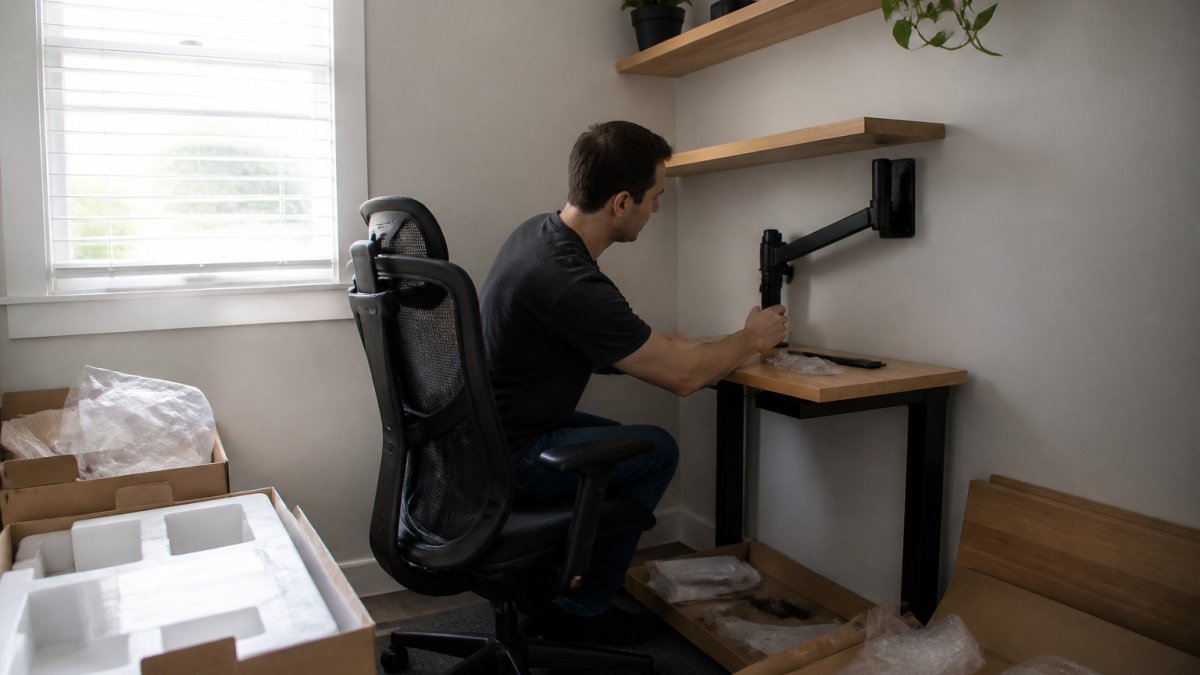
Start by measuring your room and your body. Chair seat height, desk height, monitor distance, and keyboard position all interact. If your chair is too high or too low, even the best desk won't help. If your monitor is too far away, you'll lean forward to see it, straining your neck.
The basic formula:
- Desk height: 28 to 30 inches for most people. Your elbows should bend at roughly 90 degrees when your hands rest on the keyboard.
- Monitor distance: 20 to 26 inches from your eyes. The top of the screen should be at or slightly below eye level.
- Chair height: Adjust so your feet rest flat on the floor or a footrest, and your thighs are parallel to the ground.
Vertical Storage and Wall-Mounted Options
Vertical space is your secret weapon in a compact room. Wall-mounted shelves, pegboards, and floating desks reclaim floor space and reduce visual clutter, which also reduces mental strain.
Install shelves above your desk for reference books, supplies, and equipment you use daily. Mount your monitor on an adjustable arm rather than placing it on a stand, this frees up desk space and lets you angle the screen to reduce glare and neck strain. (Source: a systematic review of research on sitting and working furniture ergonomics)
Pegboards work well for frequently used items like headphones, cables, and notepads. They're adjustable, so you can rearrange as your needs change. Over time, you'll refine what works best for your workflow.
Multi-Functional Furniture and Modular Seating
When square footage is limited, every piece should earn its place. Multi-functional furniture does double duty without doubling your footprint.
A desk with integrated storage is one example. A filing cabinet that doubles as a side table is another. Modular seating, like ottomans or small benches that tuck under desks, provides extra seating for guests without permanent floor space commitment.
Look for items that nest, fold, or stack. A rolling cart stores supplies and moves where needed. A small stool becomes a footrest during work and extra seating during calls. This flexibility is what separates a functional compact office from a cramped one.
Essential Accessories for Posture and Comfort in Tight Spaces
Your furniture foundation is solid. Now add targeted accessories that fine-tune your setup and protect your spine during long work sessions.
A footrest keeps your feet flat and supported, which stabilizes your pelvis and reduces lower back strain.
A monitor arm mounts your screen at the correct distance and height, preventing neck strain from looking down or reaching forward.
A keyboard tray keeps your wrists neutral and your elbows at the right angle. If your desk is too high or too low, a keyboard tray bridges the gap.
An external keyboard and mouse are non-negotiable if you use a laptop. Laptop screens force you to look down and hunch forward, a recipe for neck and shoulder pain.
Lighting matters too.
Optimizing Your Compact Workspace Layout
Layout determines whether your furniture actually works together or works against you. A well-arranged compact office feels spacious and supports movement.
Position your desk perpendicular to windows when possible. This reduces glare on your monitor and lets you look out periodically, which rests your eyes and breaks up static posture.
Leave walking space. You need at least 24 inches of clearance to move your chair back and stand up.
Cable management isn't just aesthetic, it's functional. Tangled cables catch your feet, snag your chair wheels, and make adjustments harder.
Noise and distractions compound physical strain. If you share your space with others or live in a noisy area, add acoustic panels or soft furnishings to absorb sound.
Setting Up Your Ergonomic Home Office Consultation
You've assembled the pieces. Now make sure they're optimized for your body. Every spine is different. What works for your colleague might create problems for you.
A professional assessment can help identify issues. Book a chiropractic consultation online to get personalized guidance on your compact workspace setup.
Research on sitting and working furniture ergonomics emphasizes that furniture design alone doesn't guarantee good ergonomics, how you use the furniture matters equally.
Consult a qualified professional to assess your compact workspace and get personalized recommendations.
Building an ergonomic home office in a small space is achievable. It requires intentional choices about furniture, layout, and accessories, but the payoff is a workspace that supports your health instead of undermining it.
| Furniture Category | Key Feature | Best For Compact Spaces | Typical Footprint |
|---|---|---|---|
| Ergonomic Office Chair | Adjustable lumbar support | Under 26" seat width | 24-28" wide |
| Compact Standing Desk | Electric height adjustment | Desks under 40" wide | 36-40" wide |
| Small Desk with Storage | Built-in drawers or shelves | Eliminates need for cabinets | 48-60" wide |
| Wall-Mounted Shelves | Vertical storage | Frees floor space | 12-24" deep |
| Monitor Arm | Adjustable positioning | Reduces desk clutter | Mounts to wall or desk |
| Footrest | Neutral foot support | Stabilizes posture | 18-24" wide |
Frequently Asked Questions
Can a small desk still be ergonomic?
Yes. A small desk can be ergonomic if it positions your monitor at eye level, keeps your keyboard and mouse at elbow height, and provides enough surface area for your primary work tasks. The key is adjustability and proper placement of accessories like monitor arms and keyboard trays. Compact furniture for ergonomic home offices prioritizes these alignment factors over overall size.
What should I look for in a compact ergonomic office chair?
Look for a small space ergonomic office chair with lumbar support, breathable mesh or fabric, adjustable seat height, and a base small enough for your room. Ensure the seat depth fits your thigh length without pressing into the back of your knees. Armrests should be adjustable or removable to save space while supporting your arms at desk height. Test the chair's swivel and mobility to confirm it doesn't obstruct doorways or pathways.
How do I maximize vertical space in a small home office?
Use wall-mounted shelves above your desk for storage and keep frequently used items within arm's reach. Install a monitor arm to free up desk surface area. Add floating shelves or wall-mounted filing systems to store documents and supplies without consuming floor space. Vertical storage reduces clutter, improves your ergonomic home office setup for small spaces, and creates a more functional workspace.
Is a standing desk practical for a compact home office?
A compact standing desk for home office use can work well if it has a small footprint and adjusts smoothly between sitting and standing heights. Look for models with cable management built in and a surface large enough for your monitor and keyboard. Alternating between sitting and standing reduces static posture strain and can improve circulation, though a quality chair remains essential for seated work periods.
Learn more about back pain care at our Montgomery, AL clinic, or book an evaluation.
Last Updated: October 22, 2026
Quick Summary
Vitamin D deficiency chronic pain shows strong statistical association in large populations, but clinical evidence reveals supplementation produces mixed results for pain relief. Low vitamin D may contribute to pain through effects on neuromuscular function, yet correcting deficiency doesn't automatically resolve chronic pain in individual patients.
- A 2024 study of 349,221 adults found severe vitamin D deficiency significantly linked to chronic widespread pain after adjusting for confounding factors.
- Clinical trials show roughly half of patients with documented deficiency see pain improvement after supplementation, while the other half see little to no change.
- Vitamin D deficiency below 20 ng/mL impairs muscle contraction efficiency and increases pain sensitivity, but association does not equal causation.
- Testing for vitamin D deficiency is recommended for chronic pain patients, but supplementation requires 8-12 weeks to evaluate effectiveness and professional guidance.
- Chronic pain typically involves multiple factors; vitamin D status may be one contributing element among structural, neurological, and inflammatory causes.
Table of Contents
- Understanding the Connection Between Vitamin D Deficiency and Chronic Pain
- How Vitamin D Deficiency Symptoms Manifest in Pain Conditions
- Association vs. Causation: What Research Actually Tells Us
- Getting a Vitamin D Test for Deficiency
- Vitamin D Supplements for Chronic Pain: Evidence and Expectations
- When to Seek Professional Evaluation
- Conclusion
- Frequently Asked Questions
Understanding the Connection Between Vitamin D Deficiency and Chronic Pain
Vitamin D deficiency chronic pain represents one of the most studied yet misunderstood connections in modern pain management. A cross-sectional study of 349,221 adults found that severe vitamin D deficiency remained significantly linked to chronic widespread pain after adjustment for confounding factors, yet the relationship between low vitamin D and pain intensity remains far more complex than headlines suggest.
The evidence shows clear associations, but what most patients don't realize is that association and causation are entirely different things. You can have vitamin D deficiency and chronic pain simultaneously without one causing the other. Understanding this distinction changes how you approach testing, supplementation, and treatment expectations.
The role of vitamin D in bone and muscle health is well-documented. Your muscles require adequate vitamin D for proper neuromuscular function. Your skeletal system depends on vitamin D to regulate calcium absorption.
Association does not equal causation. Vitamin D deficiency correlates with chronic pain in large populations, but supplementation doesn't reliably reverse pain in individual patients.
How Vitamin D Deficiency Symptoms Manifest in Pain Conditions
Vitamin D deficiency symptoms vary widely, and pain is just one manifestation among many. Low serum vitamin D levels affect your neuromuscular function, pain sensitivity threshold, and how your body processes inflammatory signals. The question isn't whether deficiency can contribute to pain, it's whether it's your pain.
Musculoskeletal Pain and Weakness
Muscle pain and muscle weakness represent the most common pain-related complaints associated with vitamin D deficiency. When your serum vitamin D drops below 20 ng/mL, your muscles lose their ability to contract efficiently. This doesn't necessarily mean you'll develop chronic pain, but it does mean your pain sensitivity increases and your recovery from injury slows.
Patients with low vitamin D often report diffuse muscle aches that worsen with activity. The pain typically affects large muscle groups, your back, shoulders, and legs. What complicates diagnosis is that this same pattern appears in dozens of other conditions: fibromyalgia, autoimmune disorders, thyroid dysfunction, and simple deconditioning.
The muscle weakness associated with deficiency is measurable and real. Studies show that correcting deficiency improves neuromuscular function. But improved function doesn't always translate to pain relief, especially if your pain has been present for years and other structural or neurological factors are at play.
Chronic Widespread Pain
Chronic widespread pain, pain affecting multiple body regions for more than three months, shows stronger statistical association with vitamin D insufficiency than localized pain does. The 2024 study of 349,221 adults found this connection held even after researchers adjusted for confounding factors like age, BMI, and physical activity levels.
Yet here's what the research also emphasizes: evidence does not establish vitamin D supplementation as an effective treatment for chronic pain. This distinction matters enormously. An association in a large population study doesn't predict individual response to treatment. Some patients with deficiency-related widespread pain improve dramatically with supplementation. Others see no change.
The pain sensitivity threshold, how much stimulus it takes to trigger pain signals, appears lower in people with vitamin D deficiency. Your nervous system becomes more reactive. This explains why deficiency might worsen existing pain conditions, but it doesn't explain why correcting the deficiency fails to resolve pain in many patients.
Widespread pain with low vitamin D doesn't automatically mean supplementation will help. Mixed results in clinical studies show that roughly half of patients with documented deficiency see pain improvement after supplementation, while the other half see little to no change.
Association vs. Causation: What Research Actually Tells Us
This is the part most guides get wrong, and it's critical for setting realistic expectations about testing and treatment.
The research data shows clear associations. Vitamin D deficiency correlates with increased pain intensity. Low vitamin D associates with higher rates of chronic pain development. These statistical relationships are real and reproducible across large populations.
Consider what a cross-sectional study actually measures: it captures vitamin D levels and pain reports at a single point in time, then looks for patterns. If people with low vitamin D report more pain, that's an association. But that same pattern could exist because:
- Chronic pain causes people to stay indoors, reducing sun exposure and lowering vitamin D
- An underlying inflammatory condition causes both low vitamin D and pain
- Sedentary behavior from pain leads to lower vitamin D and worse musculoskeletal function
- The two conditions are completely unrelated in that particular person
Clinical trials testing supplementation tell a different story than population studies. Clinical studies of vitamin D supplementation in people with known deficiency have produced mixed results for pain improvement. Some patients improve. Many don't.
This is why testing makes sense, but supplementation without baseline testing and monitoring doesn't. You need to know your actual vitamin D status. You need realistic expectations about what correction might achieve.
Getting a Vitamin D Test for Deficiency
Testing for vitamin D deficiency is straightforward, but interpreting results requires context.
The standard test measures serum 25-hydroxyvitamin D, often called 25(OH)D. This is the storage form of vitamin D in your blood, and it's what clinicians use to assess your vitamin D status.

Reference ranges vary slightly between labs, but most use these benchmarks:
- Below 20 ng/mL: Deficiency
- 20-29 ng/mL: Insufficiency
- 30-100 ng/mL: Sufficient
- Above 100 ng/mL: Potentially excessive
If your test shows deficiency or insufficiency, the next step isn't automatic supplementation, it's understanding why your level is low. Dietary intake, sun exposure, skin tone, age, and certain medical conditions all affect vitamin D status.
When you bring low vitamin D results to your healthcare provider, ask these questions: Is this deficiency causing my pain, or is something else? What's the timeline for improvement if I supplement?
Vitamin D Supplements for Chronic Pain: Evidence and Expectations
If your vitamin D is low and you have chronic pain, supplementation seems logical. The evidence, however, doesn't support the straightforward "low vitamin D causes pain, so supplementing fixes pain" narrative.
Vitamin D supplements come in two forms: D2 (ergocalciferol) and D3 (cholecalciferol). D3 is more effective at raising serum vitamin D levels. Standard supplementation ranges from 1,000 IU daily for maintenance to 4,000-10,000 IU daily for correcting deficiency, though some protocols use higher doses temporarily.
The critical finding from clinical research: correcting vitamin D deficiency improves your vitamin D status. A 2015 review examining clinical evidence concluded that supplementation studies in patients with known vitamin D deficiency had mixed results for improving chronic pain.
Why? Because pain is multifactorial. If your pain stems primarily from vitamin D deficiency affecting neuromuscular function, supplementation helps. If your pain stems from structural damage, nerve sensitization, or inflammatory conditions unrelated to vitamin D, supplementation won't touch it.
This doesn't mean supplementation is pointless. If you're deficient, correcting the deficiency improves your musculoskeletal health, bone density, and immune function, all worthwhile outcomes independent of pain relief. But approaching supplementation as a pain treatment is setting yourself up for disappointment.
If you supplement for vitamin D deficiency, give it 8-12 weeks before evaluating whether it's helping your pain. Changes in pain sensitivity occur gradually. Keep a simple log of pain intensity and activity level to track whether supplementation correlates with actual improvement in your specific situation.
| Supplementation Scenario | Realistic Expectation | Timeline |
|---|---|---|
| Correcting documented deficiency | Improved musculoskeletal function, variable pain relief | 8-12 weeks |
| Chronic pain with normal vitamin D | Minimal pain benefit from supplementation | N/A, not indicated |
| Acute pain with low vitamin D | Deficiency correction may help recovery | 6-12 weeks |
| Widespread pain with insufficiency | Mixed results; improvement possible but not guaranteed | 12+ weeks |
When to Seek Professional Evaluation
Chronic pain warrants professional assessment regardless of your vitamin D status. The question isn't whether to see someone, it's who and when.
If you've had chronic pain for months without diagnosis, vitamin D testing is reasonable. Low vitamin D is easy to correct, and it's one variable you can control. But testing alone doesn't solve chronic pain.
Red flags that require urgent professional evaluation:
- Pain accompanied by fever, unexplained weight loss, or night sweats
- Pain following trauma or injury that isn't improving
- Pain with progressive neurological symptoms (numbness, weakness, loss of function)
- Pain severe enough to interfere with basic daily activities or sleep
- Pain that doesn't fit typical patterns or changes significantly over short periods
Vitamin D deficiency doesn't cause these presentations. If these symptoms are present, vitamin D testing is secondary to more urgent diagnostic work.
For chronic musculoskeletal pain without red flags, a systematic approach works: document your pain patterns, get baseline vitamin D testing, assess your current activity and sun exposure, and work with a qualified provider to address modifiable factors.
A qualified healthcare provider can help patients distinguish between vitamin D deficiency as a primary pain driver versus one factor in a complex pain picture. This clarity changes your treatment approach and sets realistic expectations for improvement.
Conclusion
The connection between vitamin D deficiency and chronic pain is real but more nuanced than most discussions suggest. Large population studies show clear associations, yet clinical evidence reveals that supplementation produces mixed results. Testing for vitamin D deficiency makes sense if you have chronic pain, but correcting a deficiency doesn't automatically resolve pain. Your chronic pain likely involves multiple factors, structural, neurological, inflammatory, and behavioral. Vitamin D status may be one. A qualified healthcare provider can help you determine whether it's yours. A comprehensive approach to chronic pain often includes assessing vitamin D status alongside structural evaluation, movement patterns, and your complete medical picture to develop a treatment plan tailored to your actual pain drivers.
Frequently Asked Questions
Can vitamin D deficiency cause chronic pain?
Research shows an association between severe vitamin D deficiency and chronic widespread pain in observational studies. A 2024 study of 349,221 adults found this link remained significant even after accounting for confounding factors. However, association does not prove deficiency causes pain. Clinical trials of vitamin D supplementation in people with known deficiency have produced mixed results, and a 2017 review found no concrete evidence that supplementation effectively treats chronic pain. If you have chronic pain, testing your vitamin D status is reasonable, but supplementation alone may not resolve pain.
What types of pain are associated with low vitamin D?
Low vitamin D has been linked to musculoskeletal pain (bone and muscle pain), chronic widespread pain, muscle weakness, and pain sensitivity. Some research suggests it may relate to neuropathic pain and the transition from acute to chronic pain after surgery. However, many other factors cause these pain types, so vitamin D status is one consideration among many in understanding your pain.
How is vitamin D deficiency diagnosed?
Vitamin D deficiency is diagnosed through a blood test measuring 25-hydroxyvitamin D (serum vitamin D). Your healthcare provider typically orders this test if you have symptoms suggesting deficiency or risk factors like limited sun exposure, dietary restrictions, or chronic pain. Results are interpreted as: sufficient (generally above 30 ng/mL), insufficient (20-29 ng/mL), or deficient (below 20 ng/mL). If you have chronic pain and suspect low vitamin D, ask your doctor whether testing makes sense for your situation.
Can vitamin D supplements help with chronic pain?
Evidence is mixed. A 2015 review of clinical studies found that vitamin D supplementation in people with known deficiency produced mixed results for pain improvement. A 2017 review concluded there is no concrete evidence that supplementation effectively treats chronic pain. If you have confirmed vitamin D deficiency, correcting it is important for bone and muscle health, but supplementation alone may not resolve chronic pain. Work with your healthcare provider to address vitamin D status as part of a broader pain management plan.
Learn more about our full range of services at our Montgomery, AL clinic, or book an evaluation.
