
Table of Contents
- Understanding Chronic Sciatica and How Chiropractic Care Fits
- How Chiropractors Treat Chronic Sciatica
- How Long Does Chiropractic Treatment Take for Sciatica?
- Chiropractic vs Physical Therapy for Sciatica
- Sciatica Pain Relief Exercises to Do at Home
- Safety, Contraindications, and When to See a Medical Doctor
- Cost-Benefit Analysis and Long-Term Maintenance
- Conclusion
- Frequently Asked Questions
Last Updated: September 13, 2026
Understanding Chronic Sciatica and How Chiropractic Care Fits
Chronic sciatica is pain radiating along the sciatic nerve, from the lower back through the hips and buttocks and down each leg. It becomes chronic when symptoms persist beyond the typical 4-12 week acute episode (medlineplus.gov).
For adults living with this pain, chiropractic care for chronic sciatica offers a conservative, non-invasive option focused on spinal alignment and nerve function.
The distinction matters because treatment strategy changes: acute sciatica often resolves as inflammation subsides, while chronic sciatica usually points to an ongoing mechanical cause such as a herniated disc, spinal stenosis, or degenerative lumbar changes.
A common mistake is treating chronic sciatica like a flare-up. Rest and painkillers may manage symptoms for a week but do nothing about the underlying nerve compression, so many people cycle through the same pain.
What Makes Sciatica Chronic Versus Acute
The difference comes down to duration and cause.
- Acute sciatica: Symptoms last less than 4-6 weeks, often triggered by a specific event like lifting or a sudden twist. Most cases improve with time.
- Chronic sciatica: Symptoms persist for 12 weeks or longer, or recur frequently. There is usually an identifiable structural cause, such as a herniated disc, bone spur, or narrowed spinal canal.
Chronic cases involve nerve root irritation that does not resolve on its own. The longer compression goes unaddressed, the more sensitized the nerve becomes.
How Chiropractors Treat Chronic Sciatica
A chiropractor treats chronic sciatica by restoring lumbar mobility and reducing pressure on the affected nerve root. The approach is mechanical, not pharmaceutical.
The first visit usually involves a detailed history, a physical and neurological exam, and sometimes imaging if a disc issue is suspected; the plan is then built around the specific cause of the impingement.
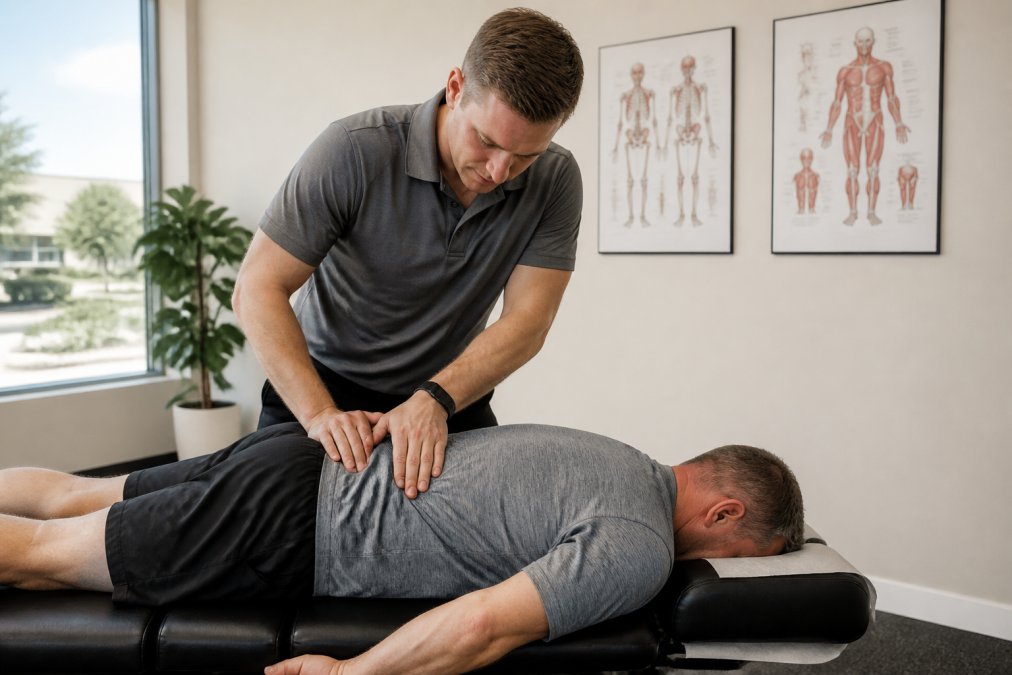
Common Chiropractic Techniques for Sciatica
Several techniques are used, often in combination:
- Spinal manipulation: A controlled, precise thrust to restore vertebral alignment and reduce nerve pressure.
- Spinal decompression: Gentle traction that creates space between vertebrae, which can relieve pressure on a herniated disc.
- Myofascial release: Hands-on work on the muscles surrounding the spine and hips to reduce tension that pulls the pelvis out of alignment.
- Joint mobilization: Slower, low-velocity movements for patients who are not candidates for high-velocity adjustments.
- Postural correction: Guidance on sitting, standing, and lifting mechanics, since poor posture is a common driver of recurring nerve irritation.
A common mistake is assuming every technique suits every patient. Someone with a severe disc herniation may need decompression and mobilization rather than a forceful adjustment, so methods should be tailored to the diagnosis.
How Long Does Chiropractic Treatment Take for Sciatica?
Most patients notice improvement within 2-4 weeks, but full recovery often takes 6-12 weeks of consistent care, depending on the cause and how long the problem has been present.
Treatment frequency starts higher and tapers off: typically 2-3 visits per week for the first few weeks, then weekly, then maintenance visits every few weeks or months.
The recovery timeline depends on several factors:
| Factor | Faster Recovery | Slower Recovery |
|---|---|---|
| Duration of symptoms | Under 3 months | Over 1 year |
| Cause | Muscle tension, mild misalignment | Herniated disc, spinal stenosis |
| Age and fitness | Younger, active | Older, sedentary |
| Home compliance | Does prescribed exercises | Skips home care |
| Overall health | No other conditions | Diabetes, obesity, prior injury |
The timeline is not linear. Some weeks feel like a setback, especially when a nerve has been compressed for a long time. Progress is measured over months, not days.
Chiropractic vs Physical Therapy for Sciatica
The right choice depends on what is driving the pain, and the two disciplines are not interchangeable. Chiropractic care targets spinal alignment and joint mechanics; physical therapy targets muscle strength, flexibility, and functional movement. For chronic sciatica, the question is which problem dominates.
How the Two Approaches Differ at the Mechanism Level
Chiropractic treatment for sciatica works on the premise that a misaligned or restricted vertebra, herniated disc, or narrowed canal is compressing the nerve root; spinal manipulation and decompression restore space and mobility so the nerve is no longer pinched.
Physical therapy works on the premise that weak core and gluteal muscles, tight hamstrings, or poor movement habits fail to support the spine, allowing the nerve to stay irritated. A physical therapist builds strength so the spine is stabilized by muscle, not alignment alone.
A useful way to think about it: chiropractic addresses the position of the spine, physical therapy addresses the support around it. Chronic sciatica often involves both.
Which One Fits Which Presentation
| Presentation | Usually Starts With | Why |
|---|---|---|
| Sharp, shooting pain with a clear mechanical trigger | Chiropractic | Suggests joint restriction or disc compression |
| Dull ache with weakness or giving-way | Physical therapy | Suggests muscular insufficiency |
| Pain that changes with posture but not activity | Chiropractic | Suggests positional nerve irritation |
| Pain after surgery or with significant deconditioning | Physical therapy | Requires graded strengthening, not manipulation |
| Long-standing pain with both stiffness and weakness | Combined | Neither approach alone addresses both drivers |
What the Evidence and Guidelines Suggest
Clinical practice guidelines for low back pain and radiculopathy generally recommend conservative, non-invasive care before injections or surgery, and both chiropractic care and physical therapy fall in that category. Most practitioners find patients with a clear mechanical component, a restricted joint, a disc bulge, a segment that will not move, respond faster to chiropractic care, while those whose primary problem is weakness or poor motor control respond faster to physical therapy.
The honest limitation: chiropractic care is not a substitute for physical therapy when the problem is muscular weakness, and physical therapy is not a substitute for chiropractic when the spine is misaligned or a joint is restricted. Choosing wrong first can delay relief by weeks.
How the Two Work Together
The most effective plans often sequence the two. A chiropractor restores lumbar mobility and reduces nerve pressure; once the nerve is calmer and the joint moves freely, a physical therapist builds the core and hip strength to hold that alignment under load. Without strengthening, alignment drifts back and pain returns.
Some clinics coordinate with referring providers so the handoff between chiropractic and physical therapy is planned rather than improvised. If your providers are not communicating, ask them to share notes, strengthening should not start before the nerve has settled.
Session Structure and What to Expect
A typical chiropractic visit runs 15-30 minutes and centers on manual treatment, with home stretches assigned between visits. A physical therapy session runs 45-60 minutes and is largely active, exercises under supervision, with manual therapy as a supplement. Chiropractic home care is usually stretching and postural correction; physical therapy home care is a full exercise program with sets, reps, and progression.
If your pain is mechanical and positional, start with chiropractic. If it is weakness-driven or you are recovering from surgery, start with physical therapy. If you have both, plan for a sequenced approach rather than picking one and hoping.
Clinical guidelines for low back pain and radiculopathy
Sciatica Pain Relief Exercises to Do at Home
Home exercises support whatever happens in the clinic. They do not replace professional care, but skipping them slows recovery.
Try these, stopping immediately if pain worsens or radiates further down the leg:
- Knee-to-chest stretch: Lie on your back, pull one knee toward your chest, hold 20-30 seconds. Repeat 3 times per side.
- Piriformis stretch: Lie on your back, cross one ankle over the opposite knee, pull the supporting thigh toward you. Hold 30 seconds per side.
- Cat-cow: On hands and knees, alternate arching and rounding the spine slowly for 10 repetitions.
- Bird-dog: On hands and knees, extend the opposite arm and leg, hold 5 seconds, switch sides. 10 reps per side.
- Walking: 15-20 minutes daily. Low-impact movement keeps the nerve from becoming more sensitized.
Pushing through sharp, shooting pain during any stretch can worsen nerve irritation. If an exercise sends pain further down the leg, stop and mention it at your next appointment.
Safety, Contraindications, and When to See a Medical Doctor
Chiropractic care is generally well tolerated for chronic sciatica but is not appropriate for everyone. A responsible chiropractor rules out contraindications before any adjustment.
Absolute Contraindications
Spinal manipulation should not be performed in these situations:
- Cauda equina syndrome, a medical emergency involving compression of the nerve bundle at the base of the spinal cord. Symptoms include loss of bladder or bowel control, numbness in the saddle area (inner thighs, buttocks, groin), and rapidly worsening weakness in one or both legs. This requires immediate emergency evaluation, not a chiropractic appointment.
- Spinal cancer or active spinal infection, manipulation can spread infection or destabilize an already compromised vertebra.
- Severe osteoporosis or known spinal fracture, the force of an adjustment can cause additional fracture.
- Significant disc herniation with progressive neurological loss, if strength or sensation is actively deteriorating, the priority is medical evaluation, not manipulation.
- Recent spinal surgery without clearance from the surgeon, the surgical site needs to heal before any external force is applied.
Relative Contraindications and Cautions
These do not rule out chiropractic care but change how it is delivered:
- Anticoagulant or blood-thinner use, increases bleeding risk with forceful techniques; low-velocity mobilization is usually preferred.
- Inflammatory arthritis or active inflammatory flare, manipulation during an active flare can worsen symptoms.
- Vertebral artery disease or prior neck surgery, relevant mainly for cervical manipulation, but worth disclosing.
- Pregnancy, many chiropractors treat pregnant patients safely with modified positioning and techniques, but the provider must be experienced with prenatal care.
When Imaging Is Required Before Treatment
A chiropractor does not always need an MRI or X-ray before starting care, but imaging should come first in specific situations:
- Red-flag history, cancer history, unexplained weight loss, night pain that wakes you, fever, or a history of significant trauma.
- Progressive neurological symptoms, worsening weakness, numbness that is spreading, or changes in bowel or bladder function.
- Failure to improve after 4-6 weeks of conservative care, if the expected response is not happening, imaging helps confirm the diagnosis.
- Suspected disc herniation or spinal stenosis, an MRI shows the soft tissue (disc, nerve root, canal) that an X-ray cannot.
- Prior spinal surgery, imaging establishes the current baseline before any new treatment.
X-rays show bone alignment and fractures; MRI shows discs, nerves, and soft tissue. A chiropractor who suspects a disc issue will typically request an MRI rather than rely on X-ray alone. If a provider recommends treatment without asking about red flags or reviewing imaging, get a second opinion.
Red Flags That Require Immediate Medical Attention
See a medical doctor immediately, not a chiropractor, if you notice any of the following:
- Loss of bladder or bowel control
- Numbness in the saddle area (inner thighs, buttocks, groin)
- Rapidly worsening weakness in one or both legs
- Severe pain that is worsening rather than improving
- Fever or unexplained weight loss alongside back pain
- Pain that is worse at night or wakes you from sleep
These symptoms can indicate cauda equina syndrome, infection, fracture, or malignancy, conditions requiring urgent medical evaluation and outside the scope of chiropractic care.
Questions a Responsible Chiropractor Will Ask
Before treatment, a thorough chiropractor should ask about your medical history, medications (especially blood thinners), prior surgeries, cancer history, recent trauma, and any red-flag symptoms above. They should also perform a neurological exam, reflexes, sensation, muscle strength, to establish a baseline. If any of that is skipped, ask why.
Cauda equina syndrome is a surgical emergency. If you have loss of bladder or bowel control, saddle numbness, or rapidly worsening leg weakness, go to an emergency room immediately. Do not wait for a chiropractic appointment.
Cauda equina syndrome overview
Cost-Benefit Analysis and Long-Term Maintenance
Chiropractic care is a conservative, non-surgical option. Total cost depends on visit count and insurance coverage — contact the clinic directly for current pricing.
Most insurance plans cover chiropractic care to some degree, though coverage varies widely. Medicare Part B covers manual manipulation of the spine when medically necessary, and many private plans limit visits per year or require a referral. To know your out-of-pocket cost, check your policy and ask the clinic directly.
Long-term maintenance is where chiropractic care for chronic sciatica pays off. Once the acute phase is over, periodic visits, postural correction, and a consistent home routine reduce recurrence. Patients who stop all care the moment they feel better often return within months with the same problem.
Ask your chiropractor for a written maintenance schedule before you finish active treatment. A plan that lists visit frequency, home exercises, and warning signs to watch for keeps you from guessing when to come back.
Conclusion
Chronic sciatica rarely resolves with a single intervention. It responds to a structured plan that addresses the mechanical cause, supports the nerve, and prevents recurrence. Chiropractic care for chronic sciatica is one of the few conservative options that works on alignment, mobility, and nerve pressure at once.
If you have been managing this pain for months without a clear plan, consider a structured evaluation and a treatment approach built around your specific diagnosis. Explore the chiropractic assessment services available at chiropracticcare.clinic to take the next step.
Frequently Asked Questions
Is a chiropractor good for severe sciatica?
Chiropractic care can help severe sciatica when the cause is mechanical, such as a herniated disc or vertebral misalignment compressing the sciatic nerve. Some published research on spinal manipulation for lumbar radiculopathy reports improvements in pain and function. Evidence quality varies by study — ask your chiropractor for sources relevant to your case. However, severe cases with progressive weakness, loss of bladder control, or cauda equina syndrome require immediate medical evaluation, not chiropractic treatment. Always get a proper diagnosis first.
How does chronic sciatica differ from acute sciatic nerve pain?
Acute sciatica typically resolves within four to six weeks and often responds to rest, ice, and over-the-counter pain relievers. Chronic sciatica persists beyond 12 weeks and usually involves ongoing nerve compression from a herniated disc, spinal stenosis, or degenerative changes in the lumbar spine. Chronic cases need a structured treatment plan that addresses the underlying cause, not just symptom relief. Chiropractic care for chronic sciatica focuses on restoring vertebral alignment and reducing nerve irritation over time.
What specific chiropractic techniques are used for sciatica?
Chiropractors use several techniques for sciatica. Spinal manipulation (adjustments) realigns the lumbar spine to take pressure off the nerve root. Flexion-distraction involves a specialized table that gently stretches the spine and decompresses the affected disc. Myofascial release and deep tissue massage relax tight muscles in the lower back and glutes that may be compressing the sciatic nerve. Some chiropractors also use ultrasound or electrical stimulation to reduce inflammation around the nerve.
Can chiropractic care provide long-term relief for chronic sciatica?
Chiropractic care can provide long-term relief when combined with therapeutic exercises and postural correction. Some research suggests spinal manipulation combined with home exercise may produce better long-term outcomes than medication alone for certain patients. Individual results vary, and your chiropractor can walk you through the specific evidence. The key is addressing the root cause, not just the symptoms. Without maintenance exercises and lifestyle adjustments, symptoms can return. Many patients benefit from periodic check-ins after their initial treatment plan ends.
When should you see a doctor versus a chiropractor for sciatica?
See a medical doctor first if you have progressive leg weakness, numbness in the groin area, loss of bladder or bowel control, or pain following a traumatic injury. These are red flags for serious conditions like cauda equina syndrome or fracture. For mechanical sciatica without red flags, a chiropractor can be a first-line conservative care option. Many chiropractors refer patients for MRI or X-ray when the diagnosis is unclear. A coordinated approach between your doctor and chiropractor often works best.
What lifestyle adjustments complement chiropractic care for sciatica?
Sitting for long periods aggravates sciatica by increasing pressure on the lumbar discs. Take breaks every 30 minutes to stand and walk. Use a chair with good lumbar support and keep your feet flat on the floor. Sleep on your side with a pillow between your knees to keep your spine neutral. Avoid heavy lifting and twisting motions. Regular stretching techniques and functional movement exercises, such as walking and swimming, help maintain mobility between chiropractic visits.
How much does chiropractic care for chronic sciatica cost?
Costs vary by provider, location, and treatment plan length. Most chiropractic clinics charge per visit, and many offer package pricing for multiple sessions. Insurance coverage for chiropractic care depends on your plan and whether the treatment is deemed medically necessary for your condition. Check with your insurance provider about coverage for chiropractic services and any visit limits. For current pricing at chiropracticcare.clinic, visit the website or contact the clinic directly for a quote.
Learn more about sciatica care at our Montgomery, AL clinic, or book an evaluation.

Complementary Role of Nutritional Habits With Your Chiropractic Care
In your journey to manage chronic pain at Chiropractic Care Clinic in Montgomery, Alabama, under the expert guidance of Dr. Elaine McNally, DC, it's important to explore supportive lifestyle habits that complement your chiropractic treatments. Nutrition is a vital element of this holistic approach - intentionally framed not as an alternative, but as a supportive partner, to enhance daily comfort and energy levels while receiving care.
Considering the importance of nutrition, our companion post on anti-inflammatory foods offers additional insights into dietary choices that can support your recovery process and complement your chiropractic care plan effectively.
Food Habits as Part of Your Care Plan, Not a Substitute for It
Your visit to our clinic involves comprehensive assessment through Digital X-ray diagnostics, various therapeutic techniques like shockwave therapy, low-level laser therapy, and more. These tools work in tandem to address structural or mechanical issues directly related to your discomfort. However, incorporating thoughtful nutrition practices can contribute to overall well-being - improving energy, aiding recovery periods, and fostering a general sense of balance alongside the care you receive.
It's valuable to see how simple daily habits such as balanced nutrition fit into your broader treatment plan. This involves understanding sleep patterns, gentle movement routines, stress management techniques, and other supportive practices that work together with chiropractic adjustments and therapies. While these habits contribute positively, they serve to complement - not replace - the core intervention strategies we offer.
Everyday Habits Patients Ask About
Often, patients inquire about broad lifestyle changes they can implement for greater well-being. Some common questions pertain to everyday nutritional choices. Though not prescriptive in nature due to our scope of practice, these general wellness recommendations can play a supportive role:
- Incorporating more vegetables and fruits into meals ensures your body receives beneficial nutrients without specifying dosages or types.
- Choosing whole grains and lean proteins can support sustained energy levels throughout the day, supporting your overall wellbeing.
- Maintaining adequate hydration is a simple, yet powerful way to keep various bodily functions optimal.
- Reducing intake of processed foods, fried items, and excessive added sugars can help maintain balanced energy levels and overall health.
Think of these suggestions as general guidelines for maintaining good health; they're intended to be supportive habits that may enhance the benefits you receive from our chiropractic care.
Bring Nutrition Questions to Your Visit
If you have questions about how nutrition might impact your comfort and energy levels during your treatment with Dr. McNally, do bring them up in your visit. It’s important to approach nutritional matters thoughtfully, as what works for one individual may not be suitable for another due to unique health profiles. While chiropractors can offer general guidance on healthy habits, they are not substitutes for registered dietitians or physicians who might handle complex dietary requirements or medication interactions.
In our consultations, we focus on integrating your nutritional lifestyle into a holistic care plan under our professional domain - without prescribing supplements or interventions beyond our scope. Feel free to ask questions during your assessment; this interaction can aid in forming a cohesive and personalized health strategy.
For more insights and tailored advice about how lifestyle adjustments could support your chiropractic care, we invite you to book an evaluation at Chiropractic Care Clinic, where Dr. Elaine McNally and her team are dedicated to enhancing your well-being through personalized care strategies. Reach out today for a comprehensive health assessment.
Learn more about our full range of services at our Montgomery, AL clinic, or book an evaluation.
Table of Contents
- Why Your Core Is the Foundation of Spinal Support
- Low Back Pain Exercises That Target Deep Stabilizing Muscles
- Safe Core Workouts for Beginners Starting with Back Pain
- How to Strengthen Core Muscles Without Flaring Up Your Back
- How Long to See Results from Core Training
- Ergonomic Integration: Protecting Your Back Between Workouts
- Recovery, Inflammation, and the Mental Side of Exercising with Pain
- Conclusion
- Frequently Asked Questions
Last Updated: September 10, 2026
Why Your Core Is the Foundation of Spinal Support
Learning how to strengthen core muscles for back pain starts with understanding what the core actually does. The core is not just the abdominals you see in the mirror; it is a cylinder of deep muscles that wraps around your spine and controls its position during every movement you make.
The transverse abdominis, pelvic floor, erector spinae, and deep abdominal muscles work together to create intra-abdominal pressure and spinal support. When these muscles contract, they form a natural brace around the vertebral column. This is why core endurance, not raw strength, is generally considered important for keeping your lumbar spine protected during daily activity.
At chiropracticcare.clinic, we often see this pattern: people with chronic low back pain often have cores that fatigue quickly, not cores that lack power. Most cases of low back pain are considered mechanical in origin, which means the muscles supporting the spine are part of the solution.

A core that can hold its position matters more than a core that can crunch heavy weight once. Endurance is the goal, not maximum strength.
Low Back Pain Exercises That Target Deep Stabilizing Muscles
The most effective low back pain exercises for deep stabilization are slow, controlled movements that teach your deep abdominal muscles to fire without moving your spine. These are not crunches. They are isometric contractions and small-range drills.
A pelvic tilt is the foundation. Lie on your back with knees bent, flatten the curve of your lower back against the floor, hold for five seconds, and release. This teaches core engagement without loading the spine.
The dead bug comes next. Lie supine with arms up and knees bent at 90 degrees. Lower one arm and the opposite leg toward the floor while keeping your neutral spine pressed down. Return and switch sides.
The bird-dog is the quadruped version: on hands and knees, extend one arm and the opposite leg while keeping your hips level. Stabilization exercise is one approach many clinicians use for chronic low back pain.
Safe Core Workouts for Beginners Starting with Back Pain
Safe core workouts for beginners begin with breathing, not bracing. Before any movement, practice a 360-degree breath: place one hand on your ribs and one on your lower abdomen, inhale through your nose for about four seconds so the ribs expand sideways, then exhale slowly for six seconds and feel the lower abdomen gently firm without sucking in. That gentle firmness is the core engagement you will carry into every exercise. If you cannot breathe normally while holding a position, the position is too hard for today.
Work through this order. Each movement teaches the next one, so do not skip ahead even if an exercise feels easy.
- Pelvic tilt on your back, knees bent, feet flat. Flatten the lower back curve toward the floor without pushing with your legs, hold five seconds, release. 2 sets of 10 slow reps. This is your warm-up and your form check.
- Dead bug, one leg only. Lie supine with arms pointing at the ceiling and knees bent at 90 degrees. Lower one heel toward the floor while keeping the lower back pressed down and the ribs from flaring. Return and switch. 2 sets of 6 per side. If the back arches, shorten the range.
- Glute bridge. Press through the heels, lift the hips until the body forms a straight line from knees to shoulders, hold three seconds at the top, lower slowly. 2 sets of 8. Squeeze the glutes rather than arching the lower back to get higher.
- Modified plank on the knees. Elbows under shoulders, forearms on the mat, hips level with the shoulders, no sagging and no piking. 3 holds of 15 seconds. Rest 30 seconds between holds.
- Bird-dog on hands and knees. Extend one arm and the opposite leg only as far as you can keep the hips square to the floor. 2 sets of 5 per side.
Dosage rules that matter more than the exercise selection: keep total session time to 15 to 20 minutes, rest 30 to 60 seconds between sets, and train three to four days per week with at least one rest day between sessions. Soreness that feels like tired muscle is acceptable; anything sharp, shooting, or traveling down a leg is not.
Stop any movement that sends pain down your leg, causes numbness or tingling, or makes your symptoms worse the next morning. A common mistake is pushing through sharp pain because "no pain, no gain" sounds motivating. It is not. Pain management comes first; strength follows. If a movement consistently provokes symptoms after two or three attempts with reduced range, drop it and revisit it in a week rather than forcing it.
Progress by adding five seconds to a hold or one rep per set, never by adding speed. Slow, controlled reps are what teach the deep stabilizers to fire without moving the spine.
Do not begin this sequence during an acute flare-up with severe pain. In that phase, gentle walking and positions of comfort come first; start the strengthening work once pain is settling and you can move without guarding.
How to Strengthen Core Muscles Without Flaring Up Your Back
The rule for avoiding flare-ups is simple: keep the spine still while the limbs move. Most flare-ups happen when people add speed or range of motion before they have core endurance, or when they train through a warning sign because the session was already scheduled.
Use progressive overload carefully. For the first several weeks, add time, not weight. A workable framework:
- Weeks 1-2: learn the movements. Two sets each, holds of 10 to 15 seconds, no added resistance.
- Weeks 3-4: add five seconds to each hold or one rep per set once the current dose feels controlled for two consecutive sessions.
- Weeks 5-8: lengthen holds toward 30 seconds and add a third set before you add any load.
- Beyond week 8: if everything is pain-free and form holds, add light resistance, a band or a small weight, but keep reps slow and stop the set when form breaks, not when the clock runs out.
A frequent error is holding your breath during bracing. Breath-holding spikes intra-abdominal pressure and can aggravate a sensitive back. Breathe through every hold; if you cannot speak a short sentence mid-hold, you are working too hard for that day.
Other mistakes that reliably cause flare-ups:
- Chasing the burn. Core stabilization is not a fatigue contest. Stop the set when the lower back starts to take over from the deep abdominal muscles.
- Training through a bad morning. If your back is more irritable than usual, cut the session to the first two exercises or take a walk instead. One skipped session costs nothing; a two-week setback costs a lot.
- Adding movements the spine does not tolerate. Sit-ups, full crunches, and loaded twists load the lumbar spine in flexion and rotation, which many people with back pain do not tolerate well. They are not required for a strong core.
- Skipping the warm-up. Five minutes of walking and a set of gentle pelvic tilts before training prevents most next-day soreness that people mistake for injury.
Red flags that mean stop and get evaluated rather than adjust your program: pain that shoots below the knee, new numbness or weakness in a leg, loss of bladder or bowel control, or pain that wakes you at night. Those are not training problems.
Track one number, how long you can hold a modified plank with steady breathing, and one feeling, how your back behaves during a normal day. When the number stalls but daily comfort improves, you are still progressing; do not add load to force the number up.
How Long to See Results from Core Training
Many people notice easier daily movement within a few weeks of consistent practice; measurable strength and endurance gains take longer and vary by individual. The timeline depends on how often you train, how long you have had pain, and whether you are also addressing posture and daily habits.
A reasonable schedule is three to four sessions per week, each lasting 15 to 20 minutes. Consistency matters more than intensity. A person who trains gently four times a week will usually progress faster than someone who trains hard once and then rests for a week because of soreness.
Track two things: how long you can hold a modified plank, and how your back feels during a normal day. Improvement in daily comfort often shows up before the numbers move.
Ergonomic Integration: Protecting Your Back Between Workouts
Your workout is 20 minutes; your posture is the other 23 hours. Posture correction between sessions protects the gains you make in the gym.
If you sit for work, set your chair so your hips are slightly higher than your knees, your feet flat, and your screen at eye level. Stand and walk for two minutes every 30 to 45 minutes. This interrupts the sustained flexion that compresses the lumbar spine and lets the erector spinae reset.
For lifting at home, hinge at the hips rather than rounding your back, and keep the load close to your body. These habits are functional movement practice, and they reinforce the same neutral spine you train on the mat.
Recovery, Inflammation, and the Mental Side of Exercising with Pain
Two things that deserve more attention in most core programs: recovery and the psychology of moving when you hurt. Both decide whether your program lasts.
After a session, mild soreness is normal. Gentle walking, hydration, and sleep support recovery; ice or heat can soothe irritation, but neither speeds tissue repair dramatically. If soreness lasts more than a few days or worsens, reduce your volume.
The mental barrier is just as real. Fear of movement after a bad episode is common, and it leads people to avoid exercise entirely, which causes muscle atrophy and more stiffness. A useful reframe: you are not testing whether your back is "fixed." You are building tolerance, one session at a time. If anxiety around movement is intense, a physical therapy or chiropractic evaluation can help you move safely within your limits.
Conclusion
The hardest part of core training with back pain is not the exercise; it is starting without fear and staying consistent when progress feels slow. A structured, gentle plan changes that. Care begins with an evaluation of how your core, posture, and daily habits interact, so your program fits your body rather than a generic template.
Frequently Asked Questions
Can strengthening my core help with back pain?
Yes. Core strengthening is widely considered helpful for reducing chronic low back pain by improving spinal support and reducing strain on the lumbar spine. Exercises that engage the transverse abdominis, pelvic floor, and erector spinae build the deep stabilizing muscles that protect your vertebral column during daily movement. Many providers use stabilization-focused exercise as one approach among several for reducing pain intensity, and your provider can advise which approach fits your condition. Start with gentle isometric contractions and progress gradually under professional guidance.
How long does it take to see results from core training for back pain?
Many people notice easier movement and better core engagement within a few weeks of consistent training, with visible strength gains typically taking longer. Timelines vary by individual. The timeline depends on your starting fitness level, how consistently you practice low back pain exercises, and whether you address ergonomic factors. A physical therapist can help set realistic milestones. Progress is rarely linear; some weeks feel easier than others, and that is normal.
Are there core exercises that are unsafe for back pain?
Yes. Exercises that involve repeated spinal flexion, such as full sit-ups and crunches, can increase pressure on spinal discs and aggravate chronic low back pain. High-impact moves like burpees or weighted twists may also be risky during a flare-up. Safe core workouts for beginners focus on isometric holds, neutral spine positioning, and controlled movements like dead bug variations and modified planks. Always stop if an exercise causes sharp pain and consult a qualified professional before starting a new routine.
What equipment do I need to start core training at home?
You can begin with no equipment at all. Bodyweight exercises like bird-dog, dead bug, pelvic tilts, and modified planks require only a mat or carpeted floor. As you progress, a resistance band or light dumbbell can add progressive overload. Many people find that a mirror helps them check their neutral spine position. If you have access to a gym, a stability ball and cable machine offer additional options, but they are not necessary for building core endurance.
Learn more about back pain care at our Montgomery, AL clinic, or book an evaluation.
Table of Contents
- Why Desk Work Aggravates Sciatica Pain
- Best Sitting Position for Sciatica Relief
- Ergonomic Desk Setup for Sciatica
- How Long to Sit With Sciatica: Break Schedules
- 5 Exercises to Ease Sciatica Pain at Work
- Managing Pain Flare-Ups During the Workday
- Conclusion: Building a Sciatica-Safe Routine
- Frequently Asked Questions
Last Updated: September 9, 2026
Sciatica pain is the radiating discomfort traveling from the lower back through the buttock and into the leg, often caused by compression or irritation of the sciatic nerve. For millions of professionals seated eight or more hours daily, desk work creates a perfect storm of prolonged pressure, weakened postural muscles, and repetitive strain that aggravates nerve root compression. This guide explains how to fix sciatica pain for desk workers through practical ergonomic adjustments, targeted movement, and sustainable workplace habits.
The core problem is static sitting without relief. Extended sitting sustains pressure on lumbar discs, and tight hip flexors pull the pelvis into an anterior tilt, narrowing spaces where nerve roots exit the spine (peer-reviewed research). You can interrupt this cycle with deliberate changes to your workstation and routine, outlined below.
Why Desk Work Aggravates Sciatica Pain
Desk work aggravates sciatica pain through sustained nerve compression and weakened muscular support. When you sit for long stretches, body weight concentrates on the lumbar discs, and slouching stretches the sciatic nerve beyond its comfortable range, sensitizing it over time.
A common mistake is treating the chair as the sole culprit. The issue involves the entire kinetic chain: tight hamstrings pull on the pelvis, weak core muscles fail to stabilize the spine, and reduced blood flow slows tissue repair. Individual susceptibility varies based on prior injuries, fitness levels, and pre-existing spinal conditions.
The psychological component also deserves attention. When pain becomes a constant distraction, stress rises, increasing muscle tension and pain perception. This feedback loop makes it harder to maintain posture awareness. Recognizing this connection helps desk workers focus on incremental improvements rather than expecting immediate resolution.
Best Sitting Position for Sciatica Relief
The best sitting position for sciatica relief maintains the natural S-curve of your spine while keeping your hips slightly higher than your knees. Begin by sitting at the front edge of your chair, then roll your pelvis forward slightly to exaggerate the lower back arch before relaxing into a neutral posture.
Your feet should rest flat on the floor with weight evenly distributed. Position your knees at a 90-degree angle, not higher than your hips. The monitor should sit at eye level, and the keyboard should be positioned so your elbows rest at approximately 90 degrees, keeping shoulders relaxed.
Avoid the "C-curve" collapse where your lower back rounds against the chair. This position increases intradiscal pressure and directly compresses the sciatic nerve root, often intensifying symptoms within minutes.
Adding a lumbar support cushion or rolled towel at the small of the back helps maintain this neutral curve. The goal is a dynamic posture where you shift positions slightly every few minutes, periodically checking that your ears, shoulders, and hips align vertically.
Ergonomic Desk Setup for Sciatica
An ergonomic desk setup for sciatica is less about buying the most expensive chair and more about creating a system of support that reduces pressure on your lumbar spine and keeps your sciatic nerve mobile. Here’s how to build that setup, piece by piece.

The Chair: Support Where You Need It Most
Your chair is your primary support surface for eight hours a day. While a high-end ergonomic chair is ideal, you can retrofit a standard office chair. The most critical adjustment is the seat depth: when you sit back, you should have 2 to 3 inches of space between the back of your knee and the front edge of the seat. A seat that is too long compresses the back of your thighs, restricting blood flow and aggravating nerve symptoms.
Next, focus on the backrest. It should support the natural inward curve of your lower back. If it doesn't provide adequate lumbar support, a dedicated lumbar cushion with adjustable firmness or height, like the Everlasting Comfort or Comfilife models, is your best investment. A rolled-up towel can work in a pinch, but a purpose-built cushion maintains its shape and provides consistent pressure.
When testing a lumbar cushion, place it so it fills the gap between your lower back and the chair's backrest. It should feel like a firm, supportive hand pressing into the small of your back, not a hard lump.
The Standing Desk: A Strategy, Not a Solution
A standing desk is a powerful tool for managing sciatica, but only if used correctly. Standing still for long periods simply shifts the problem from disc compression to joint and muscle fatigue. The most effective approach is to alternate between sitting and standing every 30 to 45 minutes. Without a sit-stand desk, create a makeshift standing station with a laptop stand or sturdy books that brings your monitor to eye level.
When standing, the desk height should place your elbows at a 90-degree angle, with your wrists straight. An anti-fatigue mat is non-negotiable for longer standing sessions; it encourages micro-movements that pump blood back to your heart and prevent lower back stiffness. A mat with a beveled edge, like those from Ergodriven or Kangaroo, prevents tripping and allows you to stand closer to your desk.
The Keyboard, Mouse, and Monitor: Aligning the Upper Chain
Your upper body posture directly influences your lower back. If your monitor is too low, you'll hunch forward, increasing pressure on your lumbar discs. The top of your monitor should be at or slightly below eye level, about an arm's length away. If you're using a laptop, you must use a separate keyboard and mouse, as typing on a built-in keyboard forces your shoulders to round forward and your head to jut out.
A vertical mouse positions your hand in a handshake posture, reducing strain on the forearm and shoulder. Similarly, a split keyboard can help keep your shoulders relaxed and your wrists straight.
The Footrest: The Foundation You're Ignoring
If your feet don't rest flat on the floor with your knees at a 90-degree angle, you need a footrest. Dangling feet pull on your hamstrings and tilt your pelvis backward, flattening your lower back and increasing disc pressure. A simple, adjustable footrest maintains a stable base; one with a slight incline or rocking motion, like the Mind Reader brand, encourages subtle leg movement.
The 10-Second Setup Check
Before you start work each day, run through this quick checklist to ensure your setup is supporting your spine:
- Feet: Flat on the floor or on a footrest.
- Knees: At a 90-degree angle, not higher than your hips.
- Hips: Slightly higher than your knees (use a seat cushion if needed).
- Lower Back: Supported by a lumbar cushion or the chair's backrest.
- Elbows: At a 90-degree angle, with wrists straight.
- Monitor: Top of the screen at eye level.
This setup is not about achieving a rigid posture but creating a supportive environment that allows you to move and shift without undue stress on your sciatic nerve. The best ergonomic setup is one you can easily adjust throughout the day.
How Long to Sit With Sciatica: Break Schedules
You should not sit for longer than 30 to 45 minutes continuously when managing sciatica pain (the CDC). Research consistently recommends breaking up prolonged sitting with brief movement intervals, or "movement snacks," to prevent the sustained compression and tissue fatigue that trigger nerve pain flare-ups.
A practical break schedule involves setting a timer for every 30 minutes of seated work. When it sounds, stand up, walk a short distance, and perform one or two gentle stretches for approximately two minutes. For tasks requiring deep concentration, use natural break points such as completing a phone call or finishing a document section as cues to move.
| Sitting Duration | Recommended Action | Impact on Sciatica |
|---|---|---|
| 0-30 minutes | Maintain neutral posture, shift weight regularly | Minimal nerve compression |
| 30-45 minutes | Stand, walk briefly, perform one stretch | Relieves disc pressure |
| 45-60 minutes | Take structured 2-3 minute movement break | Prevents stiffness onset |
| 60+ minutes | Stand or walk for 5+ minutes | Reduces flare-up risk |
Use a water glass as a natural movement cue. Keep it small and refill it frequently; the resulting trips to the break room force regular standing and walking without requiring you to track time manually.
5 Exercises to Ease Sciatica Pain at Work
These five exercises to ease sciatica pain at work require no special equipment and only a few minutes each. They focus on nerve mobility, hip flexibility, and core activation, the three areas most responsible for sciatic nerve irritation in seated workers.
-
Seated Nerve Glide: Sit tall with your affected leg extended straight. Gently point and flex your toes while simultaneously nodding your chin toward your chest and lifting it back. Perform 10 slow repetitions. This nerve flossing technique promotes smooth nerve movement without aggressive stretching.
-
Chair Piriformis Stretch: While seated, place your ankle across the opposite knee. Keep your back straight and lean forward slightly until you feel a deep stretch in the buttock. Hold for 30 seconds and repeat on each side. This targets the piriformis muscle, which lies directly over the sciatic nerve in many individuals.
-
Standing Hamstring Stretch: Place your heel on a low stool or chair seat. Hinge forward from the hips with a flat back until you feel tension behind the thigh. Hold for 30 seconds per leg. Hamstring tightness pulls on the pelvis and increases lumbar flexion, aggravating nerve tension.
-
Desk Chair Spinal Twist: Sit sideways on your chair, then rotate your torso toward the backrest, using your hands for gentle use. Hold for 20 seconds per side. This restores mobility to the thoracic spine, reducing compensatory strain on the lumbar region.
-
Standing Pelvic Tilt: Stand with your back against a wall, feet hip-width apart. Flatten your lower back against the wall by tilting your pelvis posteriorly, hold for 5 seconds, then release. Perform 10 repetitions. This exercise strengthens the deep core muscles that stabilize the lumbar spine during prolonged sitting.
Managing Pain Flare-Ups During the Workday
A sciatica flare-up at work is a unique kind of misery: the pain is sharp, distracting, and often accompanied by anxiety about making it through the next meeting. Managing it effectively requires a three-part strategy: immediate physical intervention, discreet in-office tactics, and a pre-planned communication strategy.
Immediate Physical Intervention: The First 5 Minutes
When the first sharp twinge hits, resist the instinct to freeze. Sitting rigidly in your chair, bracing against the pain, increases muscle tension and can worsen nerve irritation.
- Stand Up Slowly: Use your arms to push yourself out of the chair, avoiding a forward bend from the waist. Once standing, place your hands on your lower back and gently arch backward a few times. This helps re-establish the natural curve of your lumbar spine.
- Walk It Out: Take a slow, deliberate walk. The motion helps pump fluid through the spinal discs and can reduce nerve root inflammation. Aim for 2-3 minutes of continuous walking, even if it's just to the water cooler and back.
- Targeted Stretch: If walking doesn't ease the pain, find a private space (a bathroom stall or empty conference room) and perform a standing hamstring stretch. Place your heel on a low step or chair and hinge forward from your hips with a flat back. This can relieve tension on the sciatic nerve if tight hamstrings are a contributing factor.
- Temperature Therapy: If you have access to a small cold pack in your office fridge, apply it to the area of maximum pain for 10-15 minutes. Cold therapy is most effective for acute flare-ups as it numbs the nerve and reduces inflammation (PubMed). If the pain is more of a deep, aching spasm, a heat pack on your lower back can help relax the muscles that are likely in spasm.
Discreet In-Office Tactics: Managing Pain Without Drawing Attention
You can't always leave your desk. For those times, you need a toolkit of subtle movements that can be done while you're on a call or working at your computer.
- The Seated Glute Squeeze: While sitting, gently squeeze your gluteal muscles on the affected side for 5 seconds, then release. Repeat 10 times. This activates the muscles that support your pelvis and can take pressure off the sciatic nerve.
- The Chair Press: Place your hands on the armrests of your chair and press down, lifting your hips slightly off the seat. Hold for 3 seconds and lower. This relieves pressure on the coccyx and lumbar discs.
- The Ankle Pump: While seated, pump your ankles by pointing and flexing your toes. This encourages blood flow in your legs and can prevent the stiffness that exacerbates nerve pain.
The Communication Strategy: What to Say to Your Manager
A significant source of stress during a flare-up is the fear of being judged for needing to move or take breaks. This is where a pre-planned communication strategy is invaluable. You don't need to share every detail of your medical history, but you do need to be clear about your needs.
When you request an accommodation, such as a standing desk or more frequent breaks, frame it in terms of productivity and performance, not just pain. For example, you might say:
"I've been dealing with some lower back issues that are aggravated by long periods of sitting. To maintain my focus and productivity, I'd like to request a sit-stand desk converter and the ability to take a 2-minute walking break every hour. This will help me manage my discomfort and stay on task."
This approach is professional and focuses on the outcome (productivity) rather than the problem (pain). It's also helpful to have a conversation with your direct team about your needs. A simple, "Hey, I have a back issue that requires me to stand up and move around periodically. I might be pacing in the back of the room during meetings," sets expectations and removes the awkwardness of having to explain yourself in the moment.
The Aftermath: Rest and Recovery
After a flare-up subsides, don't immediately jump back into a marathon work session. For the rest of the day, be extra vigilant about your posture and take movement breaks every 20-25 minutes instead of 30-45. If the pain is severe and doesn't subside, it is appropriate to ask to leave work early; pushing through can set you back weeks in recovery.
Conclusion: Building a Sciatica-Safe Routine
Building a sciatica-safe routine requires consistency rather than intensity. Combine workstation ergonomics, regular movement breaks, and daily mobility exercises into a sustainable system. Start by adjusting your chair and monitor to support neutral spinal alignment, then implement the 30-minute break schedule.
The exercises above work best when performed preventively rather than only during pain episodes. Incorporate two or three into your morning and afternoon routines, and use the remaining ones as needed when tightness develops. Over several weeks, most desk workers notice reduced frequency and intensity of sciatica flare-ups.
For those who continue experiencing significant sciatica pain despite these workplace adjustments, professional evaluation may be necessary to identify the underlying cause of nerve compression. Chiropractors specialize in diagnosing and treating musculoskeletal conditions affecting the spine and nervous system. We recommend consulting a qualified professional who can assess your specific condition and develop a targeted treatment plan.
Frequently Asked Questions
Can sitting at a desk cause sciatica?
Yes. Prolonged sitting increases pressure on the lumbar spine and can irritate the sciatic nerve. A chair without proper lumbar support or slouching can compress the nerve roots. This pressure is a common trigger for sciatica symptoms. Taking regular breaks and using an ergonomic desk setup for sciatica can reduce this risk.
How often should desk workers take breaks to alleviate sciatica?
Desk workers with sciatica should take a short movement break every 30 to 45 minutes. These 'movement snacks' should last one to two minutes. Standing, walking briefly, or performing a simple stretch changes the load on your spine. This regular movement prevents stiffness and helps manage nerve pain during the workday.
What is the worst thing you can do for sciatica pain while sitting?
Sitting still for hours in a slouched position is the worst action. This posture increases pressure on the discs and nerve roots. Also, avoid sitting on a soft couch or a chair without back support. Twisting your spine while seated can also aggravate the nerve. Frequent position changes are essential for relief.
Should I be at work with sciatica?
For mild sciatica, work is often possible with adjustments. Focus on your best sitting position for sciatica, use a standing desk for part of the day, and take frequent breaks. If your work involves heavy lifting or constant driving, you may need modified duties. Consult a healthcare professional to determine if your specific tasks are safe.
If you would like this looked at in person, you can book an evaluation at our Montgomery, AL clinic.
Table of Contents
- Why Finding a Qualified Chiropractor for Injury Recovery Matters
- 5 Steps to Find a Qualified Chiropractor for Injury Recovery
- How to Verify a Chiropractic License Before Booking
- Questions to Ask a Chiropractor for Injury During Your First Visit
- Chiropractic Care After Car Accident Injury: What to Look For
- The Role of Physical Therapy and Personalized Treatment Plans
- Red Flags to Avoid When Choosing a Provider
- Conclusion
- Frequently Asked Questions
Last Updated: September 8, 2026
Why Finding a Qualified Chiropractor for Injury Recovery Matters
Recovering from a musculoskeletal injury involves more than just managing pain; the provider you choose shapes your entire recovery trajectory. A qualified chiropractor for injury recovery brings clinical training, diagnostic skills, and a treatment philosophy aligned with your specific condition, whether that involves whiplash from a car accident, a work-related injury, or a sports strain. The distinction between a provider who simply performs adjustments and one who builds a comprehensive treatment plan is often the difference between temporary relief and lasting functional improvement.
Many patients enter this process unsure what separates a licensed practitioner from someone offering generic spinal manipulation. This guide walks through the practical steps to find qualified chiropractor for injury recovery options, how to verify licenses, and which questions reveal a provider's true clinical approach.
Choosing a provider without verifying their chiropractic license or clinical approach can delay proper treatment and complicate insurance claims or legal documentation related to your injury.
5 Steps to Find a Qualified Chiropractor for Injury Recovery
A systematic search reduces the risk of ending up with a provider who cannot address your specific injury type. These five steps combine professional directories, insurance verification, and community feedback to build a shortlist of credible candidates.

Step 1: Start with Professional Directories
Professional organizations maintain directories of practitioners who meet specific membership and continuing education standards. The American Chiropractic Association's Find a Doctor directory allows you to search by zip code and filters for practitioners meeting their professional vetting criteria. This approach narrows your options to licensed chiropractors who demonstrate a commitment to professional standards, though the directory does not provide pricing details for individual clinics.
Step 2: Use Healthcare Marketplaces for Insurance Checks
Before scheduling a consultation, confirm the provider accepts your insurance plan. Digital healthcare marketplaces like Zocdoc's chiropractic booking platform offer insurance filtering to identify in-network providers, verified patient reviews, and real-time appointment scheduling. This step prevents the unpleasant surprise of an out-of-network bill after your first visit, which is a common concern for patients managing injury recovery costs.
Step 3: Read Reviews on Community Platforms
Community review platforms such as Yelp's local chiropractic clinic listings provide a large volume of user feedback about local clinics. Reviews reveal patterns about patient experiences, including wait times, communication quality, and whether patients feel rushed during appointments. While these reviews are subjective and not clinically verified, consistent themes across multiple reviews offer useful signal about a clinic's patient-centered care approach.
How to Verify a Chiropractic License Before Booking
Verifying a chiropractic license is a non-negotiable step before committing to any treatment plan. Every state requires chiropractors to hold an active license, and state licensing boards maintain public databases where you can confirm a practitioner's status, education, and any disciplinary actions. This verification process is distinct from checking professional membership; a license is a legal requirement to practice, while membership in professional organizations is voluntary.
Search for your state's chiropractic examining board website and use its license lookup tool. You will typically need the practitioner's full name or license number. Confirm that the license is active and unrestricted, and review any public disciplinary records. This process takes only a few minutes but provides legal protection and peace of mind. A licensed practitioner must also maintain continuing education credits, which ensures their techniques reflect current evidence-based practice standards.
Questions to Ask a Chiropractor for Injury During Your First Visit
The first consultation is your opportunity to assess whether the provider's approach matches your injury recovery needs. Asking targeted questions reveals how the chiropractor structures treatment and whether they prioritize a diagnosis-first methodology. Bring a list of questions to ask a chiropractor for injury, and take notes during the consultation.
Start with diagnostic questions: What is your clinical evaluation process for my specific injury? Do you use diagnostic imaging or functional assessments before beginning treatment? These questions reveal whether the provider conducts a thorough assessment or defaults to a standard adjustment protocol. A qualified practitioner should describe a process that includes a detailed history of how the injury occurred, a physical exam assessing range of motion and tenderness, and orthopedic or neurological tests to pinpoint the source of pain. If they mention imaging, ask whether they use X-rays, MRI, or CT scans, and what specific findings they are looking for, such as disc herniation or fracture.
Then ask about the treatment plan itself: How many visits do you anticipate, and what measurable results should I expect at each stage? A reputable practitioner will outline a plan with clear milestones and explain how therapeutic exercise or rehabilitative therapy complements chiropractic adjustment. Be wary of vague answers like "we'll see how you respond" without any proposed timeline. A good response might be, "For a typical whiplash injury, we'll reassess your pain and range of motion at visit four and adjust the plan based on your progress."
Ask about the specific techniques they use. Chiropractors employ a variety of adjustment styles, from high-velocity, low-amplitude (HVLA) thrusts to the more gentle Activator method or flexion-distraction technique. Ask which techniques they would use for your injury and why. For example, a patient with a lumbar disc herniation may benefit more from flexion-distraction, which gently stretches the spine, rather than a forceful rotational thrust. Understanding the rationale behind their technique choice demonstrates a thoughtful, evidence-based approach.
Ask whether the chiropractor coordinates with your primary care physician or physical therapist. Providers who communicate with other members of your care team typically deliver more cohesive recovery outcomes, especially for complex injuries. Also, ask how they document your progress, will they use outcome assessment tools like the Neck Disability Index or Oswestry Disability Index to track your functional improvement objectively?
Finally, ask about their experience with your specific injury type. A chiropractor who primarily treats chronic back pain may not be the best fit for a recent sports-related ankle sprain or a work-related repetitive strain injury. Ask, "How many patients with [your specific injury] have you treated in the past year?" and "What is your typical outcome for those patients?" This direct question helps you gauge their clinical focus and success rate.
Chiropractic Care After Car Accident Injury: What to Look For
Auto accident injuries present unique challenges that require specific clinical expertise. Whiplash, soft tissue injuries, and spinal misalignments often develop gradually after the initial impact, which means delayed symptoms are common. Chiropractic care after car accident injury should begin with a thorough evaluation to identify all affected areas, not just the most painful ones.
When evaluating a provider for post-accident care, ask about their experience with personal injury cases. Some clinics specialize in accident recovery and maintain relationships with the legal and insurance systems involved in injury claims. This specialization matters because proper medical documentation is essential if you are pursuing a personal injury claim. A clinic experienced in this area will provide detailed records that accurately reflect your injury, treatment timeline, and recovery progress, which supports both your legal case and your insurance verification process.
The specific documentation gap: Most general advice stops at "keep good records." But for a personal injury claim, your chiropractor's records must contain specific elements to be admissible and persuasive. When you meet with a potential chiropractor, ask if their documentation includes the following:
- Initial Narrative Report: A detailed written report from your first visit that establishes the mechanism of injury (how the accident caused your condition), your subjective complaints, objective clinical findings from the exam, and a diagnosis using standard medical codes (ICD-10). This report is often the cornerstone of a demand letter to an insurance company.
- Treatment Plan with Prognosis: A clear outline of the recommended frequency and duration of care, along with a prognosis for recovery. This shows the insurer that your treatment is necessary and expected to resolve, not open-ended.
- Progress Notes: Documentation from each visit that records your reported pain levels, objective measurements like range of motion, and the specific treatment provided. These notes should show a logical progression and response to care.
- Objective Outcome Measures: Records of standardized tests, such as the Neck Disability Index or a goniometer measurement of cervical range of motion, that provide quantifiable evidence of your impairment and improvement.
- Final Narrative Report: A discharge summary that outlines your final status, any permanent impairment ratings, and recommendations for future care. This is critical for calculating the full value of your claim.
If a clinic cannot clearly explain their process for producing these documents or seems unfamiliar with the legal requirements for personal injury cases, this is a significant red flag. Inadequate documentation is one of the most common reasons personal injury claims are undervalued or denied. Your chiropractor's records are your medical evidence, they must be thorough, objective, and consistent.
Additionally, ask how the clinic handles communication with your attorney. Do they have a designated staff member who responds to legal requests for records? Do they charge a fee for copying and sending records? Understanding this workflow upfront prevents delays and ensures your legal team has the evidence they need when they need it. A clinic that regularly works with personal injury attorneys will have a streamlined process for this, which can significantly reduce the stress of managing your claim while you recover.
The Role of Physical Therapy and Personalized Treatment Plans
Effective injury recovery rarely relies on chiropractic adjustment alone. A comprehensive approach incorporates physical therapy, therapeutic exercise, and rehabilitative therapy to restore joint mobility, strengthen supporting muscles, and prevent re-injury. The best providers build personalized treatment plans that evolve as your recovery progresses, rather than applying a fixed number of adjustments regardless of your response to care.
Ask potential providers how they integrate these modalities into their treatment plans. A qualified chiropractor for injury recovery will explain how specific exercises complement your adjustments and will track your functional progress through measurable outcomes like range of motion, pain levels, and daily activity tolerance. This patient-centered care model addresses both acute pain and the underlying musculoskeletal imbalance that contributed to the injury, which supports longer-term recovery efficiency.
| Recovery Element | What It Addresses | Typical Timeline |
|---|---|---|
| Initial evaluation | Injury diagnosis, pain source identification | First 1-2 visits |
| Chiropractic adjustment | Joint mobility, acute pain management | Ongoing, frequency varies |
| Therapeutic exercise | Muscle strength, stability, re-injury prevention | Weeks 2-8+ |
| Rehabilitative therapy | Functional restoration, movement patterns | Throughout recovery |
Red Flags to Avoid When Choosing a Provider
Several warning signs should prompt you to continue your search. A provider who recommends an unusually long treatment plan without clear milestones or measurable goals may not be practicing evidence-based care. Similarly, a chiropractor who dismisses diagnostic imaging or refuses to coordinate with your primary care physician raises questions about their clinical thoroughness.
Be cautious of clinics that pressure you into signing long-term care contracts or prepaying for dozens of visits before any clinical evaluation occurs. Legitimate practices assess your condition first and then propose a treatment plan based on your specific injury. Another red flag is a provider who cannot clearly explain their treatment approach or who makes absolute promises about outcomes. Honest practitioners acknowledge that recovery timelines vary based on injury severity, your overall health, and how consistently you follow the treatment plan.
If a provider cannot verify their chiropractic license, avoids discussing insurance costs upfront, or recommends the same treatment protocol for every patient regardless of injury type, seek care elsewhere. These patterns indicate a focus on patient volume rather than individualized recovery outcomes.
Conclusion
Finding a qualified chiropractor for injury recovery requires verifying credentials, asking the right clinical questions, and assessing whether the provider's treatment philosophy aligns with your injury type and recovery goals. Start with professional directories, confirm insurance coverage through healthcare marketplaces, and read community reviews to build a shortlist. Then verify each candidate's chiropractic license and schedule consultations to evaluate their diagnostic approach and treatment planning.
Frequently Asked Questions
What are the red flags to watch for when choosing a chiropractor?
Avoid providers who recommend a long, open-ended treatment plan without clear goals or measurable progress checks. Be wary of anyone who discourages you from getting a second opinion or who claims to treat conditions unrelated to the musculoskeletal system. A lack of transparency about pricing or insurance billing is also a concern. A qualified chiropractor will perform a clinical evaluation, explain their findings, and outline expected recovery milestones.
How do I verify a chiropractor's credentials and licensing?
You can verify a chiropractor's license by checking the state licensing board where they practice. In most states, this is the State Board of Chiropractic Examiners. You can also use the American Chiropractic Association (ACA) directory to see if they are a member, which indicates they meet professional standards. Confirming their credentials is a critical step in finding a qualified chiropractor for injury recovery.
Does chiropractic care help with long-term injury recovery?
Chiropractic care can support long-term recovery by focusing on restoring joint mobility and function through chiropractic adjustments and rehabilitative therapy. A treatment plan for injury recovery typically addresses acute pain first, then shifts to therapeutic exercise to prevent re-injury. The goal is to improve functional assessment results over time, helping you return to normal activities. Recovery timelines vary, so expect your provider to adjust the plan based on your progress.
What questions should I ask a chiropractor during an initial consultation?
Ask about their experience with your specific type of injury, whether it is an auto accident recovery or a work-related injury. Inquire about their approach to diagnosis, confirming they use diagnostic imaging or clinical evaluation before starting treatment. Ask about insurance verification and whether they provide medical documentation for personal injury cases. Also ask about their plan for physical therapy or therapeutic exercise as part of your recovery.
How does chiropractic treatment differ for sports injuries versus auto accident injuries?
Auto accident injuries often involve trauma like whiplash and soft tissue injury, requiring a treatment plan focused on acute pain management and post-accident care. Sports injuries may involve overuse or acute strains needing a plan centered on restoring joint mobility and strength for return to play. A qualified chiropractor will tailor the approach, but both rely on evidence-based practice, clinical evaluation, and a structured rehabilitation plan.
The search for the right provider is an investment in your recovery outcome. At chiropracticcare.clinic, we help patients navigate this process with clarity and confidence, connecting them with licensed practitioners who prioritize diagnosis-first, patient-centered care. Get started with chiropracticcare.clinic and find a provider who supports your journey from acute injury to full functional recovery.
Learn more about what to expect as a new patient at our Montgomery, AL clinic, or book an evaluation.
Table of Contents
- Why Chiropractic Care Is Part of the Migraine Conversation
- How Chiropractic Spinal Manipulative Treatment for Migraines Works
- What the Evidence Says About Chiropractic for Migraine Frequency and Intensity
- How Long Does It Take for Chiropractic to Help Migraines?
- Integrative Approaches to Chronic Migraine Management
- Building a Treatment Plan and Maintenance Routine
- Safety, Side Effects, and When to Seek Other Care
- Conclusion: A Measured Approach to Long-Term Relief
- Frequently Asked Questions
Last Updated: September 7, 2026
Why Chiropractic Care Is Part of the Migraine Conversation
Chronic migraines are a neurological condition, but the neck is often part of the story. For many people who experience frequent headaches, the upper cervical spine carries tension and dysfunction that can influence nervous system function and headache patterns. Chiropractic care, which focuses on spinal alignment and the musculoskeletal system, has become a common non-pharmacological option for those seeking to reduce migraine frequency and intensity without adding another medication to their routine.
The link between the neck and headache is well established in clinical practice. Cervicogenic headaches originate in the cervical spine, and their symptoms can overlap significantly with migraines. This guide explains how chiropractic spinal manipulative treatment fits into a broader strategy for managing chronic migraines, what the evidence suggests, and how to build a realistic treatment plan that works alongside your existing medical care.
For an in-depth look at evidence supporting chiropractic for headaches, explore our companion post to better understand how targeted adjustments can be part of a comprehensive approach for headache relief.
Below, we'll walk through the mechanisms, the timeline for results, and the practical steps for integrating chiropractic care with your primary physician's guidance. The goal is not to promise a cure, but to give you a clear framework for deciding whether this approach deserves a place in your migraine management strategy.
How Chiropractic Spinal Manipulative Treatment for Migraines Works
Chiropractic spinal manipulative treatment is a hands-on therapy where a clinician applies controlled force to joints, most commonly in the spine, to improve movement and reduce pain. For migraines, the treatment targets the upper cervical spine, the region closest to the brainstem, which plays a central role in pain regulation. The theory is that restricted or misaligned joints in this area can contribute to nerve irritation and altered signals that may trigger or worsen headache episodes.
The clinical objective is straightforward: restore better motion in the neck, reduce muscle tension, and support the body's own pain-modulating systems. This is not a direct treatment of the brain or the migraine itself, but rather an intervention aimed at a contributing physical factor. Many patients pursuing chiropractic care for migraines do so because they want to address the musculoskeletal component of their condition alongside other therapies. The treatment is typically delivered in a series of sessions, with the clinician assessing how the neck responds before recommending a longer-term schedule.

The Role of the Upper Cervical Spine
The upper cervical spine consists of the atlas and axis, the top two vertebrae that support the skull and allow for head rotation. This area is uniquely positioned to influence headache activity because of its proximity to the brainstem and the trigeminocervical complex, a region where nerve signals from the face and the upper neck converge. When joints in this area move poorly or become irritated, the resulting input can heighten sensitivity in pathways shared with migraine mechanisms.
Upper cervical adjustments use precise, low-force techniques rather than the broader twisting motions sometimes associated with spinal manipulation. The clinician identifies segments that move poorly and applies a targeted impulse to restore function. For patients whose migraines are accompanied by neck stiffness or pain that precedes an attack, addressing this region often provides the most relevant benefit.
Techniques Beyond the Adjustment
Spinal manipulation is the signature chiropractic technique, but it is rarely the only one used. A comprehensive approach for managing chronic migraines typically includes myofascial release to address tight muscle bands, soft tissue mobilization for the muscles of the neck and shoulders, and trigger point therapy for hyperirritable spots that refer pain into the head. Postural correction and ergonomic assessment are also common components, since sustained poor posture, such as prolonged forward head position from desk work, can perpetuate strain on the upper neck.
The choice of technique depends on the patient's presentation, tolerance, and the clinician's assessment. Some patients respond best to manipulation alone, while others benefit from a combination of manual therapy and rehabilitative exercise. A skilled practitioner will tailor the approach rather than applying a standard protocol to every patient.
What the Evidence Says About Chiropractic for Migraine Frequency and Intensity
The research base on chiropractic care for migraines is growing, though it remains less extensive than the literature for medication-based prevention. Clinical trials and systematic reviews have examined whether spinal manipulative therapy reduces migraine frequency and migraine intensity, with results that are generally favorable but not universally conclusive. The evidence reviews on spinal manipulation for headache disorders note that while many studies report positive outcomes, the quality of evidence varies, and larger trials are needed to confirm the magnitude of effect.
What the evidence does support is a role for chiropractic care within a broader management strategy. Patients who respond well often have a significant musculoskeletal component to their headaches, such as neck pain that accompanies or precedes the migraine. For those individuals, addressing the cervical spine can complement preventive medications and lifestyle measures, potentially allowing for better control of migraine frequency than either approach alone. The clinical practice guidelines for non-pharmacological headache management increasingly recognize multidisciplinary care, including manual therapy, as a valid component of headache treatment.
A key distinction in the research is between migraine and tension-type headaches. The evidence for manual therapy is generally stronger for tension-type headaches and cervicogenic headaches, which are closely tied to neck dysfunction. For true migraines, the response is more variable, which is why a thorough assessment before starting treatment is essential.
How Long Does It Take for Chiropractic to Help Migraines?
Chiropractic care for migraines is not an immediate fix, and patients should expect a trial period before judging results. Many clinicians recommend an initial course of care, often twice weekly for several weeks, to assess whether the neck is a meaningful contributor to the headache pattern. Improvement, when it occurs, is typically gradual, with patients noticing a reduction in migraine frequency or intensity over the first month rather than a sudden resolution.
The response timeline depends on several factors, including how long the migraines have been chronic, the degree of neck involvement, and how consistently the patient follows the treatment and home-care plan. A common mistake is to abandon treatment after a few sessions without giving the tissues time to adapt. Conversely, patients should see some measurable change, even if modest, within the first several weeks; a complete lack of response during this trial period may indicate that chiropractic is not the right primary approach.
For those who do respond, the focus shifts from active treatment to maintenance. The clinician will typically reduce visit frequency gradually, finding the lowest interval that sustains the improvement. This might mean a visit every few weeks rather than every week, with the goal of supporting long-term relief without creating dependence on the clinician.
Integrative Approaches to Chronic Migraine Management
Managing chronic migraines rarely comes down to a single intervention. The most effective strategies combine medical management, lifestyle adjustments, and manual therapy, with each component addressing a different piece of the puzzle. Chiropractic care is best positioned as one element of this integrative approach, not a replacement for neurological care or preventive medication.
The term for this in clinical practice is a multidisciplinary approach, and it is increasingly the standard for chronic pain management. A neurologist manages the medication and rules out other causes, a physical therapist or chiropractor addresses the musculoskeletal contributors, and the patient takes an active role in tracking triggers and response to treatment. For many patients, this combination produces better outcomes than any single discipline working alone.
Coordinating Care With Your Primary Physician
Before starting chiropractic care for migraines, a conversation with your primary physician is a prudent step, particularly if you have not had a recent evaluation for your headaches. Your physician can confirm the migraine diagnosis, rule out other causes, and provide the clinical context that helps the chiropractor design an appropriate treatment plan. This coordination is also important if you are taking preventive medications, as the goal is for the treatments to work together rather than at cross-purposes.
A qualified chiropractor will ask about your medical history, current medications, and any diagnostic imaging you have undergone. They should also communicate with your physician if concerns arise during treatment. This level of coordination protects your safety and ensures that the chiropractic care is targeted at the right problem.
Tracking Progress With a Headache Diary
One of the most useful tools in migraine management is a headache diary. Recording the date, duration, intensity, and potential triggers of each migraine provides objective data that guides treatment decisions. For chiropractic care specifically, a diary helps answer the critical question of whether the treatment is working. Many patients find that their perception of improvement is vague until they review several weeks of recorded data.
A practical diary includes the date and time of onset, a pain scale rating, any medications taken, and notes on potential triggers such as sleep, stress, or diet. The chiropractor can use this information to adjust the treatment plan and to identify patterns, such as a link between neck stiffness and the onset of a migraine. The guidance on headache diaries from the American Migraine Foundation emphasizes that consistent tracking is one of the most effective ways to understand and manage your condition.
Building a Treatment Plan and Maintenance Routine
A chiropractic treatment plan for migraines typically follows a phased structure. The initial phase is assessment, where the clinician takes a detailed history, performs a physical examination, and may order imaging if red flags are present. The second phase is active treatment, where the frequency is higher to address the acute dysfunction. The final phase is maintenance, where the goal is to preserve the gains achieved during active treatment.
The frequency and total number of visits vary widely between patients. Some may need only a handful of sessions to see improvement, while others with long-standing chronic migraines may benefit from a longer course of care. A responsible clinician will set clear expectations at the outset, including a plan for reassessing progress at defined intervals. If no improvement is seen after a reasonable trial, the clinician should say so and discuss alternatives rather than continuing indefinitely.
A maintenance routine extends beyond the clinic. Patients who do well often adopt habits that support their neck health, such as regular stretching, attention to workstation ergonomics, and staying physically active. The chiropractor can provide specific exercises to reinforce the spinal alignment achieved during treatment. This combination of in-clinic care and self-management is what separates a short-term fix from a sustainable improvement in migraine frequency.
Safety, Side Effects, and When to Seek Other Care
Chiropractic spinal manipulative treatment is generally considered safe when performed by a qualified practitioner, but it is not without risks. The most common side effects are transient and mild, including temporary soreness, stiffness, or fatigue following an adjustment. These typically resolve within a day or two. Serious complications from spinal manipulation are rare, but they do exist, which is why a thorough assessment before treatment is essential.
Certain individuals should not receive spinal manipulation or should only receive it with caution. These include people with certain vascular conditions, inflammatory arthritis affecting the spine, or a history of cervical spine surgery. A responsible chiropractor will screen for these contraindications during the initial consultation. If you have any of these conditions, discuss them openly with the clinician before proceeding.
There are also signs that should prompt you to seek medical care rather than continuing chiropractic treatment. If you experience a sudden, severe headache unlike your usual migraines, neurological symptoms such as weakness or vision changes, or if your headache pattern worsens significantly, you should contact your physician promptly. Chiropractic care is a tool for managing chronic migraines, not a substitute for urgent medical evaluation when symptoms change.
Conclusion: A Measured Approach to Long-Term Relief
Managing chronic migraines with chiropractic treatment is a decision that deserves careful consideration rather than blind optimism or dismissal. The evidence supports chiropractic care as a reasonable component of a multidisciplinary strategy, particularly when neck dysfunction is part of the picture. The key is to approach it with clear expectations, coordinate with your medical providers, and track your progress objectively.
If you are considering chiropractic care for chronic migraines, a consultation can clarify whether your neck is a contributing factor and whether this approach is likely to help.
Frequently Asked Questions
Is going to a chiropractor good for migraines?
For many people with chronic migraines, chiropractic care can be a useful part of a broader management strategy. Clinical evidence suggests that spinal manipulative therapy may help reduce both migraine frequency and intensity, particularly for those whose migraines are linked to neck pain or tension. It is not a guaranteed cure, and results vary. A chiropractor will assess your cervical spine and nervous system function to determine if you are a candidate. Discussing this option with your primary physician first helps ensure it fits safely with your existing migraine treatment plan.
How often should you see a chiropractor for migraine relief?
The frequency of visits depends on your individual condition and the severity of your migraines. A typical course of care often starts with more frequent visits, such as once or twice a week, to address initial spinal alignment issues. After a few weeks, your chiropractor will reassess your progress. If you are responding well, the focus usually shifts to a less frequent maintenance schedule, perhaps every two to four weeks. Your chiropractor will define a specific treatment plan based on your progress and how your symptoms change.
What is the difference between a migraine and a cervicogenic headache?
A migraine is a neurological event with symptoms like throbbing pain, nausea, and sensitivity to light or sound. A cervicogenic headache originates from a problem in the cervical spine or neck, and its pain is usually felt on one side of the head. The two can coexist, and neck pain often triggers or accompanies a migraine. Chiropractors assess for cervicogenic involvement because treating the underlying neck issue with spinal manipulative therapy may ease headache symptoms and reduce migraine triggers.
How do I track whether chiropractic treatment is working for my migraines?
Maintaining a headache diary is one of the most effective ways to measure progress. Record the date, time, and duration of each migraine, note its intensity on a scale from 1 to 10, and list any triggers like specific foods, stress, or sleep changes. Track your medication use and how often neck pain precedes a headache. Share this diary at each appointment. This patient-reported outcome measure gives you and your chiropractor concrete data to evaluate the treatment plan and adjust it as needed.
Learn more about headache care at our Montgomery, AL clinic, or book an evaluation.

At Chiropractic Care Clinic in Montgomery, our mission goes beyond just addressing the immediate concerns of back pain; we're here to help you embrace a holistic approach to managing and improving your overall well-being. A key element of this comprehensive lifestyle is nutrition - while it’s not a standalone treatment for back pain, incorporating healthier food habits can serve as supportive measures to enhance what you achieve through chiropractic care.
For a deeper understanding of how nutrition integrates into your comprehensive chiropractic care plan at Chiropractic Care Clinic, explore our insights on nutrition's role in holistic wellness.
At our clinic led by Dr. Elaine McNally, DC, who has over 30 years of experience, the mechanical and structural solutions to your pain involve precise assessments and treatments such as chiropractic adjustments and state-of-the-art therapies ranging from shockwave therapy to low-level laser therapy. It's important to understand that while there is a place for diet in wellness support, it cannot replace these specialized medical interventions.
Why Diet Is a Support, Not a Treatment
Diet plays an undeniable role in promoting overall health and can help create a supportive environment for your body. However, it's crucial to recognize that dietary choices do not possess the ability to adjust or align your spine - that is solely within the domain of chiropractic care. Nutritional habits can foster general wellness and help support your energy and comfort between appointments by providing your body with nourishing ingredients. That said, back pain relief primarily results from targeted adjustments made possible through our chiropractic evaluations and digital X-ray diagnostics.
Patients often find that maintaining a nutritious diet supports their energy levels, which many find helpful between chiropractic visits. This synergistic approach ensures you're addressing your whole health picture, not just isolated elements of it like nutrition. However, the core work in resolving musculoskeletal issues remains grounded in expert diagnostic assessments and treatment protocols tailored specifically for each patient.
Everyday Food Habits Patients Ask About
Many of our patients are curious about how they can integrate general wellness food habits into their routines to feel more capable while undergoing chiropractic care. Focusing on wholesome choices like incorporating a variety of vegetables and fruits, opting for whole grains, and integrating fatty fish into your meals might be beneficial. These foods bring essential nutrients that support overall vitality.
Reducing consumption of processed or fried foods alongside cutting down on added sugars is also often discussed as part of maintaining a balanced diet. These everyday food habits are components of lifestyle choices that can help optimize how you feel over time, yet they must be supported by the expert interventions provided at our clinic.
What to Ask Dr. McNally About Your Diet
If you have questions regarding your dietary patterns and their alignment with your chiropractic care plan, this is something worth discussing during your visit. Dr. McNally can help guide you on maintaining balanced nutrition in tandem with the chiropractic services offered at our facility.
Remember that a chiropractor is not a substitute for registered dietitians or nutrition specialists for more complex nutritional needs. Should questions arise about specific dietary challenges or conditions, seeking advice from these professionals might be appropriate.
Elevating your diet can complement the benefits of regular chiropractic care by promoting an environment where your body is better equipped to benefit from treatments like flexion distraction therapy and interferential therapy that we provide. Always consult with Dr. McNally during your appointments for personalized guidance related to both dietary considerations and ongoing chiropractic care.
At Chiropractic Care Clinic in Montgomery, Alabama, we're committed to helping you achieve the best possible results in your journey toward wellness. If you’re curious about how you can optimize your support system through healthier lifestyle choices in conjunction with our specialized care, give us a call. We invite you to book an evaluation today and become part of a community dedicated toward sustainable health improvement.
Learn more about our full range of services at Chiropractic Care Clinic in Montgomery, AL.
Table of Contents
- Sciatica vs Lower Back Pain: Key Differences at a Glance
- How to Tell If Your Pain Is Sciatica or Mechanical Back Pain
- Sciatica Nerve Pain Symptoms You Should Not Ignore
- Common Causes: Herniated Discs, Spinal Stenosis, and Lumbar Strain
- How Long Does Sciatica Last vs. Chronic Back Pain?
- Treatment Options: Chiropractic Treatment for Sciatica and Back Pain
- When to See a Doctor for Back Pain: Red Flags
- Conclusion
- Frequently Asked Questions
Last Updated: September 5, 2026
Sciatica vs lower back pain is a distinction that determines whether you are dealing with a muscle problem or a nerve problem. The two conditions feel similar at first, but they require different treatment approaches and have different recovery timelines. This guide breaks down the clinical differences, symptoms, and treatment paths.
Sciatica is a set of symptoms caused by irritation or compression of the sciatic nerve, which runs from the lower back down through the buttock and into each leg. Lower back pain, in contrast, is localized discomfort typically originating from muscles, ligaments, or joints in the lumbar spine. Understanding which category your pain falls into is the first step toward effective relief.
Sciatica vs Lower Back Pain: Key Differences at a Glance
The most reliable way to distinguish sciatica from mechanical lower back pain is to trace where the pain travels. Sciatica produces radiating pain that follows the nerve pathway down the leg, often past the knee and into the foot. Mechanical back pain stays contained in the lumbar region and does not extend beyond the buttock.
A common approach is to use the "straight leg raise" observation: pain that worsens when lifting the leg while lying flat often signals nerve root involvement. Pain that remains centralized in the lower back during this movement points more toward a muscular or joint source.

| Feature | Sciatica | Mechanical Lower Back Pain |
|---|---|---|
| Pain Location | Radiates down the leg | Localized to the lower back |
| Sensation | Shooting, burning, electric | Aching, dull, stiff |
| Neurological Signs | Numbness, tingling, weakness | Usually absent |
| Trigger | Nerve compression | Lumbar strain or posture |
| Typical Onset | Sudden or gradual | Often after activity or lifting |
How to Tell If Your Pain Is Sciatica or Mechanical Back Pain
A simple self-assessment can help you categorize your pain.
Step 1: Locate the pain.
Place one hand on your lower back and one on your buttock. If the pain stays between those two points, you are likely dealing with mechanical back pain. If you can trace a line of discomfort from your buttock down the back of your thigh, past your knee, and into your calf or foot, the sciatic nerve is involved.
Step 2: Describe the sensation.
Mechanical pain feels like a deep ache, a dull soreness, or a stiff knot that eases when you change position or walk around. Sciatica feels sharp, shooting, or electric, many patients describe it as a "lightning bolt" or a "hot wire" running down the leg. A burning sensation in the calf or foot is also a strong nerve signal.
Step 3: Test for neurological involvement.
Numbness, tingling, or a feeling of "pins and needles" in the leg or foot is a hallmark of nerve root irritation. Muscle weakness is even more specific. Try a simple seated test: sit upright and lift your foot off the floor as if pressing a gas pedal. If you cannot hold that position against light resistance, or if your foot drops when you walk, nerve compression is likely.
Step 4: Apply the slump test.
Sit on the edge of a chair, slump your shoulders forward, and tuck your chin to your chest. Then slowly straighten one leg out in front of you. If this reproduces a shooting pain down that leg, it strongly suggests nerve root tension rather than a muscle strain. This is a simplified version of what clinicians call the slump test, and it is a useful screening tool at home.
Step 5: Check the cough-sneeze response.
A sudden increase in leg pain when you cough, sneeze, or bear down to lift something points to nerve root compression. Mechanical back pain rarely reacts this way because the pressure change affects the nerve, not the muscle.
If your self-assessment points to sciatica, note whether the symptoms are constant or intermittent. Constant radiating pain that does not change with position is more concerning than pain that only appears with specific movements. Document your findings and bring that list to your first appointment.
A simple rule of thumb: if the pain stops at the knee, it is probably mechanical. If it travels past the knee, it is probably sciatica. This is not a diagnostic rule, but it is a reliable screening heuristic used in primary care settings.
The American College of Physicians recommends that clinicians use a combination of history and physical examination, including the straight leg raise test, to classify low back pain into radicular or non-radicular categories before ordering imaging (acpjournals.org). Your self-assessment should follow that same logic.
Sciatica Nerve Pain Symptoms You Should Not Ignore
Sciatica nerve pain symptoms range from mild irritation to debilitating discomfort. The classic presentation is a sharp, shooting pain that originates in the lower back or buttock and travels down one leg. Many patients describe an accompanying burning sensation or the feeling of pins and needles in the calf or foot.
Muscle weakness is a more serious sign. If you notice your foot dragging, difficulty standing on your toes, or weakness when lifting your leg, the nerve compression may be significant. These symptoms require prompt medical assessment because prolonged nerve root compression can lead to permanent damage.
Two symptoms demand immediate emergency care: sudden loss of bladder or bowel control, and numbness in the saddle area (the region that would touch a saddle). These can signal cauda equina syndrome, a condition requiring urgent surgical evaluation.
Common Causes: Herniated Discs, Spinal Stenosis, and Lumbar Strain
Sciatica typically results from structural compression of the nerve root. A herniated disc is the most common culprit, where the soft inner material of a spinal disc pushes outward and presses against the sciatic nerve. Spinal stenosis, a narrowing of the spaces within the spine, can also compress the nerve roots and produce radiating symptoms.
Mechanical lower back pain, by contrast, usually stems from lumbar strain. This occurs when muscles or ligaments in the lower back are overstretched or torn, often from improper lifting, sudden movements, or poor posture over time. The pain is localized because the injury is to soft tissue, not the nerve pathway.
Understanding the cause matters because it directs treatment. A herniated disc and a lumbar strain may both cause back pain, but they respond to different interventions. Diagnostic imaging such as MRI scans can confirm which structure is involved when the clinical picture is unclear.
How Long Does Sciatica Last vs. Chronic Back Pain?
Recovery timelines differ not just between sciatica and mechanical back pain, but also within each category depending on the underlying cause. Setting realistic expectations matters because patients who expect a two-week recovery from a condition that typically takes eight weeks often abandon treatment prematurely.
Acute sciatica: the four-to-six-week window.
Most cases of acute sciatica from a herniated disc improve substantially within four to six weeks. The body's inflammatory response gradually reduces pressure on the nerve root, and the disc material itself shrinks over time through a process called resorption. Disc herniation fragments often shrink naturally over time through a process called resorption, which is part of why conservative care is typically recommended first — ask your provider for the specific research behind this if you'd like to review it.
However, "improvement" does not mean zero pain. The sharp, shooting leg pain diminishes first, followed by the dull ache in the lower back. Numbness and tingling often take two to three months to resolve because nerve recovery is slower than soft tissue healing. Muscle weakness may take even longer and requires active rehabilitation.
When sciatica becomes chronic.
If radiating leg pain persists beyond 12 weeks despite conservative treatment, the condition is classified as chronic sciatica. At this point, the nerve root may have developed sensitization, meaning it fires pain signals even without ongoing compression. This requires a different treatment approach, often a combination of nerve-specific medications such as gabapentin or pregabalin, targeted physical therapy, and possibly epidural steroid injections to reduce local inflammation.
Mechanical back pain: a different trajectory.
Acute lumbar strain typically improves within two to four weeks. The key variable is whether the underlying cause, poor lifting mechanics, weak core muscles, or prolonged sitting posture, is addressed. Without correction, the strain recurs, and what started as an acute episode becomes a chronic pattern.
Chronic mechanical back pain, defined as pain lasting more than 12 weeks, rarely follows a linear recovery path. Instead, patients often experience a fluctuating pattern: good weeks and bad weeks, with flare-ups triggered by specific activities. The goal shifts from "curing" the pain to managing it.
The psychological dimension of chronic pain.
Chronic pain activates the same neural pathways as acute pain but also recruits brain regions involved in mood, attention, and threat perception. This is why anxiety about movement, known as kinesiophobia, is so common. Patients avoid activities they fear will trigger pain, leading to deconditioning and more pain, a vicious cycle.
Some patients find that understanding why chronic pain persists can itself help them manage their symptoms. Patients who learn that chronic pain does not always mean ongoing tissue damage report lower pain intensity and better function. Some research suggests cognitive behavioral therapy can help some patients with chronic back pain manage symptoms, though it isn't a substitute for a full evaluation.
Post-treatment recovery timelines.
If you undergo physical therapy, expect a minimum of six to eight weeks of consistent sessions before measurable improvement. The first two weeks often feel like no progress, the goal initially is to activate deep stabilizer muscles. By week four, most patients notice improved mobility; by week eight, strength gains become apparent.
Epidural steroid injections, when indicated for nerve root inflammation, typically provide relief within three to seven days. The effect peaks at two to four weeks and may last from six weeks to six months. The injection does not fix the underlying cause; it buys time for the disc to resorb or for physical therapy to take effect.
Surgical recovery, for the minority who require it, follows a different timeline. Microdiscectomy patients often experience immediate relief of leg pain but face a six-week lifting restriction and a gradual return to full activity over three months.
The most important expectation to set is that recovery is rarely linear. Both sciatica and mechanical back pain improve in fits and starts. A week of improvement followed by a flare-up is normal, not a sign of failure. Tracking your symptoms over a month-long horizon, rather than day to day, gives you a more accurate picture of whether you are truly progressing.
Treatment Options: Chiropractic Treatment for Sciatica and Back Pain
Chiropractic treatment for sciatica focuses on reducing nerve compression and restoring proper spinal alignment. The clinical rationale is that misalignments in the lumbar spine can contribute to nerve root irritation. Gentle adjustments aim to improve joint mobility and reduce pressure on the affected nerve pathway.
For mechanical back pain, chiropractic care addresses the muscular and joint dysfunction directly. Posture correction and targeted exercises are often combined with adjustments to strengthen the supporting muscles and prevent recurrence. Many patients find this approach preferable to relying solely on medication.
When comparing treatment options, ask your provider whether they distinguish between nerve-related and mechanical pain in their initial assessment. A thorough evaluation that includes a neurological exam is essential before any manual therapy begins.
Conservative treatment is generally the first-line recommendation for both conditions. Anti-inflammatory medication can manage acute symptoms, while physical therapy builds long-term resilience. For persistent nerve pain, epidural steroid injections may reduce inflammation around the nerve root. Surgical consultation is reserved for cases with progressive neurological deficits or failure of non-surgical treatment.
When to See a Doctor for Back Pain: Red Flags
Most back pain resolves without medical intervention, but specific warning signs indicate the need for prompt evaluation.
- Emergency symptoms: Loss of bladder or bowel control, saddle anesthesia, or progressive weakness in both legs requires immediate emergency care.
- Trauma-related pain: Back pain following a fall, accident, or significant injury warrants medical assessment to rule out fracture.
- Constitutional symptoms: Unexplained weight loss, fever, or pain that worsens at night can indicate an underlying systemic condition.
- Neurological progression: Pain accompanied by worsening numbness or weakness in the leg should be evaluated promptly.
- Duration: Pain lasting more than six weeks without improvement deserves professional assessment.
According to the American Academy of Orthopaedic Surgeons, most people with sciatica improve with conservative treatment within a few weeks. However, the same source stresses that persistent neurological symptoms warrant professional evaluation to prevent long-term nerve damage.
A thorough clinical examination, which may include diagnostic imaging, helps determine whether your pain is mechanical or nerve-related. This distinction guides every subsequent treatment decision.
Conclusion
Distinguishing between sciatica and lower back pain is the foundation of effective treatment. The key difference lies in whether the pain is localized to the lumbar spine or radiates along the sciatic nerve pathway into the leg. Recognizing the pattern of your symptoms will help you and your provider determine the appropriate course of action.
Chronic pain, whether mechanical or nerve-related, can be frustrating to manage, and the psychological toll is real. If you are seeking a thorough evaluation to clarify whether your symptoms stem from nerve compression or muscular strain, chiropracticcare.clinic offers assessment and treatment planning focused on spinal health. Contact chiropracticcare.clinic to schedule a consultation.
Frequently Asked Questions
How do I know if my back pain is sciatica?
Sciatica pain follows the path of the sciatic nerve, starting in the lower back and shooting down through the buttock and leg, often past the knee. Mechanical lower back pain stays localized in the lumbar spine region. If you have numbness, tingling, or weakness in your leg, it likely points to sciatica nerve pain symptoms rather than simple muscle strain.
What can be mistaken for sciatica?
Several conditions mimic sciatica, including piriformis syndrome, sacroiliac joint dysfunction, and lumbar facet joint arthritis. These can cause buttock and leg pain without true nerve root compression. A physical exam with nerve tests and diagnostic imaging like MRI scans helps confirm whether the sciatic nerve root is the actual source, guiding appropriate back pain relief.
How long does sciatica typically last?
Most sciatica episodes resolve within 4 to 6 weeks with conservative treatment like physical therapy and anti-inflammatory medication. However, how long sciatica lasts depends on the underlying cause. A mild herniated disc often improves faster than spinal stenosis. If radiating pain persists beyond this period or worsens, seek professional evaluation to prevent permanent nerve damage.
When should I see a doctor for lower back pain?
See a doctor immediately if back pain accompanies loss of bladder or bowel control, numbness in the groin area (saddle anesthesia), or progressive weakness in both legs, as these signal cauda equina syndrome. Also seek care for pain lasting over a few weeks, pain after a fall or injury, or unexplained weight loss. Early evaluation prevents chronic issues.
Is chiropractic treatment effective for sciatica?
Chiropractic care, including spinal manipulation, can be an effective conservative treatment for many cases of sciatica caused by a herniated disc. It aims to improve spinal alignment, reduce nerve compression, and restore function. Many patients find chiropractic treatment for sciatica helpful, but results vary. A consultation determines if this approach fits your specific condition.
Learn more about sciatica care at our Montgomery, AL clinic, or book an evaluation.
Table of Contents
- How Poor Posture Directly Causes Shoulder Pain
- The Biomechanics: Why Rounded Shoulders Lead to Impingement
- How to Improve Posture While Sitting at Your Desk
- Ergonomic Desk Setup for Shoulder Pain Relief
- Exercises to Fix Rounded Shoulders and Restore Range of Motion
- Sleep Posture and Shoulder Pain Prevention
- When to See a Doctor for Shoulder Pain
- Frequently Asked Questions
Last Updated: September 3, 2026
How Poor Posture Directly Causes Shoulder Pain
Poor posture fundamentally changes how your shoulder joints function. When your head juts forward and your shoulders round inward, your shoulder blades move away from their neutral position, your rotator cuff muscles work overtime to compensate, and delicate structures inside your shoulder joint compress under abnormal stress.
Your shoulder relies on precise muscle balance and alignment. Slouching disrupts this balance: chest muscles tighten while muscles between your shoulder blades weaken. This imbalance forces your rotator cuff, a group of four small muscles that stabilize your shoulder, to work harder than it should. Over weeks and months, this overwork can lead to inflammation, micro-tears, and chronic pain.
Postural shoulder pain often responds to correction because it addresses a root mechanical problem rather than just the symptoms.
The Biomechanics: Why Rounded Shoulders Lead to Impingement
Rounded shoulders can contribute to subacromial impingement. When your shoulders roll forward, the space between your upper arm bone and the bony roof of your shoulder narrows, compressing the tendons and subacromial bursa, a small fluid-filled sac that cushions the joint.
Poor posture shifts your scapula (shoulder blade) upward and forward instead of flat against your rib cage. This repositioning reduces clearance inside your shoulder joint. When you lift your arm, tendons and bursa get pinched between bone surfaces, triggering inflammation and pain. If the posture isn't corrected, inflammation can become chronic.
Rest, ice, or anti-inflammatory medication can ease symptoms in the short term. Addressing the underlying posture may help support longer-lasting results as part of a comprehensive approach.
Muscle Imbalance and Rotator Cuff Strain
Your rotator cuff, the supraspinatus, infraspinatus, teres minor, and subscapularis, stabilizes your shoulder joint by keeping your upper arm bone centered in its socket. Poor posture creates a specific muscle imbalance that overloads these muscles.
When you slouch, your chest muscles (pectoralis major and minor) tighten and shorten while your rhomboids and lower trapezius weaken. Your rotator cuff must work harder to stabilize your shoulder during everyday movements. Over time, this overuse causes tendonitis with small tears and inflammation. The problem isn't weak rotator cuff muscles; it's that they're forced to compensate for poor scapular positioning.
Subacromial Bursa Inflammation
The subacromial bursa sits under your acromion process and is lined with synovial fluid that reduces friction. When your shoulder blade shifts forward, the space available for this bursa shrinks. Repeated compression irritates the bursa lining, causing excess fluid production and swelling, which further reduces shoulder joint space and creates a painful cycle.
The bursa isn't inherently damaged, it's irritated by abnormal positioning. Restore normal shoulder blade position, and the bursa has room to function without inflammation. This is why postural correction can help with this type of pain.
How to Improve Posture While Sitting at Your Desk

Many office workers spend the majority of their workday sitting. Poor sitting posture trains your body to hold a rounded-shoulder position for a third of your day. Breaking this habit requires awareness and deliberate correction.
Sit upright with your back against your chair. Pull your shoulders back and down, squeezing your shoulder blades together slightly to feel the muscles between them engage. Hold this position for a few breaths, this is what good postural alignment feels like.
Set a timer on your phone or computer. Every 30 minutes during your workday, pause and perform this correction. After a few weeks of consistent repetition, corrected posture often starts to feel more natural as your nervous system adapts.
Ergonomic Desk Setup for Shoulder Pain Relief
Your desk setup either supports good posture or sabotages it. If your monitor is too low, you'll bend forward. If your chair lacks lower back support, you'll slouch. If your keyboard is too high, you'll raise your shoulders.
Position your monitor so the top is at or slightly below eye level when sitting upright. If using a laptop, elevate it on a stand. This eliminates forward head posture that pulls your shoulders forward.
Adjust your chair so your feet rest flat on the floor with knees at 90 degrees. Your lower back should have support from the chair's lumbar curve or a small pillow. Position your keyboard and mouse so your elbows are at 90 degrees and your wrists are neutral. Take frequent breaks every 30 to 60 minutes to interrupt static posture and allow your body to reset.
Exercises to Fix Rounded Shoulders and Restore Range of Motion
Exercise is the most effective long-term solution for postural shoulder pain. Specific movements lengthen tight chest muscles, strengthen weak back muscles, and restore normal shoulder blade positioning. Perform these exercises three to four times per week with gentle stretch or mild engagement, never sharp pain.
Scapular Stabilization Exercises
Prone Y-T-W raises: Lie face-down on an incline bench or bed edge with arms hanging. Raise your arms into a Y position (thumbs up, arms at 120 degrees), hold two seconds, and lower. Repeat 10 times. Then raise into a T position (arms out to sides, level with shoulders), hold, and lower. Repeat 10 times. Finally, raise into a W position (elbows bent 90 degrees, hands pointing forward), hold, and lower. Repeat 10 times.
Band pull-aparts: Hold a resistance band at chest height with arms extended. Pull the band apart by moving your hands outward, squeezing your shoulder blades together. Return without letting the band go slack. Perform three sets of 12 to 15 repetitions.
Wall slides: Stand with your back against a wall, heels six inches from the base. Place your arms in a goal-post position (elbows bent 90 degrees, shoulders at 90 degrees). Slowly slide your arms upward along the wall toward a straight-arm position above your head, keeping your lower back flat against the wall. Slide back down. Perform three sets of 10 repetitions.
Stretches for Tight Chest and Front Shoulders
Doorway chest stretch: Stand in a doorway with your forearm on the door frame at shoulder height, elbow bent 90 degrees. Step forward until you feel a gentle stretch across your chest. Hold for 30 seconds. Repeat three times on each side.
Sleeper stretch: Lie on your side with your shoulder at the edge of a bed. Your upper arm should be perpendicular to your body with elbow bent 90 degrees. Use your other hand to gently press your forearm downward. Hold for 30 seconds. Repeat three times on each side.
Cross-body shoulder stretch: Stand or sit upright. Bring one arm across your chest and use your other arm to pull your elbow toward your opposite shoulder. Hold for 30 seconds. Repeat three times on each side.
Perform these stretches daily, ideally morning and evening. With regular stretching and strengthening, many people notice improved range of motion and reduced shoulder pain within a few weeks; individual results vary.
Sleep Posture and Shoulder Pain Prevention
You spend a third of your life sleeping, yet most people don't consider their sleep posture. Poor sleep posture can undo daytime postural corrections.
Sleeping on your stomach forces your head to rotate, compresses one shoulder, and keeps your chest rounded. If you're a stomach sleeper, changing this is the single most important adjustment you can make.
Sleeping on your side is acceptable if you support your arm correctly. Use a pillow thick enough to keep your head aligned with your spine. Place a pillow between your knees to keep your spine neutral. Don't let your bottom arm get trapped under your body; instead, rest it in front of you or tuck it slightly under your pillow.
Sleeping on your back is ideal for shoulder health. Your shoulders rest in a neutral position, your spine is supported, and there's no compression. Use a pillow that supports your neck without pushing your head too far forward. Place a pillow under your knees to reduce lower back stress. If you wake with shoulder pain, your sleep posture is likely the culprit.
When to See a Doctor for Shoulder Pain
Postural shoulder pain is common and responsive to self-care, but some shoulder pain indicates a more serious problem requiring professional evaluation.
See a doctor if your shoulder pain is severe, doesn't improve after two weeks of postural correction and exercise, or is accompanied by warning signs: sudden severe pain (suggesting possible tear or fracture), pain radiating down your arm (suggesting nerve involvement), significant weakness or loss of motion, or swelling and redness (suggesting infection or significant inflammation).
Also seek professional evaluation if your pain follows a specific injury, fall, collision, or sudden movement, or if pain has persisted for months or years without improvement. While most postural shoulder pain responds to exercise and ergonomic changes, some people have underlying conditions like osteoarthritis, labral tears, or nerve compression requiring different treatment.
At chiropracticcare.clinic, we evaluate shoulder pain by assessing your posture, range of motion, and muscle strength to identify whether your pain stems from postural problems or structural issues. This assessment helps you understand your condition and choose the right approach.
Shoulder pain rooted in poor posture is often one of the more correctable types of musculoskeletal pain. These steps can help: improve your posture, optimize your workspace, perform targeted exercises, and correct your sleep position. These changes address the mechanical cause rather than just treating symptoms. If your shoulder pain persists despite these efforts or follows an injury, professional evaluation can identify whether you need additional treatment. Reach out to chiropracticcare.clinic to discuss your shoulder pain and develop a personalized plan to restore your range of motion and help manage the pain affecting your daily life.
Frequently Asked Questions
How can I fix shoulder pain from poor posture?
Fixing posture-related shoulder pain requires three steps: correct your sitting position to reduce forward head posture and rounded shoulders, perform scapular stabilization and chest-stretching exercises daily, and adjust your workstation so your monitor and keyboard are at proper height. Many people notice some improvement within a few weeks of consistent posture correction and exercise, though individual results vary. If pain persists beyond 6 weeks or worsens, consult a healthcare provider to rule out rotator cuff injury or subacromial impingement.
Does rounded shoulder posture cause pain?
Yes. Rounded shoulders shift the shoulder blade forward, reducing space in the subacromial bursa and compressing the rotator cuff tendons. This creates inflammation, dull ache, and sharp pain with overhead movements. Over time, slouching also causes muscle imbalance: chest and front shoulder muscles tighten while upper back and rear shoulder muscles weaken, amplifying joint stress and, in some cases, contributing to neck discomfort.
How long does it take to correct poor posture and reduce shoulder pain?
Some people notice acute pain relief within a few weeks of consistent posture correction, while complete postural correction and strength restoration can take longer. Timelines vary by individual and severity. Chronic pain lasting months or years may require longer recovery. Consistency matters more than speed; even 10 minutes daily of posture awareness and targeted stretching tends to help more than sporadic effort.
What are red flags that my shoulder pain needs immediate medical attention?
Seek immediate care if you experience sharp, sudden pain after an injury; severe pain that limits arm movement; numbness or tingling down your arm; pain that wakes you at night despite position changes; or pain accompanied by weakness or loss of range of motion. These may indicate rotator cuff tears, nerve compression, or other musculoskeletal injuries requiring professional diagnosis and treatment beyond posture correction.
If you would like this looked at in person, you can book an evaluation at our Montgomery, AL clinic.
Table of Contents
- Why Daily Stretching Matters for Back Health
- Essential Daily Stretches That May Help Reduce Back Pain Risk
- How Long to Hold Stretches for Back Pain
- Stretching Safety Tips for Back Health
- Breathing Techniques and Recovery After Stretching
- When to See a Doctor for Back Pain
- Building a Sustainable Daily Stretching Routine
- Frequently Asked Questions
Last Updated: September 1, 2026
Why Daily Stretching Matters for Back Health
Daily stretches can help reduce the risk of chronic back pain by addressing common contributors: poor posture, muscle tension, and limited mobility. Tight muscles restrict range of motion, which can lead to compensatory movement patterns that place added strain on the spine over time. Regular stretching supports flexibility and helps reduce muscle tension.
Consistent daily stretching, just 10-15 minutes, can form part of a routine that supports back health. The key is consistency: one-time sessions provide only temporary relief, while a daily practice supports more lasting adaptations in muscle tissue over time.
Essential Daily Stretches That May Help Reduce Back Pain Risk
These stretches are appropriate for general muscle tightness and stiffness. If you have a diagnosed disc condition, recent injury, osteoporosis, or numbness or tingling in your legs, check with your healthcare provider before starting this routine, and see "When to See a Doctor for Back Pain" below. Two stretches later in this routine, the Piriformis Stretch and the Seated Spinal Twist, involve hip and spinal rotation and need particular caution if you have a disc condition.
Perform these stretches daily in the order listed, holding each for the duration specified in the "How Long to Hold Stretches" section below.

Knee-to-Chest Stretch
The knee-to-chest stretch decompresses your lumbar spine and releases lower back tension.
How to perform:
- Lie flat on your back on a yoga mat or carpeted floor
- Bend one knee and gently pull your thigh toward your chest using both hands
- Keep your other leg extended or bend slightly if more comfortable
- Press your lower back gently into the floor to increase the stretch
- Hold for 20-30 seconds, then switch legs
- Repeat 2-3 times per leg
This stretch releases tension in the iliopsoas and rectus femoris muscles, which connect your thigh to your pelvis and lumbar spine. When these tighten, they pull your pelvis forward and exaggerate lower back curve, contributing to chronic pain.
Child's Pose
Child's pose gently stretches your entire back, shoulders, and hips while promoting relaxation.
How to perform:
- Start on your hands and knees on a yoga mat
- Bring your big toes together and widen your knees to hip-width apart
- Sink your hips back toward your heels while extending your arms forward
- Rest your forehead on the mat or a yoga block
- Breathe deeply and hold for 30-60 seconds
- Repeat 2-3 times
Child's pose decompresses your entire vertebral column and reduces disc pressure. It stretches your latissimus dorsi and erector spinae muscles that run along your spine.
Cat-Cow Stretch
The cat-cow stretch mobilizes your entire spine through gentle flexion and extension, improving range of motion.
How to perform:
- Start on your hands and knees with wrists under shoulders and knees under hips
- For "cow": drop your belly toward the floor, lift your gaze slightly, and arch your back gently
- Hold for 2-3 seconds
- For "cat": round your spine, tuck your chin, and draw your belly in
- Hold for 2-3 seconds
- Flow between cat and cow for 60-90 seconds, moving with your breath
- Repeat for 2-3 rounds
This dynamic stretch teaches your spine mobility in both directions and helps identify areas of restriction or discomfort.
Pelvic Tilt Exercise
The pelvic tilt strengthens your core while teaching proper pelvic alignment, essential for maintaining good posture and supporting your lumbar spine.
How to perform:
- Lie on your back with knees bent and feet flat on the floor, hip-width apart
- Keep your arms at your sides with palms facing down
- Tighten your abdominal muscles and gently tilt your pelvis so your lower back presses into the floor
- Hold for 2-3 seconds while breathing normally
- Relax and return to neutral spine position
- Repeat for 15-20 repetitions, performing 2-3 sets
The pelvic tilt strengthens your transverse abdominis and rectus abdominis muscles, which stabilize your spine and prevent excessive lumbar movement.
Supine Bridge
The supine bridge strengthens your glutes, hamstrings, and lower back while improving core stability, critical for counteracting prolonged sitting.
How to perform:
- Lie on your back with knees bent and feet flat on the floor, hip-width apart
- Place your arms at your sides with palms facing down
- Press through your heels and lift your hips toward the ceiling until your body forms a straight line from knees to shoulders
- Squeeze your glutes at the top
- Hold for 2-3 seconds, then lower your hips
- Repeat for 12-15 repetitions, performing 2-3 sets
Weak glutes force your lower back muscles to work harder during movement. Strengthening them through the bridge redistributes workload and reduces lumbar strain.
Piriformis Stretch
Caution: This stretch involves hip rotation. If you have a diagnosed disc condition, recent injury, osteoporosis, or numbness or tingling in your legs, check with your healthcare provider before continuing. See "When to See a Doctor for Back Pain" below.
The piriformis stretch targets a deep buttock muscle that, when tight, can compress the sciatic nerve and cause radiating leg pain.
How to perform:
- Lie on your back with both knees bent and feet flat on the floor
- Cross one ankle over the opposite knee, creating a figure-four shape
- Reach your hands through the triangle and grasp the back of the uncrossed thigh
- Gently pull that thigh toward your chest, feeling the stretch in your buttocks
- Hold for 30-45 seconds, then switch sides
- Repeat 2-3 times per side
Regular piriformis stretching may help reduce sciatic nerve compression and support healthy nerve function.
Seated Spinal Twist
Caution: This stretch involves spinal rotation. If you have a diagnosed disc condition, recent injury, osteoporosis, or numbness or tingling in your legs, check with your healthcare provider before continuing.
The seated spinal twist improves rotational mobility and stretches muscles along your spine and torso.
How to perform:
- Sit on the floor with both legs extended in front of you
- Bend one knee and place that foot flat on the floor, crossing it over the extended leg
- Sit up tall and place the opposite elbow on the outside of the bent knee
- Gently press your elbow against your knee to rotate your torso toward that side
- Place your other hand behind you for support
- Hold for 30-45 seconds, then switch sides
- Repeat 2-3 times per side
This stretch may help restore rotational range of motion affected by aging or prolonged sitting.
How Long to Hold Stretches for Back Pain
Stretch duration can influence whether you experience lasting flexibility improvements or just temporary relief. For static stretches like knee-to-chest, child's pose, piriformis stretch, and seated spinal twist, hold each for 20-30 seconds on your first repetition. Perform 2-3 repetitions per stretch, holding 15-20 seconds on subsequent repetitions.
Dynamic stretches like cat-cow require continuous movement for 60-90 seconds per round, performing 2-3 rounds total. Strengthening exercises like pelvic tilt and supine bridge should be performed for 15-20 repetitions per set with 2-3 sets total, holding the peak contraction for 2-3 seconds.
Your complete daily routine should take approximately 10-15 minutes. Consistency matters more than duration, because consistent shorter daily sessions may support more effective muscle adaptation than infrequent longer sessions.
Stretching Safety Tips for Back Health

Never bounce while stretching. Bouncing activates your stretch reflex, causing muscles to contract protectively rather than relax. Instead, move slowly into each stretch and hold statically at a comfortable intensity.
Avoid stretching through sharp pain. Mild discomfort is normal, but sharp pain indicates you've gone too far. Back off slightly until you feel a gentle stretch without pain. Pushing through sharp pain can injure muscle fibers or strain your spine.
Warm up before stretching with 5-10 minutes of light movement like walking. This increases blood flow and prepares muscles for stretching. Maintain proper alignment throughout each stretch, for example, keep your lower back pressed into the floor during knee-to-chest stretches rather than allowing your hips to rotate.
During acute back pain flare-ups, focus on gentle child's pose and mild knee-to-chest stretches rather than your full routine. Be cautious with twisting movements if you have disc problems, and check with your healthcare provider before performing seated spinal twists or aggressive cat-cow movements.
Breathe continuously throughout your stretches. Holding your breath increases tension and reduces stretching effectiveness. Breathe slowly and deeply, allowing each exhale to deepen your stretch slightly.
Breathing Techniques and Recovery After Stretching
Deliberate breathing amplifies stretching's relaxation benefits and helps your nervous system recognize safety, allowing deeper muscle release. Use diaphragmatic breathing: inhale slowly through your nose for a count of 4, allowing your belly to expand. Hold briefly, then exhale through your mouth for a count of 6. This extended exhale activates your vagus nerve and triggers your parasympathetic nervous system, reducing muscle tension.
Synchronize breathing with dynamic stretches, inhale during cow position and exhale during cat position. After completing your routine, spend 2-3 minutes in child's pose, focusing on deep breathing. This cool-down allows your nervous system to transition to rest mode.
Hydrate within 30 minutes of completing your routine to support muscle recovery. Ensure adequate sleep (7-9 hours nightly), which supports the body's recovery and adaptation processes.
When to See a Doctor for Back Pain
While daily stretching can help support back health for many people, certain warning signs indicate you need professional evaluation. Seek medical attention if your back pain is accompanied by numbness or tingling in your legs or feet, suggesting nerve compression. Bowel or bladder dysfunction alongside back pain requires immediate attention, as these symptoms suggest cauda equina syndrome.
Severe pain that doesn't improve with stretching, rest, and over-the-counter pain management within 2-3 weeks warrants professional evaluation. Fever accompanying back pain suggests infection requiring medical attention. Unexplained weight loss with back pain can indicate systemic illness or malignancy. A history of cancer with new or worsening back pain requires immediate evaluation. Recent trauma or significant falls preceding your back pain indicate potential fracture or serious injury.
Professional evaluation helps identify underlying issues that stretching alone cannot address.
Building a Sustainable Daily Stretching Routine
Consistency determines whether daily stretches become a lasting habit or fade within weeks. Choose a specific time each day for stretching and treat it like a non-negotiable appointment. Morning stretching energizes your body and improves posture throughout the day; evening stretching reduces accumulated tension and promotes better sleep.
Start with a shorter 5-7 minute routine for the first week, then gradually add stretches as the routine becomes habitual. Track your progress by noting which stretches you performed and any changes in pain, stiffness, or mobility.
Adapt your routine based on daily activities and how you're feeling. On particularly stiff days, extend your routine; on busy days, perform an abbreviated 5-minute version rather than skipping entirely. Designate a specific stretching space with a yoga mat and minimal distractions. Some find soft music or guided videos enhance their routine; others prefer silence.
Tell family members about your commitment or find a stretching partner for accountability. Recognize that daily stretches represent an investment in long-term spinal health, 10-15 minutes daily is a small investment that may help support long-term spinal health.
Daily stretches can help support back health by addressing muscle tightness and promoting spinal mobility. The stretches outlined here address major muscle groups supporting your lumbar spine. Consistency matters more than intensity; consistent shorter daily sessions may support more effective results than occasional longer sessions. If pain persists despite consistent stretching, worsens, or is accompanied by concerning symptoms like numbness or nerve pain, professional evaluation is essential. At chiropracticcare.clinic, we support your spinal health through personalized, conservative care when stretching and self-care need professional support.
Frequently Asked Questions
Q: Can stretching every day help chronic back pain?
A: Daily stretching can help reduce muscle tension, improve flexibility, and support spinal health when done consistently and correctly. Gentle, controlled stretches increase range of motion in the lumbar spine and surrounding muscles, which may reduce pain caused by stiffness and poor posture. However, results depend on proper technique, appropriate hold duration, and addressing underlying causes. Consult a healthcare professional to determine if daily stretching is suitable for your specific condition.
Q: How long should I hold stretches for back pain relief?
A: Most effective stretches are held for 20-30 seconds per repetition, typically performed 2-3 times. This duration allows muscles to relax and lengthen without triggering protective tension. For flexibility improvement, aim for 3-5 repetitions of each stretch. Avoid bouncing or forcing stretches beyond mild tension. Consistency matters more than duration, regular daily stretching produces better results than occasional longer sessions.
Q: When should I see a doctor about back pain?
A: Seek medical attention if back pain persists beyond 4-6 weeks, worsens despite stretching, includes numbness or tingling in the legs, follows an injury, or significantly limits daily activities. Severe pain, loss of bladder or bowel control, unexplained weight loss, or fever warrant immediate evaluation. A healthcare provider can diagnose underlying conditions, rule out serious pathology, and recommend appropriate treatment including physical therapy or chiropractic care.
Q: What stretches are safe if I have limited mobility?
A: Modified stretches work well for limited mobility. Seated stretches like the seated spinal twist eliminate balance concerns. Supine (lying down) stretches such as the knee-to-chest provide support and reduce strain on the lumbar spine. Chair-based stretches allow you to control range of motion precisely. Start with gentle movement and gradually increase range as flexibility improves. Always avoid forcing stretches into pain, mild tension is the goal.
If you would like this looked at in person, you can book an evaluation at our Montgomery, AL clinic.
