


How to Choose an Ergonomic Chair for Lower Back Arthritis
If lower back arthritis makes sitting painful, match chair support to stiff joints. Compare seat depth, lumbar adjustment and long-hour comfort.
Read More →
Last Updated: November 1, 2026
Quick Summary
Posture correction exercises for chronic migraine usually include chin tucks, gentle neck stretches, and light neck and shoulder strengthening, done alongside medical care rather than in place of it. Research on exercise for migraine is still developing, so these routines support treatment and are not a known cure.
Chronic migraine affects a large share of adults, and many people look for ways to manage it beyond medication. A 2025 study described a group-based exercise program for chronic migraine patients that targeted neck and shoulder muscles and included postural correction. Strength Training and Posture Correction of the Neck study, 2025
This step-by-step guide is written for readers who want a structured way to work on posture alongside their medical care. The routine below is meant to support, not replace, treatment from a physician.
Posture is the way the head, neck, shoulders, and upper back are held during daily activities. You can also read about chiropractic care for recurring tension migraines to see how posture-focused treatment is approached for this type of headache.
A 2023 clinical practice guideline sets out recommendations for healthcare and exercise professionals on therapeutic exercise for migraine. clinical practice guideline on therapeutic exercise for migraine, 2023 It is a useful reference for anyone who wants to understand how exercise fits into a broader plan.
Posture training should not be seen as a cure. Posture correction exercises alone are not a known cure for migraine attacks. Learn more about how neck pain can contribute to headaches.
Talk with your doctor before starting any new exercise routine, especially if you have a history of neck injury, recent surgery, high blood pressure, or unexplained or worsening headaches. Some headache patterns need prompt medical evaluation.
Stop an exercise and seek care if you notice any of the following:
Move slowly and stay within a comfortable range. Gentle effort is the goal. Avoid bouncing, forcing a stretch, or turning your head quickly.
Many people with chronic migraine and neck tension spend six or more hours a day at a desk. Small setup changes may reduce the cumulative strain that builds over a workday, and may make the exercises in Steps 2 through 4 easier to perform with good alignment. The goal is not a perfect posture you hold all day; it is a setup that lets you change position often without craning or slumping.
Use a tape measure or a ruler once, then adjust as needed:
A good workstation does not replace the exercises in Steps 2 through 4; it can reduce the load on the neck and shoulders. If you notice that headaches cluster on long screen days, log your desk hours alongside your headache days (see the tracking section) so you can see whether setup changes make a difference.
Read more about whether poor posture can also cause shoulder pain and how to adjust an office chair for posture.
The workstation checks below are the measurements the article recommends for a posture-friendly desk.
| Setting | Recommended value | Note |
|---|---|---|
| Monitor distance | 20 to 26 inches | Roughly an arm's length from your eyes |
| Seat height | Knees at or below hip level | Use a footrest if feet dangle |
| Position change | At least once an hour | Stand, walk, or shift position |
| Walking break | Two minutes | Part of the hourly position change |
Forward head posture is common among people who spend long hours looking down at phones or screens. The chin tuck is a simple way to practice bringing the head back over the shoulders.
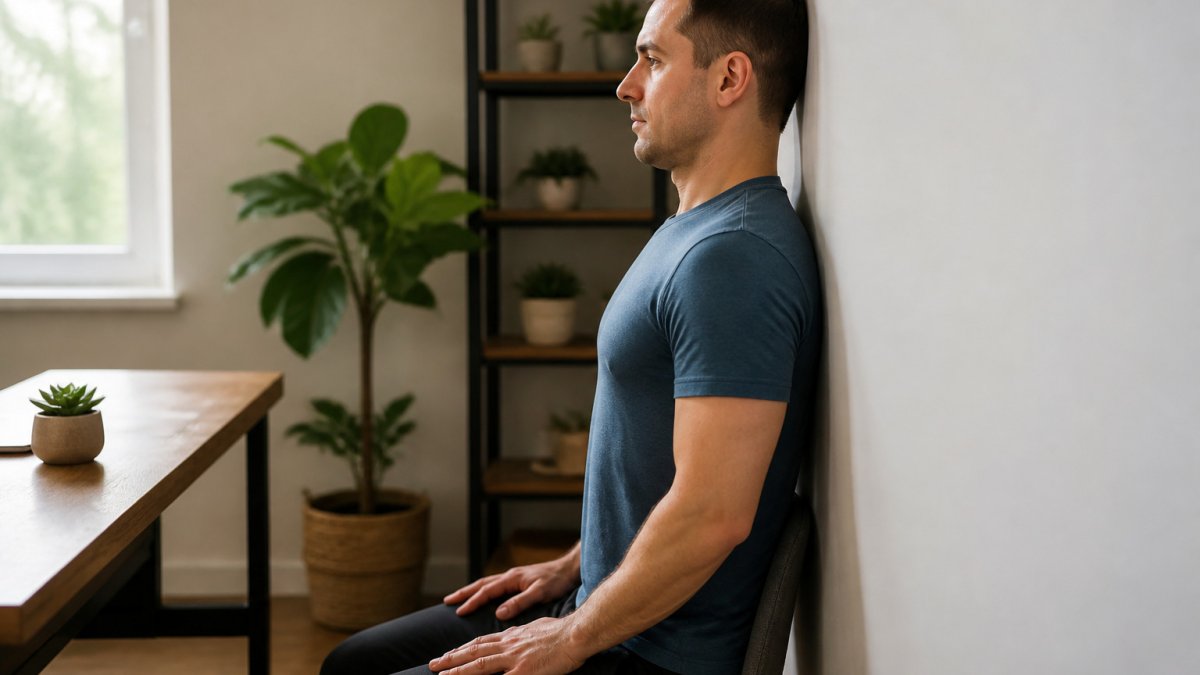
Start with a few repetitions and build slowly. Stop if the movement causes pain or increases your headache. A healthcare professional can show you a version that fits your body.
Gentle stretching can ease muscle tension in the neck and upper back. Keep every stretch mild, and hold each one without bouncing.
Neck stretches are generally used as a supporting habit alongside other care. They are not a standalone treatment. If stretching brings on a headache, reduce the intensity or stop. Learn more about how neck pain can cause headaches.
Strengthening the muscles that support the head and shoulders is a common approach to posture over time. Start with light resistance or body-weight movements.
Build gradually. Two to three sessions per week is a common starting point. Pain that lasts more than a day after a session suggests the load was too high. Learn more about chiropractic adjustments for cervicogenic headaches.
This section offers a sequenced plan, general dosing guidance, progression rules, and a simple way to track your response. It is general guidance, not a prescription, your clinician can adjust it to your history.
The routine builds from gentle mobility to loaded strengthening over about eight weeks. Move to the next phase only when you can complete the current phase without a flare that lasts more than a day.
Phase 1 (Weeks 1-2): Gentle mobility and awareness
Phase 2 (Weeks 3-4): Add light strengthening
Phase 3 (Weeks 5-6): Add resistance
Phase 4 (Weeks 7-8 and beyond): Build tolerance
Keep a simple log (paper or a notes app) with these fields:
Review the log every two weeks. Look for trends rather than day-to-day fluctuations: Are headache days trending down or stable? Is neck discomfort easing? Are you able to do more without a flare? If headaches become more frequent or more severe, stop progressing and contact your doctor.
Physical therapy can provide individualized assessment and supervised exercise for people with headache or neck symptoms. Share your exercise log and any changes in symptoms with your care team so they can adjust your plan.
Bring your questions to your doctor, physical therapist, or other qualified professional before making major changes to your routine. The right plan depends on your health history and symptoms, and a professional evaluation is the best way to find it.
Posture correction exercises may be a useful part of a broader migraine care plan, particularly for people whose neck and shoulder muscles are tense or whose head sits forward during long periods of sitting. Research on this approach is still developing. A 2025 study described a group-based program combining neck and shoulder strengthening with postural correction for chronic migraine patients. The findings do not establish that posture work alone relieves migraine. Exercise should be discussed with a qualified clinician before starting, especially for people with severe or changing headache patterns.
Many programs suggest short sessions several days per week rather than long sessions occasionally, and a gradual build-up tends to be better tolerated. Research comparing exercise modalities for migraine frequency, intensity, duration and disability is ongoing, so there is no single validated dose. A practical starting point is a few gentle movements once or twice a day, adjusted based on how your head and neck feel the following day. Stop any exercise that increases pain, and confirm the plan with a healthcare professional.
Stop an exercise if it triggers a headache, causes numbness, tingling, weakness, dizziness, vision changes, or sharp neck pain. Seek prompt medical care for a sudden, severe headache, a headache with fever, stiff neck, confusion, or neurological symptoms. People with a recent injury, including a car accident or work-related injury, should consult their treating clinician before beginning any program. This information is general and does not replace an individual evaluation by a qualified professional.
Migraine usually involves recurring attacks that may include throbbing pain, light or sound sensitivity, nausea, and sometimes aura. Cervicogenic headache is typically linked to neck structures and is often triggered or worsened by neck movement or sustained positions. Tension-type headache commonly causes a band-like pressure. Because these patterns can overlap, a formal diagnosis from a physician or qualified headache specialist is the reliable way to distinguish them, and posture exercises should not replace that evaluation.
If you would like personalized guidance, contact chiropracticcare.clinic to discuss whether a professional evaluation fits your situation.


