

Why Sciatica Pain Gets Worse at Night: Causes and Relief
Sciatica pain at night has real causes: pressure, inflammation, and cortisol shifts. Learn sleeping positions and fast relief tips to sleep better.
Read More →
Last Updated: September 24, 2026
Yoga can be an excellent tool for flexibility and mindfulness, but certain poses place excessive stress on the lumbar spine. Understanding which yoga poses to avoid with chronic back pain becomes essential to preventing further injury, since many instructors don't account for individual spinal conditions when recommending poses. (Source: herniated discs)
Poses involving excessive flexion (forward bending), extension (backward bending), or torsion (twisting) can compress spinal discs or irritate nerve roots, triggering pain that lasts for days after a single session.
Different conditions require different approaches: sciatica, disc degeneration, and muscle strain each respond differently to poses. Forward folds therapeutic for a healthy spine can be problematic for disc degeneration. Modifications and props become essential, but first you need to know which poses pose the greatest risk.
Certain yoga poses to avoid with chronic back pain appear repeatedly in discussions with chiropractors and physical therapists because they create the most common problems for people managing chronic back conditions.
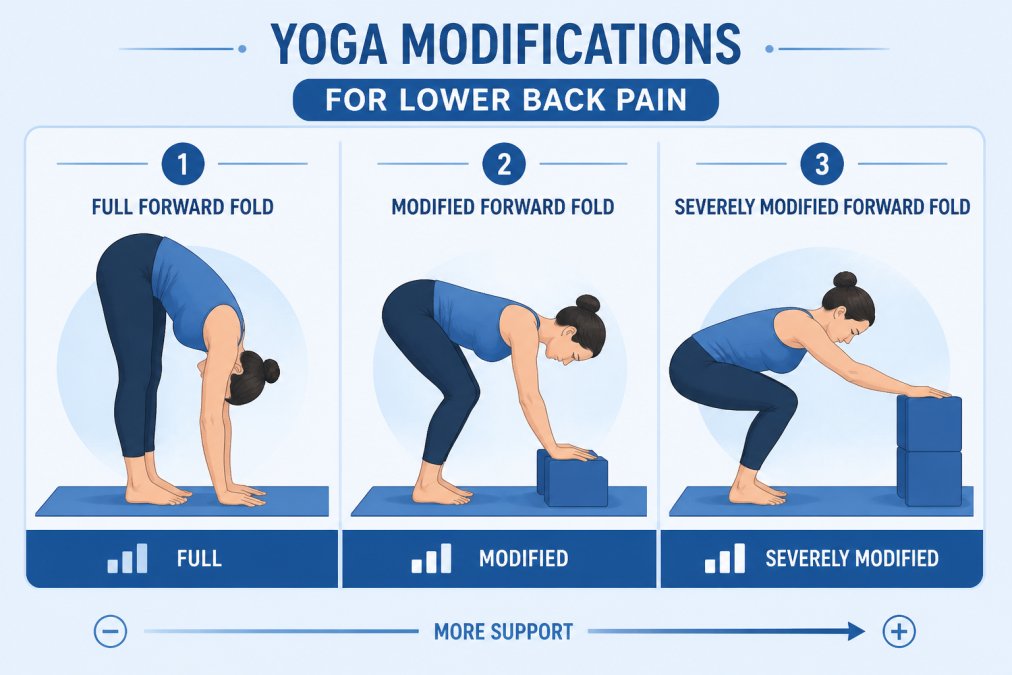
Forward folds feel deceptively safe, but a full forward fold places significant strain on the lumbar spine and stretches the posterior chain aggressively.
Forward folding increases intervertebral disc pressure and can push disc material toward nerve roots in people with herniated discs, triggering acute pain or radiating symptoms down the leg.
Keep knees slightly bent and place hands on blocks to reduce range of motion; hold for no more than a few seconds and never bounce.
Deep backbends compress the posterior elements of vertebrae and aggravate facet joints. For people with spinal stenosis or arthritis, this compression reduces the already-limited space around nerve roots.
Many practitioners arch from their lower back instead of distributing the bend evenly, concentrating movement in the lumbar region and increasing injury risk.
Modify backbends by holding them briefly, engaging your core, and using props to limit range of motion.
Deep spinal rotation, especially combined with flexion, stresses intervertebral discs and irritates facet joints. Poses like Parivrtta Parsvakonasana or deep seated twists create torsion that compromised discs cannot tolerate.
Twisting while in flexion creates the highest disc pressure and greatest injury risk (Checking your browser).
Use gentle, supported twists with props to limit rotation depth.
Poses like Boat Pose or extended Plank variations can aggravate chronic back pain if poor form shifts stress to the lower back instead of the abdominal muscles.
Jumping directly into demanding core poses without modification damages the spine further, even though core strength is needed to protect it.
Use blocks, straps, and modifications to maintain alignment while building core strength gradually.
The solution is learning to practice safely with modifications tailored to your specific condition. Modifications reduce spinal load, limit range of motion, and maintain neutral alignment, but the adjustment you need depends on your diagnosis: herniated disc, sciatica, facet joint irritation, or muscle strain.
Modifications for Herniated Disc Pain
For herniated discs, place hands on blocks at highest height (reducing flexion 40-50%), keep knees bent 15-20 degrees, and hold 20-30 seconds. For seated folds, sit on a blanket to tilt pelvis forward and reduce flexion demand.
For herniated discs, twist only in neutral spine with core engaged, rotating from thoracic spine only. Use a strap to limit rotation depth and never twist while flexed.
Modifications for Sciatica and Nerve Root Irritation
For sciatica, keep knees bent 30-45 degrees and hands on blocks to reduce nerve stretch. Reclined hamstring stretches with a strap work better than seated versions because gravity doesn't add intensity.
Gentle spinal extension can reduce nerve root compression from disc bulges. Use a bolster under your chest in supported backbends, holding 30-45 seconds, and avoid aggressive backbends.
Modify Pigeon Pose by using a block under your hip and limiting forward fold depth. Reclined Figure Four often provides better relief because it stretches the piriformis without nerve stretch.
Modifications for Facet Joint Pain and Stenosis
For facet joint pain or stenosis, minimize backbends. If practicing them, keep extremely gentle: Sphinx Pose for 15-20 seconds with bolster under chest. Avoid deep backbends like Wheel.
Twists should be performed in slight spinal flexion to open facet joints. Use props to limit rotation depth.
General Modification Principles Across All Conditions
All modifications should maintain neutral spine alignment: preserve natural curves without flattening or exaggerating them.
Engage deep abdominal muscles before entering any pose by drawing your navel toward your spine; maintain this engagement throughout.
Hold modified poses for 20-45 seconds initially, gradually increasing as your condition improves. Never progress deeper until you can hold the modified version comfortably for 45 seconds without pain.
Progress gradually and pain-responsively. If a modified pose causes pain during or within 2 hours after practice, reduce the modification or skip it for 1-2 weeks.
Some stretches actively help chronic back pain by improving flexibility and reducing muscle tension through gentle lengthening without compression.
Child's Pose with bolster support gently decompresses the lumbar spine; keep hips high to avoid excessive flexion and hold 30-60 seconds.
Supine Figure Four stretches hip flexors and glutes without spinal stress; hold each side 30-45 seconds. (Source: National Institute of Arthritis and Musculoskeletal and Skin Diseases (NIAMS))
Cat-Cow poses improve spinal mobility through controlled flexion and extension; move gently, synchronizing breath with movement, and never bounce.
Sphinx Pose offers gentle spinal extension without full backbend intensity; hold 20-30 seconds.
Props are essential tools for anyone managing chronic back pain, recommended by physical therapists and chiropractors. They reduce range of motion, distribute load evenly, and allow therapeutic benefits without excessive spinal stress.
Yoga Blocks: Reducing Range of Motion and Disc Pressure
Yoga blocks reduce spinal flexion by 30-50% in forward folds when hands are placed on blocks instead of the floor.
Start with blocks on highest setting to reduce spinal flexion most aggressively; gradually lower height as your condition improves.
In forward folds, place hands on blocks at hip width. In Downward Dog, blocks elevate torso and reduce spinal flexion. In Child's Pose, place block under forehead to prevent excessive lumbar flexion.
In supported backbends, place a block lengthwise under your thoracic spine to limit arch depth and prevent lumbar compression.
Straps: Controlling Stretch Intensity and Maintaining Alignment
Straps allow you to control stretch intensity in seated forward folds by looping around feet and adjusting pull, letting you lengthen your spine while stretching hamstrings.
In reclined hamstring stretches, loop strap around foot and pull to bring leg toward torso while keeping lower back flat; hold 45-60 seconds per side.
Wrap strap around torso at rib height to limit rotation depth and prevent forcing deeper than is safe.
Bolsters: Supporting Gentle Extension and Restorative Poses
In supported backbends, place bolster lengthwise under thoracic spine with head supported by blanket; hold 2-3 minutes for gentle therapeutic extension.
In twists, place bolster vertically beside hip and rest torso against it to limit rotation depth; hold 30-45 seconds per side.
In Child's Pose, place bolster between thighs and torso to elevate torso and reduce spinal flexion; hold 1-2 minutes.
Blankets: Positioning, Cushioning, and Alignment
A folded blanket under hips in seated poses tilts pelvis forward and reduces lumbar flexion demand, transforming uncomfortable poses into sustainable ones.
Blankets also cushion your knees in kneeling poses. Kneeling without cushioning can create compensatory tension in your lower back as your body tries to balance. A folded blanket under your knees reduces this compensation. In poses like Camel, place a blanket under your knees to reduce the intensity of spinal extension.
Use blankets to support your head and neck in restorative poses. Proper head support prevents your neck from extending excessively, which can create referred pain in your lower back through postural compensation.
Prop Combinations for Maximum Effectiveness
Using multiple props together creates synergistic effects. In a modified forward fold, combine blocks (under hands), a blanket (under hips), and a strap (around feet) to create a fully supported, low-intensity stretch. This combination allows you to hold the pose longer while maintaining perfect alignment.
In supported backbends, combine a bolster (under thoracic spine), a blanket (under head), and another blanket (under knees) to create a fully supported, therapeutic pose. This setup allows 3-5 minutes of gentle extension without any strain.
Selecting Props Based on Your Condition
Investing in Quality Props
Yoga modifications help many people, but chronic back pain sometimes requires professional assessment. Knowing when to see a chiropractor for back pain prevents minor issues from becoming serious injuries and ensures you're practicing safely given your specific condition.
Full forward folds, unsupported backbends, deep twists, and poses that load the lumbar spine without core engagement typically aggravate chronic back pain. Poses that involve spinal flexion (rounding forward) or excessive extension (arching backward) compress vertebrae and can irritate existing disc issues or muscle strain. The safest approach is to work with a qualified instructor who can assess your specific condition and recommend modifications.
Yes. Practicing yoga poses without proper alignment, modifications, or core engagement can worsen chronic back pain. Movements that increase spinal compression, overstretching the posterior chain, or forcing range of motion beyond your current capacity may trigger pain flare-ups or create new injuries. This is why modifications and professional guidance are essential for anyone with existing back conditions.
The best modifications use props (blocks, straps, bolsters) to reduce spinal load and maintain neutral spine alignment. Shortening your range of motion, bending knees in forward folds, and engaging your core during all poses protects your lumbar spine. Therapeutic yoga focusing on gentle stretching, pelvic stability, and mindful movement is safer than dynamic or power yoga styles for chronic pain.
See a chiropractor if your back pain persists beyond a few weeks, limits daily activities, or worsens with certain movements like yoga. A chiropractor can assess spinal alignment, identify biomechanical issues, and determine whether pain stems from disc problems, muscle strain, or other causes. They can also provide guidance for yoga practice and recommend specific modifications based on your condition.


