

Knee Pain After Activity? What a Chiropractic Exam Checks First
Knee pain chiropractor in Montgomery, AL: see what Dr. McNally's exam checks first after running, sport, or job-related knee pain. Call (334) 997-7463.
Read More →
Last Updated: August 30, 2026
When you're dealing with persistent back or neck pain, the choice between seeing a chiropractor or a spine surgeon can feel overwhelming. The two professions approach spinal health from fundamentally different angles: one emphasizes manual therapy and structural realignment, the other focuses on diagnostic imaging and surgical intervention when conservative care fails. Understanding which practitioner fits your condition, and when, requires knowing what each actually does, how they're trained, and where their methods diverge most significantly.
Many individuals arrive confused about whether they need surgery or whether non-invasive care can resolve their issue. The distinction matters enormously. A spine surgeon will typically recommend surgery only after conservative treatments have failed or when imaging reveals structural pathology requiring immediate intervention. A chiropractor, by contrast, uses manual therapy and spinal manipulation to address what they identify as vertebral subluxation and neuromuscular dysfunction. Neither approach is universally "better", context determines which is appropriate.
This comparison cuts through the confusion. We'll examine the training each profession requires, the treatment philosophies that guide their practice, the conditions each handles best, and critically, when they should work together rather than compete. The goal isn't to crown a winner but to help you understand which professional, or which combination, actually addresses your specific problem.
Chiropractors complete a Doctor of Chiropractic (D.C.) degree from an accredited chiropractic college, typically requiring four years of full-time study after earning a high school diploma or equivalent. The curriculum covers anatomy, physiology, biochemistry, and clinical sciences, alongside specialized training in spinal manipulation, radiography, and patient assessment. After graduation, chiropractors must pass the National Board of Chiropractic Examiners (NBCE) licensing exam and meet individual state requirements to practice.
Scope of practice varies by state. In most states, chiropractors can perform spinal manipulation, order and interpret X-rays, and recommend therapeutic exercises. Some states permit chiropractors to order MRI scans or perform other diagnostic procedures. However, chiropractors cannot prescribe medications or perform surgery in any U.S. state. Their licensure focuses on manual therapy and conservative care, tools designed to treat musculoskeletal conditions without pharmaceutical or surgical intervention.
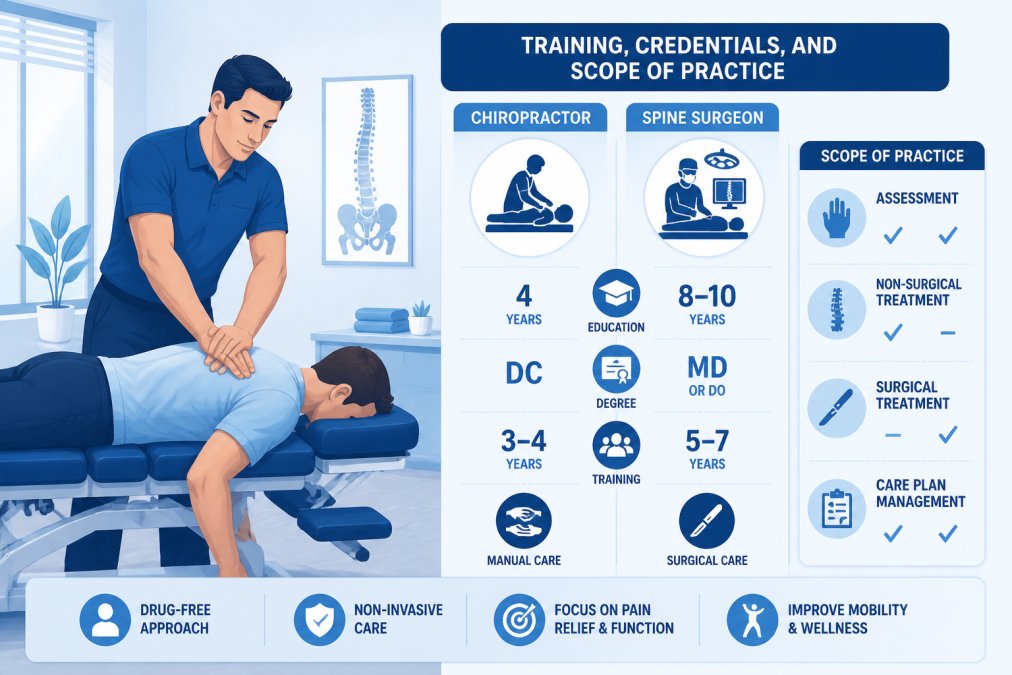
Spine surgeons follow a much longer training pathway. After completing medical school (four years), they pursue an orthopedic surgery residency (five years) or neurosurgery residency (seven years), followed by a spine surgery fellowship (one to two additional years) (acgme.org). This 12-15 year commitment includes extensive training in surgical anatomy, operative technique, and post-operative management. Board certification requires passing rigorous exams administered by the American Board of Orthopaedic Surgery (ABOS) or American Board of Neurological Surgery (ABNS).
Spine surgeons are licensed physicians who can prescribe medications, order advanced diagnostic imaging, and perform surgical procedures. Their scope encompasses the full spectrum of spinal care: from conservative management and diagnostic evaluation to complex spinal fusion, laminectomy, and other surgical interventions. They're trained to recognize when a condition requires surgery and when it doesn't, a critical distinction that prevents unnecessary procedures.
The educational disparity reflects the complexity of surgical intervention. Spine surgeons must understand not just how to operate but when surgery is medically justified, how to minimize complications, and how to manage patients across the entire treatment continuum.
The philosophical gulf between these professions shapes everything they do. Chiropractors operate from a model emphasizing manual therapy and spinal realignment. Their core belief centers on vertebral subluxation, the idea that misalignments of vertebrae interfere with nerve function and cause pain or dysfunction. Treatment focuses on correcting these misalignments through spinal manipulation, adjustments, and related manual techniques. This approach is non-invasive and emphasizes the body's capacity for self-healing when structural alignment improves.
Spine surgeons, by contrast, base their practice on anatomical pathology identified through diagnostic imaging. They look for structural problems, herniated discs, spinal cord compression, degenerative disc disease, nerve impingement, that imaging reveals. If conservative treatment (physical therapy, medication, injections) fails to resolve symptoms or if imaging shows severe structural damage, surgery becomes the logical next step. Their philosophy is evidence-based practice grounded in what imaging demonstrates and what clinical outcomes data supports.
Neither philosophy is inherently wrong. The issue arises when the wrong approach is applied to the wrong patient. Someone with mild muscular back pain may benefit enormously from chiropractic care. Someone with severe spinal cord compression causing progressive neurological deficit needs surgery, not manipulation.
A spine surgeon should be your first choice, or at minimum, your second opinion, when specific red flags appear. If imaging reveals structural pathology like a herniated disc compressing the spinal cord, a severe stenosis limiting the spinal canal, or instability between vertebrae, surgical consultation is warranted. Progressive neurological symptoms, weakness, numbness, or loss of bowel/bladder control, demand urgent evaluation by a spine surgeon.

Chronic pain that's failed conservative treatment after 6-12 weeks also justifies surgical evaluation. This doesn't mean surgery will happen, many patients improve without it, but a spine surgeon can determine whether structural pathology exists and whether intervention might help. Acute traumatic injuries to the spine, such as fractures from falls or motor vehicle accidents, require immediate spine surgeon evaluation to assess stability and rule out spinal cord injury.
Age alone isn't a barrier. Seniors can undergo spine surgery successfully when the indication is clear and medical fitness allows. The real question isn't age but whether the patient's condition is amenable to surgical correction and whether the risks of surgery are justified by the expected benefit.
Most back pain resolves without surgery. Physical therapy remains the gold standard for conservative care, addressing muscular weakness, poor biomechanics, and reduced functional mobility. Therapeutic exercises restore strength and flexibility while teaching proper body mechanics to prevent recurrence. Physical therapists work collaboratively with both chiropractors and spine surgeons, often providing the foundation for recovery in both surgical and non-surgical cases.
Anti-inflammatory medications, muscle relaxants, and targeted injections (epidural steroid injections, facet joint injections) provide pain relief while allowing rehabilitation to progress. These interventions are temporary bridges, they reduce pain enough for physical therapy to be tolerable. They're not permanent solutions but valuable tools in the conservative treatment arsenal.
Chiropractic care, spinal manipulation, and manual therapy address pain through different mechanisms. Some patients experience immediate relief from manipulation; others benefit from the mobilization and soft tissue work that accompanies adjustments. The evidence supporting spinal manipulation for acute lower back pain is reasonably strong, though outcomes for chronic conditions are more variable (peer-reviewed research). The key is finding what works for your body, and recognizing when a particular approach isn't producing results after a reasonable trial period.
| Treatment Approach | Best For | Timeline | When to Escalate |
|---|---|---|---|
| Physical therapy | Most acute and chronic pain | 4-8 weeks | If no improvement after 8 weeks |
| Chiropractic care | Acute musculoskeletal pain, mobility | 2-6 weeks | If pain persists or worsens |
| Anti-inflammatory medication | Pain management alongside therapy | Ongoing as needed | If masking progressive neurological symptoms |
| Epidural injections | Radiculopathy, acute flare-ups | 2-4 weeks relief | If pain returns or neurological symptoms develop |
| Spine surgery | Structural pathology, failed conservative care | Varies by procedure | Consider if conservative care fails 6-12 weeks |
Spine surgery recovery is neither quick nor simple. Most patients spend 1-2 days in the hospital post-operatively, followed by 4-6 weeks of restricted activity (aans.org). Heavy lifting, bending, and twisting are off-limits during this period. Return to light work may occur within 2-3 weeks; return to full activity typically requires 8-12 weeks or longer depending on the procedure's complexity.
Physical therapy begins within days of surgery. Early mobilization prevents stiffness and promotes healing. Therapists guide patients through progressive exercises, starting with gentle range-of-motion work and advancing to strengthening as healing progresses. This rehabilitation is non-negotiable, skipping it significantly increases the risk of poor outcomes and chronic pain.
Pain management post-surgery involves a combination of approaches. Opioid medications are typically used short-term (first 1-2 weeks) then transitioned to non-opioid pain control. Many patients benefit from epidural steroid injections if pain persists beyond the initial healing phase. Some patients report improvement in pain within days; others experience gradual improvement over weeks or months as inflammation resolves and nerves decompress.
Post-surgical chiropractic care can be valuable. Once the surgeon clears the patient (typically 6-8 weeks post-op), gentle spinal manipulation and manual therapy can address residual stiffness, improve mobility, and support the physical therapy process. This isn't about "fixing" the surgery, it's about optimizing recovery and preventing compensatory patterns that create new pain.
The best outcomes often emerge when chiropractors and spine surgeons stop viewing themselves as competitors and start functioning as collaborators. A spine surgeon evaluates a patient, determines that surgery isn't indicated, and refers them to a chiropractor for conservative care. The chiropractor provides manual therapy and exercises for 6-8 weeks. If the patient isn't improving, the chiropractor refers them back to the surgeon for re-evaluation. This cycle, conservative care, reassessment, escalation when necessary, represents evidence-based practice.
Post-surgical collaboration is equally valuable. The surgeon performs the procedure and manages immediate post-operative care. Once healing is sufficient, a chiropractor or physical therapist provides ongoing manual therapy and rehabilitation. The spine surgeon remains available for complications or setbacks. This multidisciplinary approach recognizes that surgery is one tool among many and that optimal outcomes require coordinated expertise.
Communication is essential. When a chiropractor and spine surgeon are discussing the same patient, outcomes improve. The chiropractor understands the surgical anatomy and what the surgeon is trying to accomplish. The surgeon appreciates that conservative care, when properly executed, resolves many cases that might otherwise proceed to surgery. Both professionals benefit from knowing what the other is doing.
Patient-centered care means choosing the right professional for the right problem at the right time. Sometimes that's a chiropractor. Sometimes it's a spine surgeon. Often, it's both, sequentially or in parallel. The worst outcome occurs when professional ego prevents the right referral at the right moment.
Insurance coverage for chiropractic care varies widely. Some plans cover chiropractic services with a copay and deductible, similar to other medical care. Others exclude chiropractic entirely or limit coverage to a specific number of visits per year. Medicare covers chiropractic adjustments (spinal manipulation only) when deemed medically necessary for spinal subluxation, though coverage details and limits vary — confirm with Medicare or your plan. Workers' compensation often covers chiropractic care for work-related injuries. The key is understanding your specific policy before beginning treatment.
Spine surgery is typically covered by insurance when medically indicated, though authorization and prior approval may be required. The surgery itself is covered; post-operative physical therapy is usually covered as well. Out-of-pocket costs depend on your deductible, coinsurance percentage, and whether you've met your annual out-of-pocket maximum.
Cost-benefit analysis matters. A patient spending money out-of-pocket on chiropractic care that resolves their pain is getting good value. A patient spending the same amount on chiropractic care that produces no improvement is wasting money. The question isn't the cost in isolation but whether the treatment is producing results. If after 4-6 weeks of chiropractic care you're not seeing meaningful improvement, the cost-benefit equation shifts. That's the moment to seek a second opinion from a spine surgeon or pursue different conservative approaches.
Surgery carries higher upfront costs but may be cost-effective if it resolves a problem that conservative care couldn't address. A patient who undergoes spine surgery and returns to full function may consider it a sound investment. A patient who undergoes that amount and remains in pain may consider it a poor one. The distinction depends on case selection, ensuring surgery is performed only when truly indicated.
Choosing between a chiropractor and spine surgeon shouldn't be a binary decision. Your back pain likely doesn't care which professional's philosophy is "correct", it responds to treatment that addresses its underlying cause. If conservative care including chiropractic manipulation, physical therapy, and targeted injections resolves your pain, you've found your answer. If structural pathology on imaging or progressive neurological symptoms appear, spine surgery consultation becomes essential. The best outcomes emerge when both professions are available, respected, and deployed appropriately. The question isn't which is better, it's which is right for you, right now.
Chiropractors complete a Doctor of Chiropractic (DC) degree, typically 4 years of graduate study after undergraduate education, focusing on spinal manipulation and musculoskeletal care. Spine surgeons are medical doctors (MDs or DOs) who complete medical school, a 5-7 year orthopedic or neurosurgery residency, and often additional fellowship training in spine surgery. Spine surgeons are licensed to perform surgery and prescribe medications; chiropractors focus on non-invasive manual therapy and rehabilitation.
Consult a spine surgeon if you have severe neurological symptoms (numbness, weakness, loss of bowel or bladder control), significant spinal cord compression visible on imaging, progressive nerve damage, or structural abnormalities like herniated discs or spinal stenosis that haven't improved with conservative treatment over 6-12 weeks. Spine surgeons evaluate whether surgery is necessary or if non-surgical options remain viable.
Yes, chiropractic care can support post-surgical recovery when coordinated with your surgeon. After the acute healing phase (typically 6-12 weeks post-surgery), gentle manual therapy, rehabilitation exercises, and spinal mobilization may help restore function and reduce stiffness. Always obtain your surgeon's clearance before beginning chiropractic treatment following spine surgery, as certain manipulations may compromise surgical repairs early in recovery.
Conservative treatment includes physical therapy, manual therapy, anti-inflammatory medication, activity modification, and ergonomic adjustments to manage pain and inflammation without surgery. Surgical intervention (such as discectomy or fusion) is considered when conservative methods fail after 6-12 weeks, when nerve compression causes severe or worsening neurological deficits, or when structural damage significantly limits function. Most disc issues resolve with conservative care alone.
Insurance coverage varies significantly by plan. Many plans cover chiropractic care for acute musculoskeletal injuries but may limit the number of visits or require referrals. Spine surgery is typically covered when medically necessary, though prior authorization is often required. Contact your insurance provider to understand your specific benefits, deductibles, and whether referrals are needed for either treatment type. Out-of-pocket costs depend on your plan's structure and the provider's fees.


