

Ergonomic Desk Setup for Small Spaces: 2026 Guide
Build an ergonomic desk setup for small spaces with exact measurements, monitor arm benefits, and posture pain fixes. Get the fit right in tight rooms.
Read More →
Last Updated: September 10, 2026
Learning how to strengthen core muscles for back pain starts with understanding what the core actually does. The core is not just the abdominals you see in the mirror; it is a cylinder of deep muscles that wraps around your spine and controls its position during every movement you make.
The transverse abdominis, pelvic floor, erector spinae, and deep abdominal muscles work together to create intra-abdominal pressure and spinal support. When these muscles contract, they form a natural brace around the vertebral column. This is why core endurance, not raw strength, is generally considered important for keeping your lumbar spine protected during daily activity.
At chiropracticcare.clinic, we often see this pattern: people with chronic low back pain often have cores that fatigue quickly, not cores that lack power. Most cases of low back pain are considered mechanical in origin, which means the muscles supporting the spine are part of the solution.
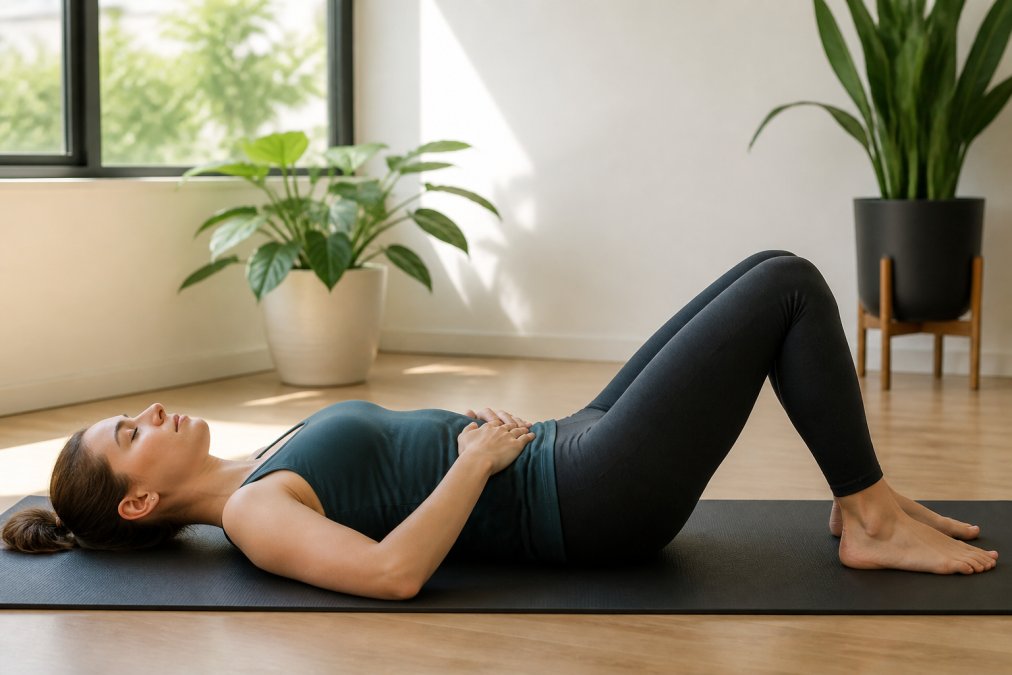
The most effective low back pain exercises for deep stabilization are slow, controlled movements that teach your deep abdominal muscles to fire without moving your spine. These are not crunches. They are isometric contractions and small-range drills.
A pelvic tilt is the foundation. Lie on your back with knees bent, flatten the curve of your lower back against the floor, hold for five seconds, and release. This teaches core engagement without loading the spine.
The dead bug comes next. Lie supine with arms up and knees bent at 90 degrees. Lower one arm and the opposite leg toward the floor while keeping your neutral spine pressed down. Return and switch sides.
The bird-dog is the quadruped version: on hands and knees, extend one arm and the opposite leg while keeping your hips level. Stabilization exercise is one approach many clinicians use for chronic low back pain.
Safe core workouts for beginners begin with breathing, not bracing. Before any movement, practice a 360-degree breath: place one hand on your ribs and one on your lower abdomen, inhale through your nose for about four seconds so the ribs expand sideways, then exhale slowly for six seconds and feel the lower abdomen gently firm without sucking in. That gentle firmness is the core engagement you will carry into every exercise. If you cannot breathe normally while holding a position, the position is too hard for today.
Work through this order. Each movement teaches the next one, so do not skip ahead even if an exercise feels easy.
Dosage rules that matter more than the exercise selection: keep total session time to 15 to 20 minutes, rest 30 to 60 seconds between sets, and train three to four days per week with at least one rest day between sessions. Soreness that feels like tired muscle is acceptable; anything sharp, shooting, or traveling down a leg is not.
Stop any movement that sends pain down your leg, causes numbness or tingling, or makes your symptoms worse the next morning. A common mistake is pushing through sharp pain because "no pain, no gain" sounds motivating. It is not. Pain management comes first; strength follows. If a movement consistently provokes symptoms after two or three attempts with reduced range, drop it and revisit it in a week rather than forcing it.
The rule for avoiding flare-ups is simple: keep the spine still while the limbs move. Most flare-ups happen when people add speed or range of motion before they have core endurance, or when they train through a warning sign because the session was already scheduled.
Use progressive overload carefully. For the first several weeks, add time, not weight. A workable framework:
A frequent error is holding your breath during bracing. Breath-holding spikes intra-abdominal pressure and can aggravate a sensitive back. Breathe through every hold; if you cannot speak a short sentence mid-hold, you are working too hard for that day.
Other mistakes that reliably cause flare-ups:
Track one number, how long you can hold a modified plank with steady breathing, and one feeling, how your back behaves during a normal day. When the number stalls but daily comfort improves, you are still progressing; do not add load to force the number up.
Many people notice easier daily movement within a few weeks of consistent practice; measurable strength and endurance gains take longer and vary by individual. The timeline depends on how often you train, how long you have had pain, and whether you are also addressing posture and daily habits.
A reasonable schedule is three to four sessions per week, each lasting 15 to 20 minutes. Consistency matters more than intensity. A person who trains gently four times a week will usually progress faster than someone who trains hard once and then rests for a week because of soreness.
Track two things: how long you can hold a modified plank, and how your back feels during a normal day. Improvement in daily comfort often shows up before the numbers move.
Your workout is 20 minutes; your posture is the other 23 hours. Posture correction between sessions protects the gains you make in the gym.
If you sit for work, set your chair so your hips are slightly higher than your knees, your feet flat, and your screen at eye level. Stand and walk for two minutes every 30 to 45 minutes. This interrupts the sustained flexion that compresses the lumbar spine and lets the erector spinae reset.
For lifting at home, hinge at the hips rather than rounding your back, and keep the load close to your body. These habits are functional movement practice, and they reinforce the same neutral spine you train on the mat.
Two things that deserve more attention in most core programs: recovery and the psychology of moving when you hurt. Both decide whether your program lasts.
After a session, mild soreness is normal. Gentle walking, hydration, and sleep support recovery; ice or heat can soothe irritation, but neither speeds tissue repair dramatically. If soreness lasts more than a few days or worsens, reduce your volume.
The mental barrier is just as real. Fear of movement after a bad episode is common, and it leads people to avoid exercise entirely, which causes muscle atrophy and more stiffness. A useful reframe: you are not testing whether your back is "fixed." You are building tolerance, one session at a time. If anxiety around movement is intense, a physical therapy or chiropractic evaluation can help you move safely within your limits.
The hardest part of core training with back pain is not the exercise; it is starting without fear and staying consistent when progress feels slow. A structured, gentle plan changes that. Care begins with an evaluation of how your core, posture, and daily habits interact, so your program fits your body rather than a generic template.
Yes. Core strengthening is widely considered helpful for reducing chronic low back pain by improving spinal support and reducing strain on the lumbar spine. Exercises that engage the transverse abdominis, pelvic floor, and erector spinae build the deep stabilizing muscles that protect your vertebral column during daily movement. Many providers use stabilization-focused exercise as one approach among several for reducing pain intensity, and your provider can advise which approach fits your condition. Start with gentle isometric contractions and progress gradually under professional guidance.
Many people notice easier movement and better core engagement within a few weeks of consistent training, with visible strength gains typically taking longer. Timelines vary by individual. The timeline depends on your starting fitness level, how consistently you practice low back pain exercises, and whether you address ergonomic factors. A physical therapist can help set realistic milestones. Progress is rarely linear; some weeks feel easier than others, and that is normal.
Yes. Exercises that involve repeated spinal flexion, such as full sit-ups and crunches, can increase pressure on spinal discs and aggravate chronic low back pain. High-impact moves like burpees or weighted twists may also be risky during a flare-up. Safe core workouts for beginners focus on isometric holds, neutral spine positioning, and controlled movements like dead bug variations and modified planks. Always stop if an exercise causes sharp pain and consult a qualified professional before starting a new routine.
You can begin with no equipment at all. Bodyweight exercises like bird-dog, dead bug, pelvic tilts, and modified planks require only a mat or carpeted floor. As you progress, a resistance band or light dumbbell can add progressive overload. Many people find that a mirror helps them check their neutral spine position. If you have access to a gym, a stability ball and cable machine offer additional options, but they are not necessary for building core endurance.


